BAGHDAD: The story of Doha Sabah Abdallah’s personal tragedy and loss deeply resonated with Pope Francis during his historic visit last weekend to the northern Iraqi town of Qaraqosh, once devastated by Daesh.
Back in 2014, her son’s death alerted the town’s Christian community to the impending Daesh onslaught. A mortar shell fired by the militants as they approached Qaraqosh struck outside Abdallah’s house, killing her son and two cousins playing in the front yard.
The pope heard Abdallah’s testimony at a church ceremony in Qaraqosh last Sunday.
But just days after the pontiff’s visit — meant to give hope to Iraq’s dwindling Christian community and encourage its members to stay — Abdallah doubts the realities of life in Iraq will change.
She said she would also leave if given a chance.
“The pope doesn’t have Moses’ staff, he can’t part the seas and solve our very difficult problems,” she said.
“If I had the resources or if someone gave me the chance to leave this country, I would never come back.”
Years after Iraqi forces declared victory over Daesh and drove terrorists from the area, Abdallah’s disabled daughter still cannot attend proper schools, homes are still shattered and in ruins. Jobs are hard to come by, and none of Abdallah’s relatives abroad plan to return.
Iraq’s Christian population has dwindled from around 1.5 million before the 2003 US-led invasion to just a few hundred thousand today. Estimates put the current population between 250,000-500,000.
As churches and Christian communities were increasingly targeted by extremist groups at the height of Iraq’s sectarian war that followed the invasion, the country saw an exodus of Christians. Even more fled after the brutal 2014 IS onslaught that emptied out entire Christian villages across the northern plains of Ninevah.
Francis’s four-day visit to Iraq, including Qaraqosh, aimed to encourage Christians to stay, rebuild and restore what he called Iraq’s “intricately designed carpet” of faiths and ethnic groups.
Qaraqosh, a majority Christian town in Ninevah, is just one of many that was attacked by Daesh seven years ago. The militants overran the town, damaged its church and scrawled the proclamation Daesh “will remain” on town walls.
The few Christians who returned after the liberation of Qaraqosh in 2016 found bullet-riddled mannequins and other signs that the militants had used the church premises as a firing range for target practice.
Many homes were leveled in the battles to oust the group and basic services have yet to be restored. Most of the town’s Christians remain scattered elsewhere in Iraq or abroad.
Abdallah remembers vividly that August 2014, when Daesh rampaged through Christian communities across Ninevah. She remembers her son and his two cousins.
“Their souls saved the whole city,” she recounted to the pontiff on Sunday.
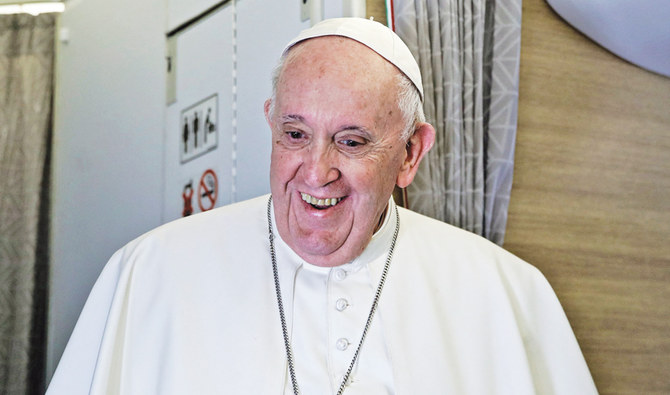
On the plane back to Rome, the pope singled her testimony and told reporters it had “touched me most.”
“She said one word: forgiveness. I was moved,” Francis said.
At every turn of his historic trip as he crisscrossed Iraq, Francis urged Iraqis to embrace diversity — from Najaf in the south, where he held a historic face-to-face meeting with powerful Shiite cleric Grand Ayatollah Ali Al-Sistani, to Nineveh to the north, where he met with Christian victims like Abdallah.
But after the pontiff’s departure, Abdallah said, reality has set in.
“Our situation is difficult because there is no internal agreement within the government,” she said. “How could anyone come back? There are no basic services.”
Bahnam Yussef, another resident of Qaraqosh, echoed her concerns. “The pope’s visit drew the world’s attention to Iraq,” he said, but Christians need more assurances before returning.
“They must get help, some of them have houses destroyed and burned, all this loss has to be compensated,” he added.
Marking the pope’s visit, Prime Minister Mustafa Al-Kadhimi declared March 6 a national day for tolerance and co-existence.
But such gestures have not been accompanied by practical steps. So far, Iraq has not passed any legislation or enacted policies to entice Christians to return.
Abdallah said her wish is to live in an Iraq where Christians and other minorities are afforded equal rights — not today’s Iraq where the sectarian power-sharing system often marginalizes minorities.
“It was incredible to see the pope, I never dreamed I would be so close to him” she said. “But it hasn’t changed anything.”

Iraqi woman who met the pope sees little chance for change
Short Url
https://arab.news/yg9hc
Iraqi woman who met the pope sees little chance for change
- Francis’s four-day visit to Iraq, including Qaraqosh, aimed to encourage Christians to stay, rebuild and restore what he called Iraq’s “intricately designed carpet” of faiths and ethnic groups
Lebanon ex-central bank chief's corruption case being sent to top court, officials say
BEIRUT: The corruption case of Lebanon's former central bank governor, who is widely blamed for the country’s economic meltdown, has been transferred to the country's highest court, judicial officials told The Associated Press on Tuesday.
Riad Salameh was released on $14 million bail in September after a year in prison while awaiting trial in Lebanon on corruption charges, including embezzlement and illicit enrichment.
The trial of Salameh, 75, and his two legal associates, Marwan Khoury and Michel Toueini, will now be heard at the Court of Cassation, according to a copy of the notice obtained by the AP. Salameh and the others will be issued with arrest warrants if they don't show up for trial at the court.
No trial date has been set yet. Salameh denies the charges. The court’s final ruling can't be appealed, according to the four officials who spoke on condition of anonymity, because they weren't authorized to speak with the media.
In September 2024, he was charged with the embezzlement of $42 million, with the court later adding charges of illicit enrichment over an apartment rented in France, supposedly to be a substitute office for the central bank if needed. Officials have said that Salameh had rented from his former romantic partner for about $500,000 annually.
He was once celebrated for steering Lebanon’s economic recovery, after a 15-year civil war, upon starting his long tenure in 1993 and keeping the fragile economy afloat during long spells of political gridlock and turmoil.
But in 2023, he left his post after three decades with several European countries investigating allegations of financial crimes. Meanwhile, much of the Lebanese blame his policies for sparking a fiscal crisis in late 2019 where depositors lost their savings, and the value of the local currency collapsed.
On top of the inquiry in Lebanon, he is being investigated by a handful of European countries over various corruption charges. In August 2023, the United States, United Kingdom and Canada imposed sanctions on Salameh.
Salameh has repeatedly denied allegations of corruption, embezzlement and illicit enrichment. He insists that his wealth comes from inherited properties, investments and his previous job as an investment banker at Merrill Lynch.
Lebanon’s current central bank governor, Karim Souaid, announced last week that he's filing legal complaints against a former central bank governor and former banking official who diverted funds from the bank to what he said were four shell companies in the Cayman Islands. He didn't name either individual.
But Souaid said that Lebanon's central bank would become a plaintiff in the country's investigation into Forry Associates. The U.S. Treasury, upon sanctioning Salameh and his associates, described Forry Associates as “a shell company owned by Raja (Salameh’s brother) in the British Virgin Islands” used to divert about $330 million in transactions related to the central bank.
Several European countries, among them France, Germany, and Luxembourg, have been investigating the matter, freezing bank accounts and assets related to Salameh and his associates, with little to no cooperation from the central bank and Lebanese authorities.
Souaid said that he will travel later this month to Paris to exchange “highly sensitive” information as France continues its inquiries.
Riad Salameh was released on $14 million bail in September after a year in prison while awaiting trial in Lebanon on corruption charges, including embezzlement and illicit enrichment.
The trial of Salameh, 75, and his two legal associates, Marwan Khoury and Michel Toueini, will now be heard at the Court of Cassation, according to a copy of the notice obtained by the AP. Salameh and the others will be issued with arrest warrants if they don't show up for trial at the court.
No trial date has been set yet. Salameh denies the charges. The court’s final ruling can't be appealed, according to the four officials who spoke on condition of anonymity, because they weren't authorized to speak with the media.
In September 2024, he was charged with the embezzlement of $42 million, with the court later adding charges of illicit enrichment over an apartment rented in France, supposedly to be a substitute office for the central bank if needed. Officials have said that Salameh had rented from his former romantic partner for about $500,000 annually.
He was once celebrated for steering Lebanon’s economic recovery, after a 15-year civil war, upon starting his long tenure in 1993 and keeping the fragile economy afloat during long spells of political gridlock and turmoil.
But in 2023, he left his post after three decades with several European countries investigating allegations of financial crimes. Meanwhile, much of the Lebanese blame his policies for sparking a fiscal crisis in late 2019 where depositors lost their savings, and the value of the local currency collapsed.
On top of the inquiry in Lebanon, he is being investigated by a handful of European countries over various corruption charges. In August 2023, the United States, United Kingdom and Canada imposed sanctions on Salameh.
Salameh has repeatedly denied allegations of corruption, embezzlement and illicit enrichment. He insists that his wealth comes from inherited properties, investments and his previous job as an investment banker at Merrill Lynch.
Lebanon’s current central bank governor, Karim Souaid, announced last week that he's filing legal complaints against a former central bank governor and former banking official who diverted funds from the bank to what he said were four shell companies in the Cayman Islands. He didn't name either individual.
But Souaid said that Lebanon's central bank would become a plaintiff in the country's investigation into Forry Associates. The U.S. Treasury, upon sanctioning Salameh and his associates, described Forry Associates as “a shell company owned by Raja (Salameh’s brother) in the British Virgin Islands” used to divert about $330 million in transactions related to the central bank.
Several European countries, among them France, Germany, and Luxembourg, have been investigating the matter, freezing bank accounts and assets related to Salameh and his associates, with little to no cooperation from the central bank and Lebanese authorities.
Souaid said that he will travel later this month to Paris to exchange “highly sensitive” information as France continues its inquiries.
© 2026 SAUDI RESEARCH & PUBLISHING COMPANY, All Rights Reserved And subject to Terms of Use Agreement.