Gilgit-Baltistan officials declare region free of COVID-19

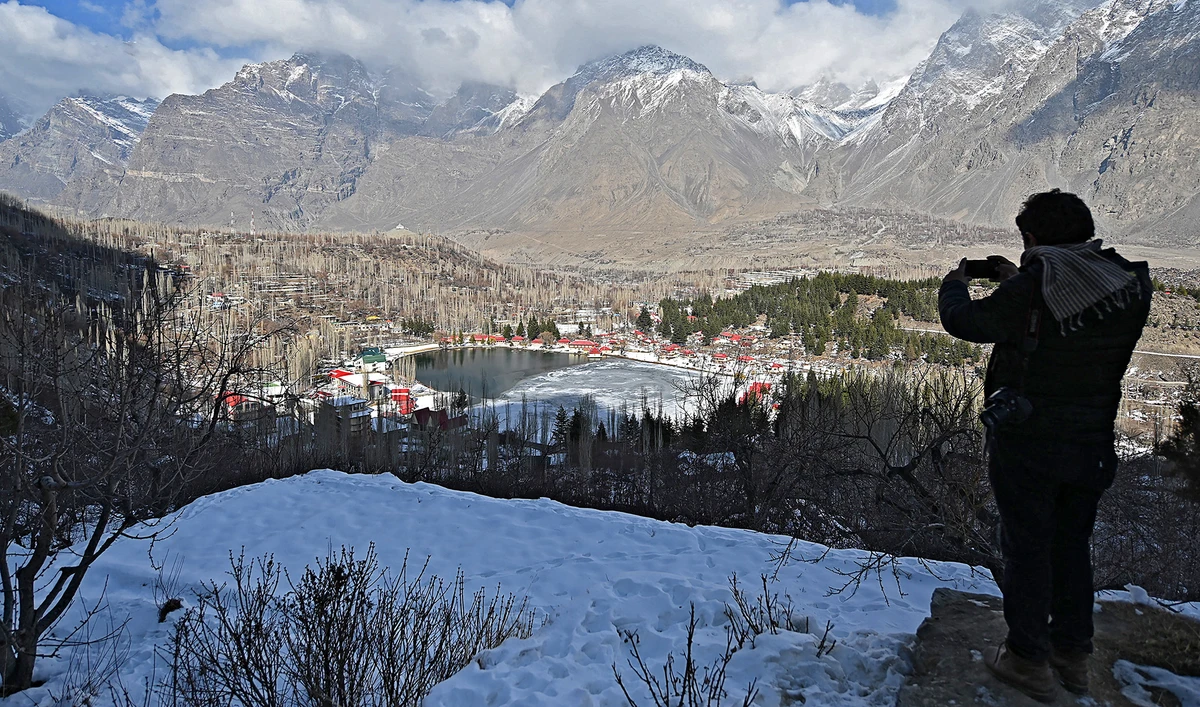
A tourist takes pictures of the Lower Kachura Lake at the Shangrila Resort, about 6 Km from Skardu on January 24, 2021. (AFP/File)
Short Url
Updated 12 March 2021
Follow

Gilgit-Baltistan officials declare region free of COVID-19

  • Senior health officials maintain they managed to 'defeat' the disease since people of the area wore face masks and practiced social distancing
  • Officials fear another wave of coronavirus infections after tourists return to the area

ISLAMABAD: Two days after the government announced a spring break for education institutions in several cities of Punjab as well as Islamabad and Peshawar due to the rising number of coronavirus cases, a senior official in Pakistan's northern Gilgit-Baltistan (GB) region claimed that the area had not reported new COVID-19 infections since March 10.

"The first coronavirus case emerged in GB on March 2, 2020," Dr. Shah Zaman, a medical expert and government's focal person for COVID-19, told Arab News on Friday. "There have been no positive cases after the recovery of the last three patients on March 10."

In a brief interview on telephone, Zaman said the region was home to about 1.5 million people who were scattered in different areas.

"Due to the cold weather, many people temporarily migrated to the southern parts of the country, making it somewhat easier for us to defeat the pandemic. Now, praise be to God, we have zero cases of the disease," he added.

Zaman agreed that the number of cases could surge once again after the residents of the region returned from other cities and the flow of tourists resumed in the coming days. He urged people traveling to Gilgit-Baltistan to bring their negative test results with them.

According to the figures released by the health department, the area recorded 4,960 confirmed coronavirus cases with 103 related deaths. The recovery rate remained 97.92 percent in the region while the death ratio was 2.08 percent. 

"When the virus emerged, there was an environment fear since no one knew what was happening," Dr. Haider Asim, district health officer in Kharmang district, told Arab News. "Doctors and paramedics soon realized, however, that they had to prevent the spread of the deadly disease. Now, after about a year, there are zero active COVID-19 cases in GB."

Despite bringing the virus under control, he said it was vital for the government to strictly enforce the necessary precautionary measures since these cases could reemerge once people started traveling back to the region.

"The residents of the area followed all standard operating procedures by wearing face masks and maintaining the required social distance," he added. "All stakeholders, including religious clerics, district administration officials and local community members, worked together to prevent the spread of the disease. The same community spirit also made it possible for us to achieve this milestone."

The health ministry spokesman Sajid Hussain Shah told Arab News that the situation was different in Gilgit-Baltistan from the rest of the region, helping the authorities succeed in controlling the disease.

"COVID-19 cases are soaring in other parts of the country," he said. "If people begin to follow the SOPs like they did in GB, we will be able to eradicate the disease across Pakistan."
Pakistan to launch AI screening in January to target fake visas, agent networks

Updated 5 sec ago
Follow

Pakistan to launch AI screening in January to target fake visas, agent networks

  • New system to flag forged-document travelers before boarding and pre-verify eligibility
  • Move comes amid increasing concern over fake visas, fraudulent agents, forged papers

ISLAMABAD: Pakistan will roll out an AI-based immigration screening system in Islamabad from January to detect forged documents and prevent illegal overseas travel, the government said on Thursday. 

The move comes amid increasing concern over fake visas, fraudulent agents and forged papers, with officials warning that such activity has contributed to deportations, human smuggling and reputational damage abroad. Pakistan has also faced scrutiny over irregular migration flows and labor-market vulnerability, particularly in the Gulf region, prompting calls for more reliable pre-departure checks and digital verification.

The reforms include plans to make the protector-stamp system — the clearance required for Pakistani citizens seeking overseas employment — “foolproof”, tighten labor-visa documentation, and cancel the passports of deportees to prevent them from securing visas again. The government has sought final recommendations within seven days, signalling a rapid enforcement timeline.

“To stop illegal immigration, an AI-based app pilot project is being launched in Islamabad from January,” Interior Minister Mohsin Naqvi said following a high-level meeting chaired by him and Minister for Overseas Pakistanis Chaudhry Salik Hussain.

Naqvi said the new screening technology is intended to determine travelers’ eligibility in advance, reducing airport off-loads and closing loopholes exploited by traffickers and unregistered agents.

The interior minister added that Pakistan remains in contact with foreign governments to improve the global perception and ranking of the green passport, while a uniform international driving license will be issued through the National Police Bureau.

The meeting also approved zero-tolerance measures against fraudulent visa brokers, while the Overseas Pakistanis Ministry pledged full cooperation to streamline the emigration workflow. Minister Hussain said transparency in the protector process has become a “basic requirement,” particularly for labor-migration cases.

Pakistan’s current immigration system has long struggled with document fraud, with repeated cases of passengers grounded at airports due to forged papers or agent-facilitated travel. The launch of an AI screening layer, if implemented effectively, could shift the burden from manual counters to pre-flight verification, allowing authorities to identify risk profiles before departure rather than after arrival abroad.

The reforms also come at a moment when labor mobility is tightening globally. Gulf states have begun demanding greater documentation assurance for imported labor, while European and Asian destinations have increased scrutiny following trafficking arrests and irregular-entry routes from South Asia. For Pakistan, preventing fraudulent departures is increasingly linked to protecting genuine workers, reducing deportation cycles and stabilizing the country’s overseas employment footprint.