

Gilgit-Baltistan officials declare region free of COVID-19

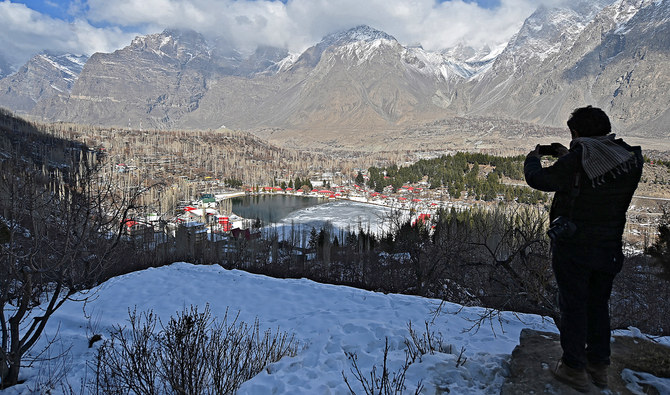
A tourist takes pictures of the Lower Kachura Lake at the Shangrila Resort, about 6 Km from Skardu on January 24, 2021. (AFP/File)
Short Url
Updated 12 March 2021
Follow

Gilgit-Baltistan officials declare region free of COVID-19

  • Senior health officials maintain they managed to 'defeat' the disease since people of the area wore face masks and practiced social distancing
  • Officials fear another wave of coronavirus infections after tourists return to the area

ISLAMABAD: Two days after the government announced a spring break for education institutions in several cities of Punjab as well as Islamabad and Peshawar due to the rising number of coronavirus cases, a senior official in Pakistan's northern Gilgit-Baltistan (GB) region claimed that the area had not reported new COVID-19 infections since March 10.

"The first coronavirus case emerged in GB on March 2, 2020," Dr. Shah Zaman, a medical expert and government's focal person for COVID-19, told Arab News on Friday. "There have been no positive cases after the recovery of the last three patients on March 10."

In a brief interview on telephone, Zaman said the region was home to about 1.5 million people who were scattered in different areas.

"Due to the cold weather, many people temporarily migrated to the southern parts of the country, making it somewhat easier for us to defeat the pandemic. Now, praise be to God, we have zero cases of the disease," he added.

Zaman agreed that the number of cases could surge once again after the residents of the region returned from other cities and the flow of tourists resumed in the coming days. He urged people traveling to Gilgit-Baltistan to bring their negative test results with them.

According to the figures released by the health department, the area recorded 4,960 confirmed coronavirus cases with 103 related deaths. The recovery rate remained 97.92 percent in the region while the death ratio was 2.08 percent. 

"When the virus emerged, there was an environment fear since no one knew what was happening," Dr. Haider Asim, district health officer in Kharmang district, told Arab News. "Doctors and paramedics soon realized, however, that they had to prevent the spread of the deadly disease. Now, after about a year, there are zero active COVID-19 cases in GB."

Despite bringing the virus under control, he said it was vital for the government to strictly enforce the necessary precautionary measures since these cases could reemerge once people started traveling back to the region.

"The residents of the area followed all standard operating procedures by wearing face masks and maintaining the required social distance," he added. "All stakeholders, including religious clerics, district administration officials and local community members, worked together to prevent the spread of the disease. The same community spirit also made it possible for us to achieve this milestone."

The health ministry spokesman Sajid Hussain Shah told Arab News that the situation was different in Gilgit-Baltistan from the rest of the region, helping the authorities succeed in controlling the disease.

"COVID-19 cases are soaring in other parts of the country," he said. "If people begin to follow the SOPs like they did in GB, we will be able to eradicate the disease across Pakistan."


Pakistan finance chief calls for change to population-based revenue-sharing formula

Updated 14 February 2026
Follow

Pakistan finance chief calls for change to population-based revenue-sharing formula

  • Muhammad Aurangzeb criticizes current NFC formula, says it is holding back development
  • Minister says Pakistan to repay $1.3 billion debt in April as economic indicators improve

ISLAMABAD: Pakistan’s Finance Minister Muhammad Aurangzeb said on Saturday the country’s revenue-sharing formula between the federal and provincial governments “has to change,” arguing that allocating the bulk of funds on the basis of population was holding back long-term development.

The revenue-sharing is done under the National Finance Commission (NFC) Award that determines how federally collected taxes are divided between the center and the provinces. Under the current formula, much of the distribution weight is based on population, with smaller weightages assigned to factors such as poverty, revenue generation and inverse population density.

“Under the NFC award, 82 percent allocation is done on the basis of population,” Aurangzeb said while addressing the Federation of Pakistan Chambers of Commerce & Industry’s regional office in Lahore. “This has to change. This is one area which is going to hold us back from realizing the full potential of this country.”

Economists and policy analysts have long suggested broadening the NFC criteria to give greater weight to tax effort, human development indicators and environmental risk, though any change would require political consensus among provinces, making reform politically sensitive.

Aurangzeb also highlighted the economic achievements of the country in recent years, saying Pakistan’s import cover had improved from roughly two weeks just a few years ago to about 2.5 months currently, adding that the government had repaid a $500 million Eurobond last year.

“The next repayment is of $1.3 billion in April,” he continued, adding that “we will pay these obligations, which are the obligations of Pakistan, as we go forward.”

The minister also noted that unlike in 2022, when devastating floods forced Pakistan to seek international pledges at a Geneva conference, the government did not issue an international appeal during more recent flooding, arguing that fiscal buffers had strengthened.

“This time, the prime minister and the cabinet decided that we do not need to go for international appeal because we have the means,” he said.

He reiterated the government was pursuing export-led growth to avoid repeating past boom-and-bust cycles driven by import-led expansion that quickly depleted foreign exchange reserves and pushed Pakistan back into International Monetary Fund programs.
