RIYADH: Cairo and Khartoum have agreed to establish a sovereign fund to finance projects between the two countries, sources told Al Arabiya on Thursday. They revealed Egyptian-Sudanese discussions to establish a railway line between the two countries, and to remove entry visas between Egypt and Sudan.
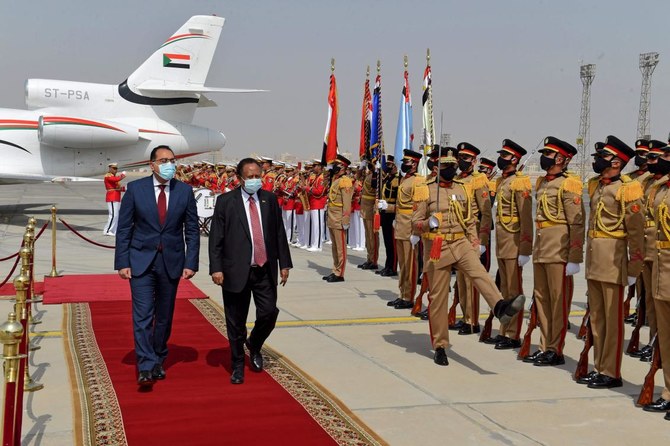
Egypt President Abdel Fattah El-Sisi received Dr. Abdullah Hamdok, Prime Minister of Sudan, at the Federal Palace on Thursday.
The meeting dealt with “following up issues of bilateral relations between the two sides, in light of the president’s recent visit to Khartoum, as well as developments in regional issues of mutual interest,” Presidency official spokesman, Bassam Radi, said.
The two sides also reviewed the latest developments around Ethiopoia’s Grand Renaissance Dam.
Sudan and Egypt are seeking to build a united front in an ongoing row over the controversial dam being built by Ethiopia on the Blue Nile.
The dispute hinges on how much water Ethiopia will release downstream if an extended drought occurs.
Sudan Prime Minister’s visit to Egypt follows the visit that President Abdel Fattah El-Sisi made to Khartoum last week.

Cairo and Khartoum said to plan sovereign fund amid dam controversy
https://arab.news/gbv7r
Cairo and Khartoum said to plan sovereign fund amid dam controversy
- Joint railway among potential projects
- Row with Ethiopia over dam discussed
Emerging markets should depend less on external funding, says Nigeria finance minister
RIYADH: Developing economies must rely less on external financing as high global interest rates and geopolitical tensions continue to strain public finances, Nigeria’s finance minister told Al-Eqtisadiah.
Asked how Nigeria is responding to rising global interest rates and conflicts between major powers such as the US and China, Wale Edun said that current conditions require developing countries to rethink traditional financing models.
“I think what it means for countries like Nigeria, other African countries, and even other developing countries is that we have to rely less on others and more on our own resources, on our own devices,” he said on the sidelines of the AlUla Conference for Emerging Market Economies.
He added: “We have to trade more with each other, we have to cooperate and invest in each other.”
Edun emphasized the importance of mobilizing domestic resources, particularly savings, to support investment and long-term economic development.
According to Edun, rising debt servicing costs are placing an increasing burden on developing economies, limiting their ability to fund growth and social programs.
“In an environment where developing countries as a whole — what we are paying in debt service, what we are paying in terms of interest costs and repayments of our debt — is more than we are receiving in what we call overseas development assistance, and it is more than even investments by wealthy countries in our economies,” he said.
Edun added that countries in the Global South are increasingly recognizing the need for deeper regional integration.
His comments reflect growing concern among developing nations that elevated borrowing costs and global instability are reshaping development finance, accelerating a shift toward domestic resource mobilization and stronger economic ties among emerging markets.


