

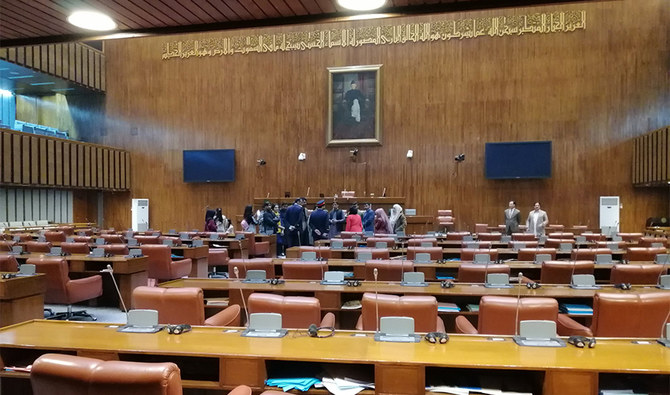

ISLAMABAD: Voting to elect the chairman of Pakistan’s senate ended at 5pm on Friday after a day marred by opposition leaders’ allegations they had found "hidden" cameras in a polling booth ahead of voting.
The senate election last week was already tainted by accusations of corrupt practices and a controversy over the method of voting.
Opposition Pakistan People’s Party Senator Mustafa Nawaz Khokhar said on Twitter he had seen a spy camera in the polling booth:
As protests erupted in the house and opposition politicians demanded an investigation, the presiding officer issued orders that the “current polling booth should be removed, another should be set up afresh.”
Minister for Science and Technology Fawad Chaudhry responded to Khokhar's tweet, saying what he was calling a spy cam looked "more like a CCTV cable … spy cameras are far more sophisticated.”
Former prime minister Yousuf Raza Gillani is the joint candidate of the opposition for the post of senate chairman, and Maulana Abdul Ghafoor Haideri for deputy chairman. The government has announced outgoing chairman Muhammad Sadiq Sanjrani as its candidate for another term.
On Thursday, Information Minister Shibli Faraz announced that senator Mirza Mohammad Afridi, a billionaire from Pakistan’s northwestern tribal areas (FATA), would be the government’s candidate for deputy chairman.
“Prime Minister Imran khan has nominated Senator Mirza Mohammad Afridi for Deputy Chairman Slot giving representation to Ex FATA PTI member,” Shibli said in a tweet.
“Though the opposition enjoys a clear majority in the Senate to win both the seats, political pundits say it is going to be a close contest and any deviation from party policy and wastage of votes in secret ballot can translate into an upset,” Pakistan’s Dawn newspaper reported.
The ruling coalition in senate currently has 27 members of the ruling Pakistan Tehreek-e-Insaf, 12 of the Balochistan Awami Party, three of the Muttahida Qaumi Movement, three independents and one each of the Pakistan Muslim League (Quaid) and the Grand Democratic Alliance.
Opposition senators are 21 from the Pakistan Peoples Party, 17 from the Pakistan Muslim League-Nawaz, five from the Jamiat Ulema-e-Islam (Fazl), two each from the Awami National Party (ANP), Balochistan National Party (Mengal), The Pashtunkhwa Milli Awami Party and National Party and one from the Jamaat-i-Islami.
The opposition collectively has 52 members in the house, against 47 senators from the ruling coalition, with the difference between the vote bank of the government and the opposition narrowed down to four.
Last Saturday, Pakistani Prime Minister Imran Khan sought, and won, a vote of confidence from parliament in a session marked by an opposition boycott of the vote and clashes between government supporters and opposition leaders outside the parliament building.
Khan was able to secure 178 votes, against the 172 required to win confidence, the speaker of the house announced.
Khan, who became prime minister following the 2018 general elections, volunteered to seek parliament’s confidence after the government’s finance minister lost a key senate seat election earlier in the week to Gillani.
Opposition parties boycotted the session, saying the senate seat defeat was enough to show that Khan no longer enjoyed the confidence of the house, and the vote of confidence was unnecessary.


