

Yemen’s army brings partial end to Houthi siege of Taiz

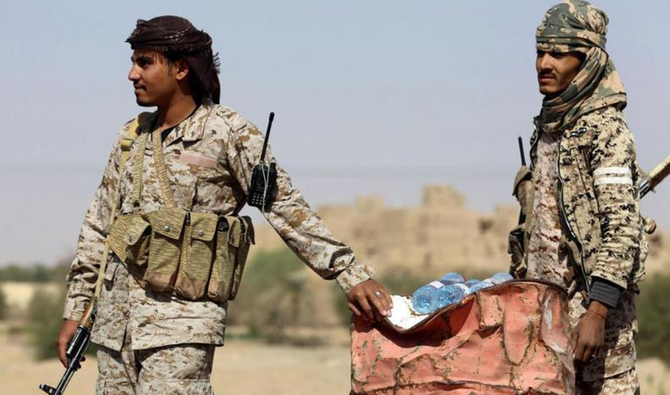
Al-Baher said a group of Houthi fighters, along with their leader, surrendered to the army as many others fled the battlefields. (AFP/File Photo)
Short Url
Updated 11 March 2021
Follow

Yemen’s army brings partial end to Houthi siege of Taiz

  • Since early last week, Yemeni troops in Taiz have broken months of military stalemate in the city

AL-MUKALLA: Yemen’s army on Wednesday announced it had partially broken a six-year siege of the southern city of Taiz by the Iran-backed Houthis.

Spokesman Col. Abdul Basit Al-Baher told Arab News that troops had seized control of several mountain locations on the western edges of the city and reopened a road to western areas on the Red Sea.

For the first time in years, soldiers from the Taiz axis met other government troops from the Giants Brigades (military unit fighting for the government) in a liberated area in Al-Wazyia after breaking the last Houthi line of defense that had long-separated them.

“This is an important development since it not only breaks the siege but unifies the fronts against our common enemy,” Al-Baher said, adding that troops were currently consolidating gains in Al-Wazyia as other forces pushed toward Al-Bareh.

If the advances continued at the same speed, government troops would be able to open another strategic road linking the city with Hodeidah and other Red Sea coastal areas, Al-Baher said.

Since early last week, Yemeni troops in Taiz have broken months of military stalemate in the city by launching a new offensive to push back the Houthis from the city’s fringes and break the rebels’ siege.

The army took over control of Jabal Habashy district and several strategic locations on the eastern and western edges of Taiz after killing and wounding dozens of Houthis.

State TV media showed images of soldiers retrieving tanks, armored personnel carriers, and rocket launchers abandoned by the defeated Houthis.

Al-Baher said a group of Houthi fighters, along with their leader, surrendered to the army as many others fled the battlefields.

Yemeni army commanders attributed Houthi setbacks in Taiz to long attrition by army troops and the rebels’ mobilization of their highly trained military units in the central province of Marib.

The official news agency said Yemen’s President Abed Rabbo Mansour Hadi, during a telephone conversation with Taiz Gov. Nabil Shamsan, ordered his troops in Taiz to press ahead with their military offensive until the Houthi siege had been ended.

After failing to seize control of the city’s downtown during early military expansion across Yemen in 2015, the Houthis surrounded the densely populated city, blocking vital food and medical supply lines. The militia group has repeatedly shelled residential areas in Taiz, killing and wounding hundreds of civilians over the last six years.

Yemen’s Defense Ministry said that army troops and allied tribesmen scored limited military gains on different fronts in the province of Marib.

The army seized control of a mountain in Al-Kasara, west of Marib, after killing, wounding, and capturing dozens of Houthis.

In other contested areas in Marib such as Murad, Serwah, and Helan, government troops took defensive positions, focusing on pushing back Houthis as warplanes from the Arab coalition targeted Houthi military reinforcements and locations.

Hadi called Yemini defense minister, Mohammed Al-Maqdashi, to congratulate government troops on their gains and repeated his order to the army to foil “Iran’s scheme and its tools” in Yemen.


Top Hamas leader rejects disarmament or ‘foreign rule’

Updated 7 sec ago
Follow

Top Hamas leader rejects disarmament or ‘foreign rule’

  • “As long as there is occupation, there is resistance. Resistance is a right of peoples under occupation” said Meshal

DOHA: A senior Hamas leader said Sunday that the Palestinian Islamist movement would not surrender its weapons nor accept foreign intervention in Gaza, pushing back against US and Israeli demands.
“Criminalizing the resistance, its weapons, and those who carried it out is something we should not accept,” Khaled Meshal said at a conference in Doha.
“As long as there is occupation, there is resistance. Resistance is a right of peoples under occupation ... something nations take pride in,” said Meshal, who previously headed the group.
Hamas, an Islamist movement, has waged an armed struggle against what it sees as Israel’s occupation of Palestinian territories. It launched a deadly cross-border raid into Israel from Gaza on October 7, 2023, which triggered the latest war.
A US-brokered ceasefire in Gaza is in its second phase, which foresees that demilitarization of the territory — including the disarmament of Hamas — along with a gradual withdrawal of Israeli forces.
Hamas has repeatedly said that disarmament is a red line, although it has indicated it could consider handing over its weapons to a future Palestinian governing authority.
Israeli officials say that Hamas still has around 20,000 fighters and about 60,000 Kalashnikovs in Gaza.
A Palestinian technocratic committee has been set up with a goal of taking over the day-to-day governance in the battered Gaza Strip, but it remains unclear whether, or how, it will address the issue of demilitarization.
The committee operates under the so-called “Board of Peace,” an initiative launched by US President Donald Trump.
Originally conceived to oversee the Gaza truce and post-war reconstruction, the board’s mandate has since expanded, prompting concerns among critics that it could evolve into a rival to the United Nations.
Trump unveiled the board at the World Economic Forum in the Swiss ski resort of Davos last month, where leaders and officials from nearly two dozen countries joined him in signing its founding charter.
Alongside the Board of Peace, Trump also created a Gaza Executive Board — an advisory panel to the Palestinian technocratic committee — comprising international figures including US envoys Steve Witkoff and Jared Kushner, as well as former British prime minister Tony Blair.
On Sunday, Meshal urged the Board of Peace to adopt what he called a “balanced approach” that would allow for Gaza’s reconstruction and the flow of aid to its roughly 2.2 million residents, while warning that Hamas would “not accept foreign rule” over Palestinian territory.
“We adhere to our national principles and reject the logic of guardianship, external intervention, or the return of a mandate in any form,” Meshal said.
“Palestinians are to govern Palestinians. Gaza belongs to the people of Gaza and to Palestine. We will not accept foreign rule,” he added.