DUBAI: Saudi domestic airlines are seeing a quicker recovery in routes within the Kingdom than larger regional rivals relying on pandemic-paralyzed long haul travel.
The CAPA Live aviation industry event on Wednesday heard that the Kingdom’s domestic airline sector was recovering strongly in sharp contrast to most of its neighbors.
The Middle East has been particularly hard hit by the global aviation slowdown because of its comparatively under-developed domestic market.
In 2019, the region had the lowest share of domestic air capacity, with just one in five seats on offer defined as an internal flight — compared to a global average of 59 percent, CAPA said.
It has meant that countries such as Bahrain, Kuwait, Lebanon and Qatar have not been able to rely on domestic flights to keep planes in the air. However larger countries in the region such as Saudi Arabia and Iran have bigger domestic markets to fall back on.
“The domestic recovery in Saudi Arabia is already showing positive signs, in frequency terms at least,” said CAPA analyst Richard Maslen.
Weekly domestic flights in the Kingdom have grown to about 3,000 according to CAPA data.
That represents a decline of just 23 percent over the first two months of the year compared to the same period a year ago before COVID restrictions hit.
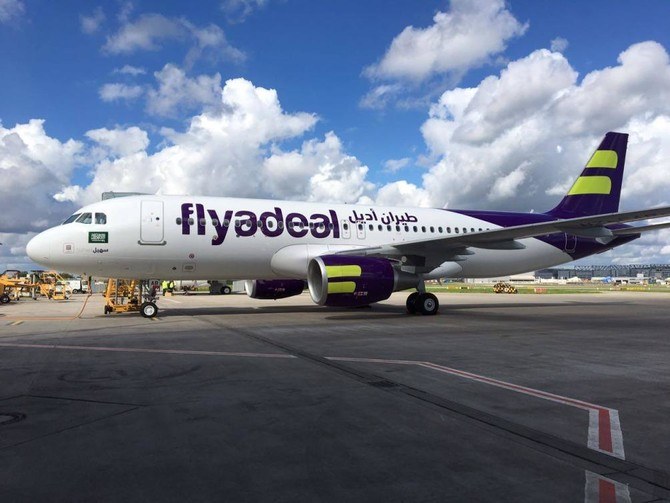
Earlier flyadeal CEO Con Korfiatis told the consultancy that the Saudi low cost carrier was offering schedules with frequencies just 10 percent lower than this time last year.

Saudi domestic flights buck Mideast air travel slowdown
https://arab.news/22f8y
Saudi domestic flights buck Mideast air travel slowdown
- The Middle East has been particularly hard hit by the global aviation slowdown
Aramco rises nearly 3% as Gulf stocks fall on Middle East tensions
RIYADH: Saudi Arabian Oil Co. shares rose nearly 3 percent in intraday trading on March 1, outperforming regional markets as escalating tensions in the Middle East weighed on Gulf equities.
The stock climbed as much as 3.2 percent to SR25.76 ($6.87) before easing slightly to SR25.64, up 2.72 percent from the previous close of SR24.96, according to Tadawul data. More than 12 million shares were traded, with turnover exceeding SR306 million as of 12:20 p.m. Saudi time.
The gains came even as most Gulf markets declined after Israel and the US launched strikes on Iran, triggering retaliatory attacks and raising fears of a broader regional conflict.
The Kingdom’s benchmark Tadawul All Share Index dropped as much as 4.6 percent in early trading, putting it on track for its sharpest intraday fall since April, Reuters reported.
Elsewhere in the region, Boursa Kuwait suspended trading as a precautionary measure. Oman’s main index trimmed losses to 1.5 percent after falling more than 3 percent earlier, while Bahrain’s benchmark slipped 0.6 percent. Qatar’s market was closed for a bank holiday.
Investors are now closely watching oil markets, particularly the Strait of Hormuz, a key shipping route that carries about 15 million barrels of crude per day, nearly 30 percent of global seaborne oil trade.
“The most immediate and tangible development affecting oil markets is the effective halt of traffic through the Strait of Hormuz,” said Jorge Leon, senior vice president and head of geopolitical analysis at Rystad Energy.
“Unless de-escalation signals emerge swiftly, we expect a significant upward repricing of oil at the start of the week,” he added.
Leon said some supply could be rerouted through alternative pipelines, including Saudi Arabia’s East-West pipeline to the Red Sea, which has a capacity of about 5 million barrels per day, and the UAE’s Abu Dhabi pipeline, with a capacity of around 1.5 million barrels per day. Even so, he estimated the disruption could temporarily remove 8 million to 10 million barrels per day from global supply.
Barclays raised its Brent crude forecast to about $100 a barrel from $80 a day earlier, while analysts expect prices could jump by as much as $20 per barrel when trading resumes on March 2 if tensions escalate further, Reuters reported.
“Should the Strait remain effectively closed or energy infrastructure be confirmed as damaged, the upside risks to prices would increase further,” Leon said.
Even a short disruption in Hormuz traffic could lead to tanker delays, cargo rescheduling, and supply bottlenecks, keeping energy markets volatile in the near term.