Libya’s parliament approves Cabinet after decade of chaos

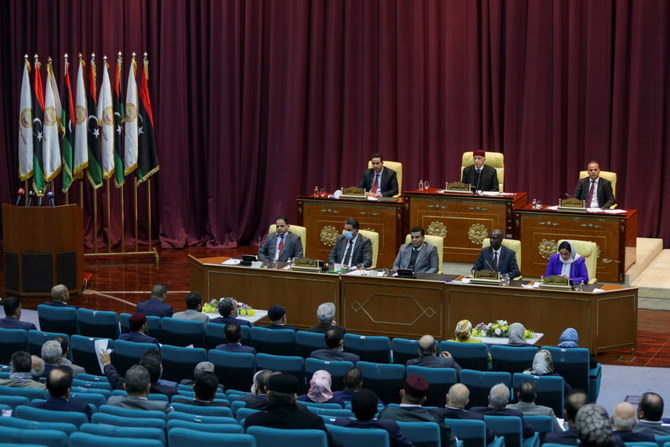
Libyan Parliament meet to discuss approving new government. (Reuters)
Short Url
Updated 11 March 2021
Follow

Libya’s parliament approves Cabinet after decade of chaos

  • UN peace plan puts country on verge of first unified government since toppling of Muammar Qaddafi

JEDDAH: Libya’s reunited parliament voted on Wednesday to approve an interim government after a decade of chaos and violence, to oversee elections in December as part of a UN-backed peace plan.
The parliament’s approval of Prime Minister Abdulhamid Dbeibeh’s Cabinet by 132 votes to 2, at a session in the frontline city of Sirte, is the biggest opportunity in years for a resolution to Libya’s conflict.
“Through this vote, it became clear that the Libyans are one unit,” Dbeibeh told parliament.
Tarek Megerisi of the European Council on Foreign Relations said: “If we come out of this with one government and one set of institutions then we’re already in a far superior place than we’ve been for the past five years.”
It was parliament’s first full session in years after it split between eastern and western factions in 2014, three years after an uprising toppled Muammar Qaddafi and plunged Libya into chaos.
A cease-fire has held since the autumn, but the main road across the front lines from Sirte to Misrata remains closed and parliament members from the west had to fly in from Tripoli.
Critics of the UN peace plan say it has merely rearranged the tangle of alliances and enmities among power brokers who have dominated Libya for years, without disrupting their ability to loot its wealth or wreck political agreements they dislike.
Nevertheless, Libya is on the cusp of a first unified government in years and with all sides formally committed to elections. In a visible sign of returning normality, the first civilian airline flight in six years traveled on Tuesday between Benghazi and Misrata.
“It is good for us to have one government ... but it is more important for the government to abide by the agreement and bring the country to elections,” said Khaled Al-Ajili, 42, a businessman in a Tripoli cafe.


Israel-backed militia kill two Hamas operatives in Gaza

Updated 16 sec ago
Follow

Israel-backed militia kill two Hamas operatives in Gaza

  • Popular Forces said it had carried out a raid in Rafah, killing two Hamas members who refused to surrender
CAIRO: An Israeli-backed Palestinian militia said on Wednesday it had killed two Hamas operatives in southern Gaza, marking a renewed challenge to Hamas after Israel empowered its rivals in ​areas under Israeli military control.
The armed group, known as the Popular Forces, said in a statement it had carried out a raid in Rafah, killing two Hamas members who refused to surrender and detaining a third. It shared a photo that it said depicted one of the slain men.
Hamas, which brands such groups as “collaborators,” declined to ‌comment on the ‌claim, which Reuters couldn’t independently authenticate. ‌Rafah ⁠sits ​in ‌territory under Israeli control under the terms of an October Israel-Hamas deal.
The Popular Forces, founded by an anti-Hamas armed Bedouin leader, Yasser Abu Shabab, is believed to be the largest group operating in Israel-controlled areas.
Abu Shabab was killed in December in what the group described as a family feud. He was replaced ⁠by his deputy Ghassan Duhine, who vowed no let up in the ‌fight against Hamas. The Popular Forces and ‍others have reported more recruits ‍since the October deal took effect.
The emergence of the ‍groups, though they remain small and localized, has added to pressures on Islamist Hamas and could complicate efforts to stabilize and unify a divided Gaza, shattered by two years of war. The groups ​remain unpopular among the local population, as they operate under Israeli control.
Nearly all of Gaza’s two million ⁠people live in Hamas-held areas, where the group has been reestablishing its grip and where four Hamas sources said it continues to command thousands of men despite suffering heavy blows during the war.
But Israel still holds well over half of Gaza — areas where Hamas’ foes operate beyond its reach. With President Donald Trump’s plan for Gaza moving slowly, there is no immediate prospect of further Israeli withdrawals.
Prime Minister Benjamin Netanyahu acknowledged Israeli backing for anti-Hamas groups in June, saying Israel had “activated” clans. ‌Israel has given little detail since then.
The Popular Forces deny receiving support from Israel.