



JEDDAH: When Khaled Makhshoush first began creating his pixel art as a hobby in 2016, he saw it simply as a means of creative expression stemming from his interest in playing and developing video games.
He never imagined that, within five years, he would have set himself up as a professional freelance artist whose work is in demand from clients all over the world and been commissioned to create art for Paris Fashion Week.
“It certainly did not happen overnight,” the 28-year-old artist, who was born and raised in Riyadh, told Arab News, adding that he used to be delighted to receive a few hundred likes when he posted his work on social media. Now, practically every post receives thousands of thumbs-up from admirers, both international and local.
“I’m very happy with that. And I am honored that people like my stuff because I do still remember the time that I wasn’t an artist,” he said.
Although his blocky artworks — which resemble old-school 8-bit and 16-bit video games — may appear simplistic, Makshoush explained that each one can now take him up to a month to complete. That was not the case at first, however, when he took a “quantity-over-quality approach” and churned out a picture every day.
“In that period, I started to learn a lot about art and how to appreciate it. My focus shifted, and I felt like I could express things about me in my art,” he said.
“Looking back at that period, I can see it was very simplistic, like I was a child learning how to speak; a very simplistic self-learning (process), trying to experiment with color and different shapes. But it quickly became a very personal experience to me, and I feel like it’s made me more mature.” As he learned more about the techniques behind pixel art, he added, each piece took longer to complete.
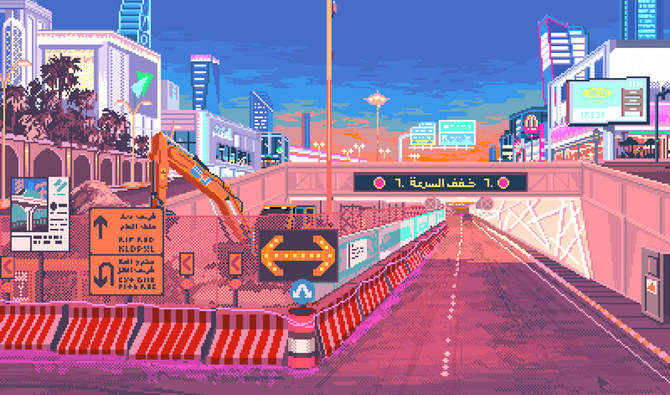
Much of Makshoush’s work involves a reimagining of local landscapes, especially the streets of Riyadh.
FASTFACTS
• Khaled Makhshoush first began creating his pixel art as a hobby in 2016.
• Within five years, he became a professional freelance artist whose work is in demand from clients all over the world.
“I’m always attracted to the spaces around me and how the atmosphere — the lights and colors — changes (depending on) the time of day,” he said. “I like to express myself through space, and specifically modern places.”
His most popular artwork — “Early Evening” — depicts the streets of Riyadh not as they are, but as they exist in Makshoush’s mind, influenced by actual elements of the city.
“A lot of my audience isn’t based in the Middle East, and a lot of them thought I was drawing something futuristic, representing the cyber-punk aesthetic,” he said. “That made me think of how our cities have that unique outlook to them that we don’t really think about much.”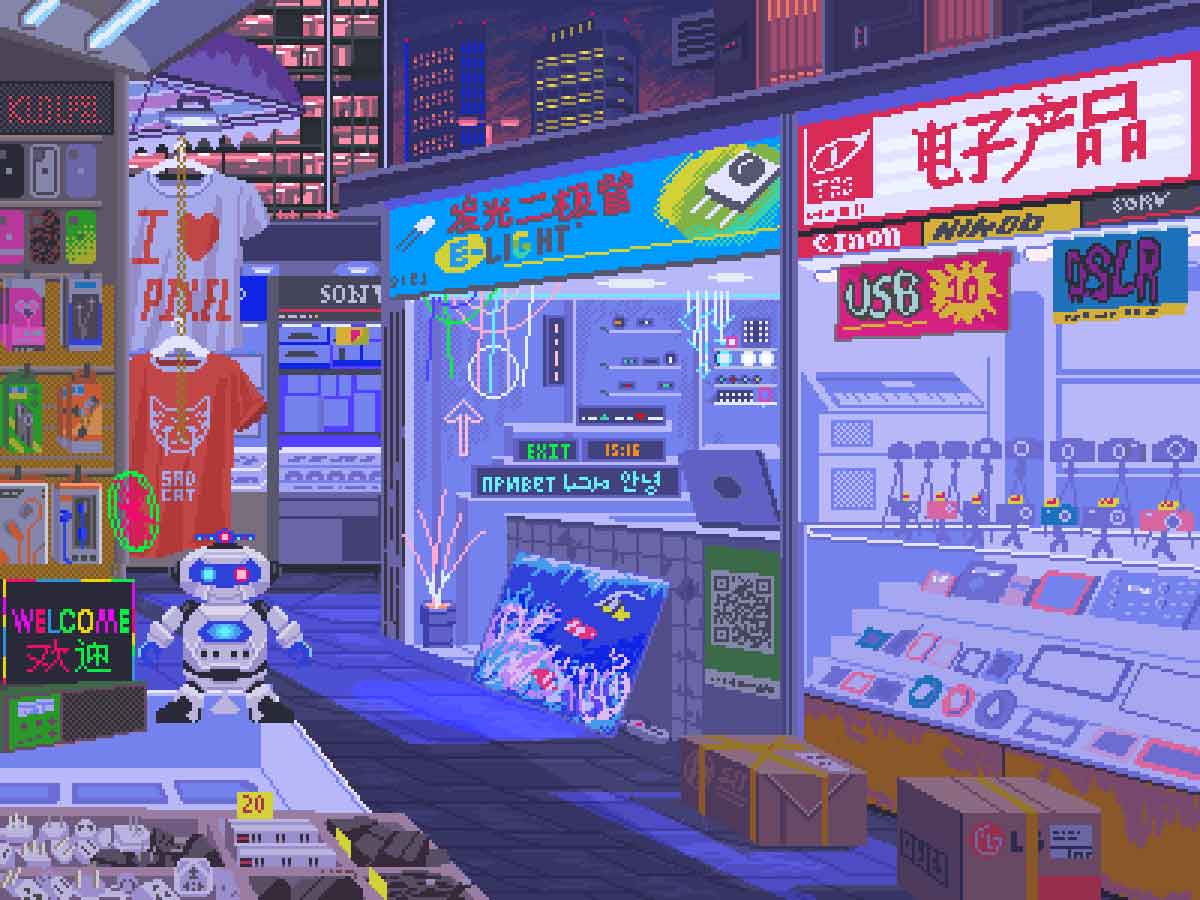
While pixel art has yet to gain a strong foothold in Saudi Arabia, Makhshoush has been surprised at how many people enjoy his aesthetic and feel a strong affinity towards his work, he said. Younger artists have been reaching out to tell him they have been inspired to try pixel art for themselves after viewing his work.
But it’s not only his visual style that makes Makhshoush a pioneer in the Kingdom’s art scene. Freelance artists are still a rarity in the country, but Makshoush said that local clients are beginning to show more interest in his work — perhaps reassured by the number of international clients he has produced work for over the past few years.
“In the beginning, I had a lot of things to figure out and I’ve encountered people who told me that my prices were too low,” he said. “It was certainly uncharted territory to make a living out of (pixel) art.”


