



WASHINGTON D.C.: Iran’s persecution of political dissidents has been well documented. But the popular conception of the “Iranian people” tends to privilege the grievances of Shiite Muslims and Persian speakers over those of ethnic minorities. Prominence is invariably given to events in Tehran and other urban areas at the expense of happenings in remote provinces.
Overall, non-Persian ethnic groups in Iran make up around 50 percent of the population, yet they are overwhelmingly marginalized.
In recent years, the regime in Tehran and its enablers in the West have assiduously pushed the narrative that the US is the oppressor and the “Iranian people” are the victim. But frequently the propaganda gets punctured when protests by Iran’s oppressed ethnic minorities spin out of control, such as the violent clashes that recently rocked the country’s impoverished southeast.
Several rights groups reported in a joint statement that authorities shut down the mobile data network in Sistan and Balochistan province, calling the disruptions an apparent “tool to conceal” the government’s harsh crackdown on protests convulsing the area.
Outraged over the shootings of fuel smugglers trying to cross back into Iran from Pakistan, local people had attacked the district governor’s office and stormed two police stations in the city of Saravan.
An ongoing low-level insurgency in Sistan and Balochistan involves several militant groups, including those demanding more autonomy for the region. The relationship between its predominantly Sunni Baloch residents and Iran’s Shiite theocracy has long been tense.
Since the Islamic Revolution of 1979, ethnic Kurds, Arabs and Balochis have faced particularly harsh crackdowns by regime security forces. Consequently, more than 40 years on, provinces such as Khuzestan, Kurdistan and Sistan and Balochistan remain some of the most unstable and least developed parts of Iran.
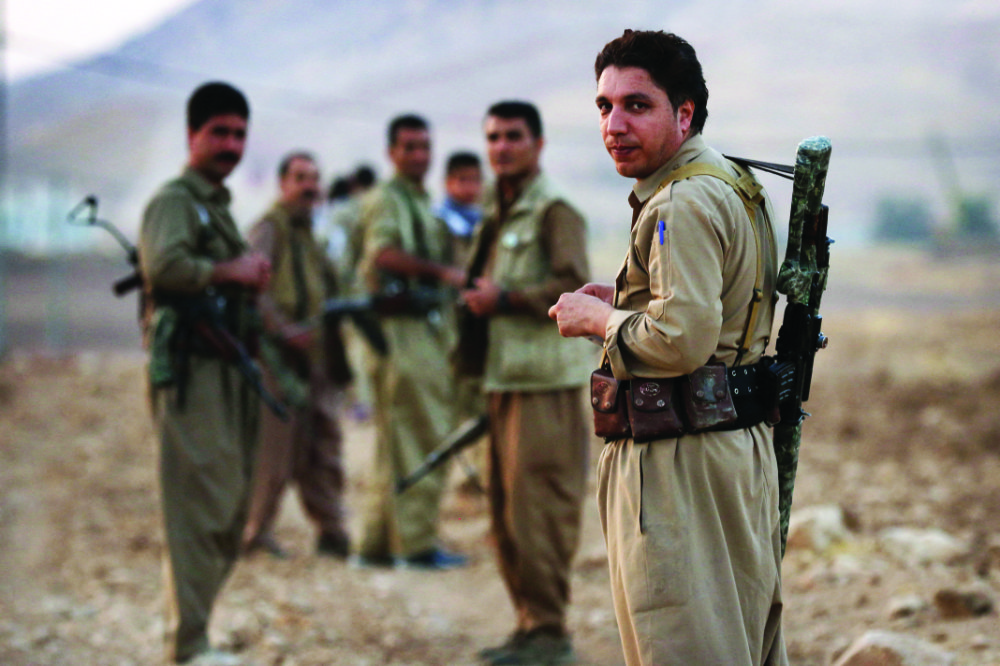
Provinces such as Khuzestan, Kurdistan and Sistan and Balochistan remain some of the most unstable and least developed parts of Iran. (AFP)
Authorities typically claim they are fighting “terrorism” and “extremism” when justifying executions, arbitrary detentions and the use of live ammunition against protesting minorities. Even the most benign of dissident activities — like running a social media page critical of the regime — can carry the death penalty.
“It is a well-known fact that discrimination in Iran is institutionalized through the constitution,” Abdul Sattar Doshouki, director of the London-based Center for Balochistan Studies, said in a report submitted to the UN Human Rights Council Forum on Minority Issues.
“The Iranian regime’s policy in Sistan and Balochistan, and for that matter in other provinces too, is based on racial discrimination, assimilation, linguistic discrimination, religious prejudice and inequality, brutal oppression, deprivation and exclusion of the people who are the majority in their own respective provinces and regions.”
Baloch activists have repeatedly called on the international community and regional powers to press the Iranian government to end its systemic policy of harassment and imprisonment of their local leaders.
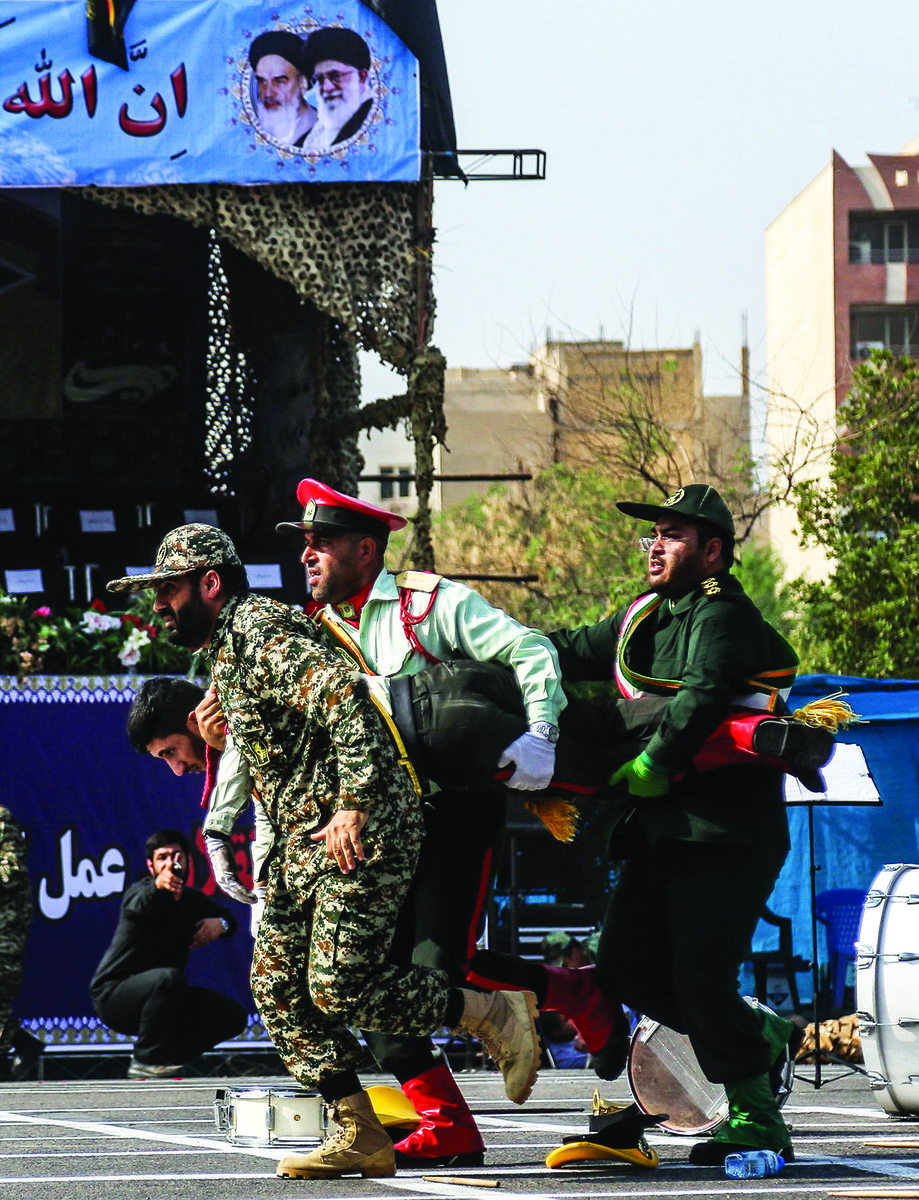
The 2018 attack on a military parade in Ahvaz highlighted growing resentment among minority groups at Tehran’s repressive tactics. (AFP)
Ahwazi Arabs, the largest Arab community in Iran, face similar repression. Natives of Khuzestan, they live in extreme poverty, despite the region holding almost 80 percent of Iran’s hydrocarbon resources.
The province has never had an Arab governor and the majority of its top officials are Persians with close ties to the Islamic Revolutionary Guard Corps (IRGC). The official language is Persian; Arabic is not taught in schools.
On Tuesday, the Ahwaz Human Rights Organization reported the execution of four additional political prisoners in the infamous Sepidar prison. Among the few who avoided such a fate is Saleh Hamid, an Ahwazi Arab cultural and political activist who was detained by Iranian authorities in the early 2000s for allegedly distributing anti-regime propaganda.
According to the account he gave to the US-based Iran Human Rights Documentation Center (IHRDC), Hamid traveled to Syria to enroll at the University of Damascus, where he joined the university’s Ahwazi Arab Students’ Association.
Hamid said the student group primarily promoted Ahwazi Arab culture, but he believes he was identified as a subversive by Syrian intelligence because he was detained at Imam Khomeini airport upon his return from vacation.
He was released after four days but rearrested by plainclothes officers at his father’s home in Ahvaz. Hamid spent two months in the IRGC’s detention center in Chaharshir before being released on bail. He fled the country before his trial date.
Hamid believes Tehran’s policy of persecution is designed to wipe out any ethnic identities that cannot be subsumed under the Islamic Republic’s hegemonic ideology. He says the international community, particularly European powers keen to preserve the 2015 Iran nuclear deal, should make the protection of minorities a precondition of any trade agreements with the regime.
“Human rights in Iran are a victim of negotiations on the nuclear file and trade between the EU and Iran,” Hamid told Arab News. “When they negotiate, they forget human rights, about the suppression and crackdown. We want human rights cases to be one of the main negotiating points with the regime. There is discrimination in all fields. If you ask an Arab citizen in Iran if he’s benefited from the oil, they’ll tell you ‘nothing but smoke’.”
Iranian Azerbaijanis, who make up at least 16 percent of the country’s population, are another minority group with a long list of grievances. Although Shiites, many Azeris are viewed by the IRGC with suspicion because of their cultural and linguistic affinities with Turks, in addition to the sense of ethnic kinship they feel with the people of neighboring Azerbaijan.
Proof of the political alienation of Iranian Azerbaijanis came most recently in the form of protests in the northern city of Tabriz during the war between Azerbaijan and Armenia that ended in November. They were angry at Tehran for reportedly sending weapons through its overland border to Armenia for use against Azerbaijan.
Iranian Azeris who speak of their home region as “Guney Azerbaijan,” or south Azerbaijan, are also not allowed to use their mother tongue in educational institutions. Many of them have come to view “reunification” of their historical region with Azerbaijan as the only solution.
The IRGC recently detained and savagely beat an Iranian Azerbaijani activist, Yashar Piri, for writing graffiti demanding greater language rights. The courage shown by Piri was remarkable given that detention, torture or arbitrary execution is the fate that awaits minority-rights activists.
“Persecution of religious minorities is one of the main pillars of this regime,” Masih Alinejad, an Iranian journalist and activist, told Arab News.
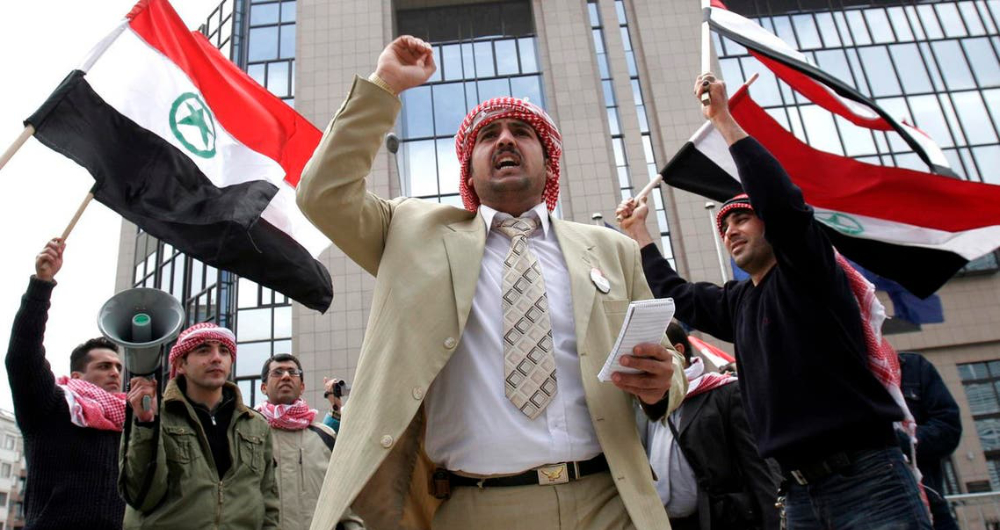
Overseas Ahwazis have lobbied governments to take action. (AP)
“For the past 42 years now, the regime has not refrained from resorting to arresting, persecuting, executing and confiscating the properties of these minorities. These minorities have been barred from realizing their full potential and have had limited employment opportunities.
“Sunni Muslim minorities like the Kurds and the Balochis have not fared any better. The regions inhabited by these minorities are some of the poorest and most under-invested by the regime, and these minorities are overrepresented in the execution statistics of the Islamic Republic of Iran. These regions are so poor that many people have to resort to cross-border smuggling of goods in order to eke out a living and feed their families.”
This is certainly the case for Iran’s northwestern Kurds, who make up around 10 percent of the overall population. Concentrated predominantly in the provinces of West Azerbaijan, Kermanshah, Kurdistan and Ilam, many young Kurdish men make a living carrying goods on their backs across the perilous mountain passes of the Zagros into Iraq’s northern Kurdish region.
Known as kolbars, those who survive the bitter cold and sheer drops must also navigate vast minefields and trigger-happy IRGC border guards.
Like other minorities in Iran, Kurds are not permitted to learn their native tongue on the national curriculum. Suspected membership of one of the many Kurdish opposition groups operating along the border also carries the death penalty.
Activists say the terror of executions and the threat of demographic displacement that Iran’s minorities face should be recognized for what they are: crimes against humanity.
They note with dismay that the economic, social and political exclusion of Iran’s ethnic and religious minorities never figures in the diplomatic discourse surrounding the nuclear issue and the IRGC’s regional meddling.
In the final analysis, the activists point out, the defiance of Iran’s minority communities, who are determined to hold on to their identity and traditions, constitutes a much needed check on the absolutism of the Shiite theocracy.
Twitter: @OS26


