

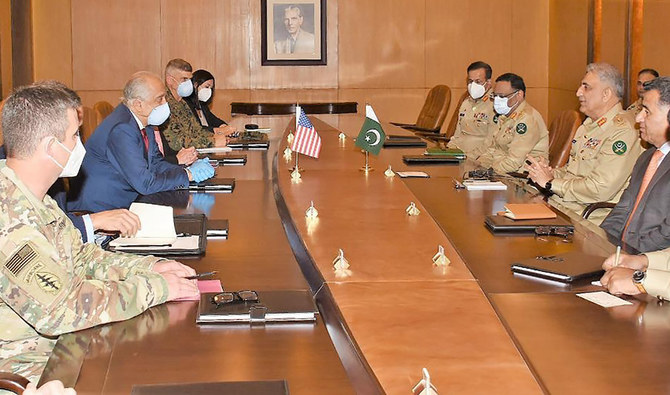

ISLAMABAD: The United States special envoy on Afghan peace, Zalmay Khalilzad, on Monday held talks with Pakistani army chief General Qamar Javed Bajwa at the military headquarters in Rawalpindi and discussed an ongoing peace process to end the long Afghan war, the Pakistani military said.
A statement by the Pakistan army said Commander Resolute Support Mission in Afghanistan, General Austin Scott Miller, accompanied Khalilzad and both sides discussed matters of mutual interest, regional security and ongoing Afghanistan reconciliation process with Gen Bajwa.
“The visiting dignitary greatly appreciated Pakistan's role in the ongoing peace process,” the Pakistan army’s media wing said.
Pakistan's intelligence chief Lt. Gen. Faiz Hameed, special representative for Afghanistan Mohammad Sadiq and national security advisor Moeed Yusuf also attended the meeting.
This was Khalilzad’s first visit to Pakistan since Joe Biden took over as president. His visit also comes after he presented a "power sharing" formula to Afghan leaders and the Taliban, which is aimed at pushing for a political settlement to end the war.
Taliban spokesman Mohammad Naeem confirmed that a draft of the plan was shared with the Taliban on Friday when Khalilzad met senior Taliban leaders in Doha.
“A copy of the plan, which is currently under discussions, has been handed over to us. We will issue a formal response after studying,” Naeem told Arab News on Monday in a WhatsApp reply.
Afghanistan’s National Security Adviser Hamdullah Mohib on Sunday confirmed that Khalilzad has shared proposals with President Ashraf Ghani but declined to share further details.
A copy of the “Afghanistan Peace Agreement,” available with Arab News, explained the guiding principles for Afghanistan’s future, proposing a transitional peace government, a political roadmap and a permanent and comprehensive ceasefire.
The three-part proposed agreement has addressed the Taliban’s calls for the establishment of an Islamic government and says, “a new High Council for Islamic Jurisprudence shall be established to provide Islamic guidance and advice to all national and local government structures.”
The High Council for Islamic Jurisprudence shall have a role in advising the judiciary, the draft said.
A 15-member High Council of Islamic Jurisprudence shall be established within days of this agreement, to provide Islamic guidance on social, cultural, and other contemporary issues, the document added: “A transitional Peace Government of Afghanistan shall be established as of the date of this Agreement. The Peace Government shall exist until it transfers power to a permanent Government following the adoption of a new Constitution and national elections.”
The United States government said on Sunday all options remained on the table for its remaining 2,500 troops in Afghanistan, saying it has made no decisions about its military commitment after May 1.
The State Department comments came after reports emerged that US Secretary of State Antony Blinken had made a new urgent push for a United Nations-led peace effort that included a warning that the US military was considering exiting Afghanistan by May 1.
Blinken in a letter to Afghan President Ashraf Ghani said the United States is “considering the full withdrawal of forces by May 1st as we consider other options”.
Peace negotiations between the Afghan government and the Taliban insurgents in Qatari capital of Doha, have largely stalled as Biden’s administration reviews how to handle the peace process, including troops withdrawal.
Violence in Afghanistan has increased recently as peace talks between the Taliban and the government has made no progress. Both sides have said they were getting ready for a “tough” spring offensive.
Afghan officials and western diplomats told Reuters during Khalilzad’s visit to Kabul he discussed the idea of an interim government after bringing Afghan leaders together for a multilateral conference outside the country.
A Taliban spokesman in Doha said the group has received a proposed draft plan for the peace process and were reviewing it.
Ghani has strongly opposed the idea of the interim government and said any new government should be formed through elections.


