



JEDDAH: A determination to strengthen the contribution of Saudi women to society and the economy is one of many bold ambitions outlined in the Kingdom’s Vision 2030.
Women’s economic empowerment is critical to achieving gender equality and strengthening sustainable development cooperation. It includes women’s ability to participate equally in existing markets, having a louder voice and more agency, and their meaningful involvement in economic decision-making at all levels.
This can be achieved by ensuring women’s financial inclusion, technical inclusion, entrepreneurship empowerment and participation in decision-making.
For the second year in a row, Saudi Arabia has made notable progress in advancing women’s economic opportunities, according to the World Bank Group’s latest report.
The Women, Business, and the Law 2021 report placed Saudi Arabia among the leading countries in the Middle East and North African region — scoring 80 points out of 100, up from the 70.6 achieved in 2020.
According to the report, Saudi Arabia has progressed in reducing wage inequality, eliminated restrictions on female employment in jobs previously deemed too dangerous, and lifted bans on women working night shifts.
As science progresses at a rapid pace, access to new technology and the ability to create and shape technological change is increasingly becoming a fundamental tool to support women’s empowerment and improve their lives, especially in a post-pandemic world.
During a roundtable discussion in July last year spawned by Women20 (W20), an official engagement group of the G20, speakers noted that only 48 percent of women are accustomed to the latest technology, while 60 percent of Saudi women use social media platforms without producing any digital content. This confirms that women are users of technology, not producers, they said.
“Improving digital and cybersecurity literacy among women contributes to their economic empowerment, since they will be needed in all sectors locally, regionally and internationally,” Dalal Al-Harthi, a cybersecurity expert, told Arab News.
FASTFACT
The Women, Business, and the Law 2021 report placed Saudi Arabia among the leading countries in the Middle East and North African region.
Al-Harthi is a faculty member at Shaqra University and resident engineer at the US-based cybersecurity company Palo Alto Networks. Throughout the last three years, she has worked in three positions across different institutions in the US as the only female engineer in her teams.
However, she considered those situations as motivation to prove herself, as opposed to a challenge.
“Males historically and currently dominate the cybersecurity field. A recent report by Cybersecurity Ventures states that women make up 20 percent of the cybersecurity workforce. Because of this massive shortage of women among cybersecurity professionals today, I became deeply passionate about raising this percentage to 50 percent,” Al-Harthi said.
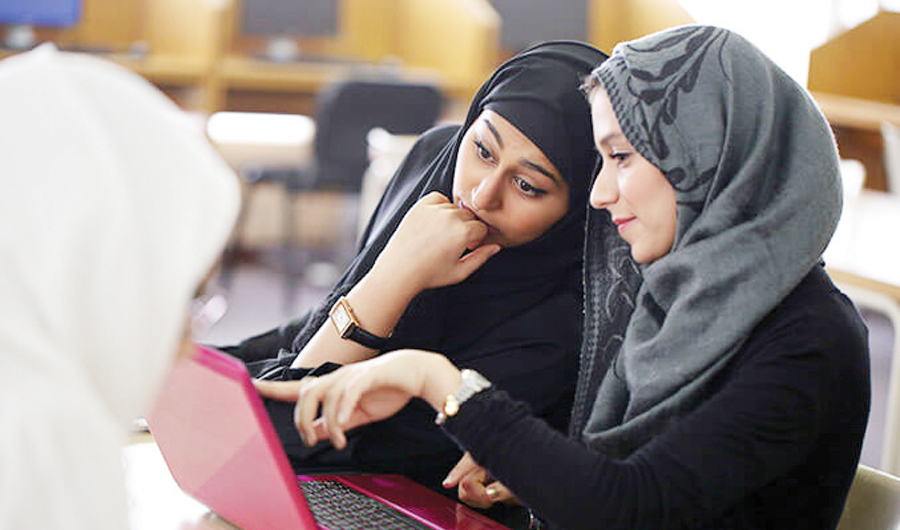
Digital empowerment of women allows them to seize the opportunities provided by evolving global markets. (Social media)
“The cybersecurity field is the hottest cake in the market, and in high demand around the world,” she added.
Therefore, the digital empowerment of women and girls by upgrading their knowledge and skills allows them to seize the opportunities provided by evolving global markets. Moreover, attracting more women to the tech sector is essential to unlocking the potential of the Fourth Industrial Revolution and ensuring technology is developed from a balanced perspective.
Al-Harthi advises women who want to venture into cybersecurity to improve their technical skills, obtain professional certificates, look into cybersecurity job descriptions to grasp the bigger picture, and work on their communication, research and writing skills.
According to the undersecretary for women’s empowerment at the Saudi Ministry of Human Resources and Social Development, Hind Al-Zahid, having women in prominent leadership positions will result in greater numbers of women in senior roles in the labor market.
Saudi Arabia has increasingly encouraged women’s leadership in recent years. The most notable event came earlier this year, which saw the appointment of Iman Al-Mutairi as executive director for destination branding at the Soudah Development Co., a new brand fully owned by Saudi Arabia’s sovereign wealth fund, the Public Investment Fund.
Several initiatives have also been launched to prepare women for leading positions in the public sector, such as the QIYADYAT platform and the leadership academy at the Public Administration Institute.
As it stands, 2.5 percent of leading positions in the Kingdom’s public sector are occupied by women, but in the private sector, the figure rises to 25 percent.
In a recent interview with Al-Arabiya TV, Al-Zahid said that the gap between the public and private sectors is due to the lack of a talent pool that helps include more women in the public sector, as many women work in the education and health industries.
On the bright side, the latest numbers show that women’s participation in the labor market has increased to 31 percent, exceeding the government’s goal of 25 percent by 2025.
Dr. Albandari Al-Rabiah, director of the Studies and Information Department at the Public Administration Institute, said that studies have shown that a balanced representation of women leaders across different levels of an organization leads to a higher level of performance and innovation, and therefore increased revenues and a distinct competitive advantage.
Dr. Al-Rabiah also conducted a field study to evaluate the experience of women leaders in the Kingdom’s public sector.
“The results of the study demonstrated the high sense of commitment among Saudi women toward their responsibilities and role in society, as well as their relentless pursuit to prove themselves, in addition to a number of challenges that face women on the ascending ladder to leadership positions,” she said.
Two years after the study was published, Al-Rabiah insists that the Kingdom is witnessing a decisive turning point for women and their journey towards leadership positions.
The unemployment rate among women in Saudi Arabia is 31 percent, while among men, it stands at 9 percent. Therefore, women have been encouraged to get involved in entrepreneurship to expand their participation in the labor market, fuel economic growth and create more jobs for their female peers.
Vision 2030 aims to increase the contribution of SMEs to Saudi gross domestic product from 20 to 35 percent.
Emon Shakoor, an ex-neuroscience researcher and now technology entrepreneur who started her journey in her early 20s, launched Saudi Arabia’s first tech-inclusion and female-focused accelerator to help more women venture into the field.
“Today in Saudi, according to Ministry of Education numbers, more women are graduating from tech-related majors than men, however after graduation they do not continue working in the industry,” said Shakoor, CEO and founder of Blossom Accelerator.
She said that the way to solve this problem is for women to have more allies, mentors, and networks, because that is the only way that women graduating from the field can stay and strive in the industry.
Shakoor added that entrepreneurship is a male-dominated sector, and that although female entrepreneurs have become more and more noticeable, the most successful and biggest companies in the Kingdom were founded by men.
That is the case not because men are better than women, but because men have their well-established communities, she said.
In her own life, Shakoor said that she did not always receive enough social trust and respect as an ambitious and successful entrepreneur.
“I overcame the situation by continuing to work and focusing on my customers, who are other women founders,” she said.
“People underestimate you at the beginning, but focus on the customer, and you’ll eventually succeed.”


