


ISLAMABAD: In the snowy mountain village of Minimarg in Pakistan’s Gilgit-Baltistan, dozens of people walked through five feet of snow last month to protest notifications issued by the government to establish two huge national parks in the region.
The proposal to create the two parks spread over 3,000 square km in the regions of Diamer and Astore, has been met with scathing criticism among communities who say the move will deprive them of huge swathes of land which they have for generations used to graze animals and chop trees for firewood.
“The residents will be deprived of their lands after the conservation. We will never let the government change the status of public agency on local lands,” Abbas Mosavi, who is leading the protest against the national parks, told Arab News last week.
“We are not against tourism’s industry and conservation,” Mosavi clarified, but added that according to a 1975 act, the lands’ occupation and ownership could only be transferred from the people to the state.
In November last year, Pakistan announced its decision to grant Gilgit-Baltistan, an autonomous region it administered in the country’s far north, the status of a full province.
On Friday, Gilgit-Baltistan’s minister for wildlife and forests, Raja Zakaria, urged the federal wildlife department during the second session of the GB legislative assembly, to take local stakeholders into account before making any moves toward the creation of the national parks.
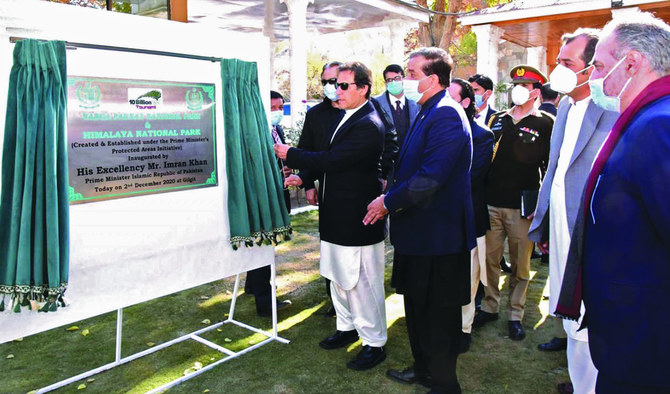
Prime Minister Imran Khan inaugurated the Himalaya and Nanga Parbat National Parks in Gilgit-Baltistan in December last year to protect endangered wildlife and promote eco-tourism in the area when he participated in the oath-taking ceremony of newly-elected members of the GB legislative assembly.
“Government announced and issued separate notifications of Nanga-Parbat and Himalaya National Parks without taking the stakeholders of the area into confidence,” a senior PML-N leader and resident of Astore valley, Rana Farooq, told Arab News.
“We are ready to sit with the government, if they take back the notification. Without reversing the notification, we will never let the government establish national parks in our area,” he said.
“Under the decision, residents of the national parks can neither utilize herbal products nor cut firewood,” he said.
Gilgit-Baltistan’s Environmental Protection Authority Assistant Director Khadim Hussain told Arab News that the issue was being politicized even though 80 percent of the proposed parks’ incomes would be going to local communities directly.
“To protect the natural environment and promote eco-tourism, the formation of more and new national parks is the need of the hour,” Hussain said.
“People are not aware of the benefits of national parks. Livelihood and economic conditions of people will be improved. If they resist and the decision is reversed... the natural environment will be destroyed due to growing tourists’ flows into the beautiful valleys.”
Conservationists agree with Hussain’s point of view.
“Gilgit-Baltistan is one of the most beautiful valleys of the world-- surrounded by lofty mountains and home to endangered species like ibex,” Dr. Mayoor Khan, a renowned conservationist in GB, told Arab News.
“National parks strengthen the economic condition of spatial people and open doors of employment. They ensure the health of our environment as parks maintain healthy ecosystems, providing clean water and clean air, and enabling the conservation of natural resources,” he said.
“People who are opposing the parks are not aware of their benefit. Conservation in upper parts of Gilgit-Baltistan are necessary to protect the natural environment and resources. The standards of people’s way of life will be changed. GB already has four national parks and their communities are enjoying the benefits,” he said.
“This offers the public access to safe, affordable, and healthy ways to experience and appreciate nature,” he continued, and added that revenues generated by the national parks would go to local communities to further expedite conservation activities.


