



LONDON: In 1938, American filmmaker Orson Welles’ narration of H.G. Wells’ alien invasion novel “The War of the Worlds” caused panic and pandemonium for listeners in the US who believed the tale to be a public broadcast by the government.
The next day, headlines across newspapers read “Radio Listeners in Panic, Taking War Drama as Fact.” Historical research, however, suggested that the actual panic itself was overstated by the media, as the broadcast itself had few listeners.
Fast-forward to 2021 with the long arms of social media and the internet, what would happen if a video showing US President Joe Biden sitting in the Oval Office announcing that he will be striking Iran imminently were to appear? Or if a video showing French President Emmanuel Macron crassly insulting Muslims surfaced?
Artificial Intelligence (AI) technology, called deep learning, which generates images of fake events, known as deepfakes, allows for the creation of a moving image that looks and sounds exactly like Biden or Macron, but isn’t them, to speak and say whatever the creator wants, with most observers unable to tell if it is fake.
“Even before deep fakes, social media has platforms, and the different services have led to some threats on users in our region, especially women and other vulnerable communities,” Mohamed Najem, executive director of SMEX, a digital-rights organization focusing on Arabic-speaking countries, told Arab News.
“Deep fakes bring more serious threats to the aforementioned groups, especially if (criminals) want to destroy someone’s reputation — women, especially, are at risk, with them having gained more freedom within different conservative communities, which could see them suffer real damage” he added.
Recently, a series of very convincing TikTok videos showing Actor Tom Cruise doing multiple activities has left millions confused as to whether or not it really is the famous actor. Other known deepfakes show former US President Barack Obama calling his successor Donald Trump a “dipsh*t” and Facebook co-founder and CEO Mark Zuckerberg speaking about stealing users’ private data.
According to a report published last year by University College London (UCL), deepfakes rank as the most serious AI crime threat.
“As the capabilities of AI-based technologies expand, so too has their potential for criminal exploitation. To adequately prepare for possible AI threats, we need to identify what these threats might be, and how they may impact our lives,” author Lewis Griffin stated in the report.
Among the most serious concerns posed by fake content such as deepfakes is that, as they are so difficult to identify, they could be used for all manner of dubious purposes, ranging from discrediting a politician or a public figure to blackmail.
“Unlike many traditional crimes, crimes in the digital realm can be easily shared, repeated, and even sold, allowing criminal techniques to be marketed and for crime to be provided as a service. This means criminals may be able to outsource the more challenging aspects of their AI-based crime,” co-author Dr. Matthew Caldwell stated in the report.
To make matters worse, the rise in convincing deepfakes could in turn play a major role in discrediting major news institutions.
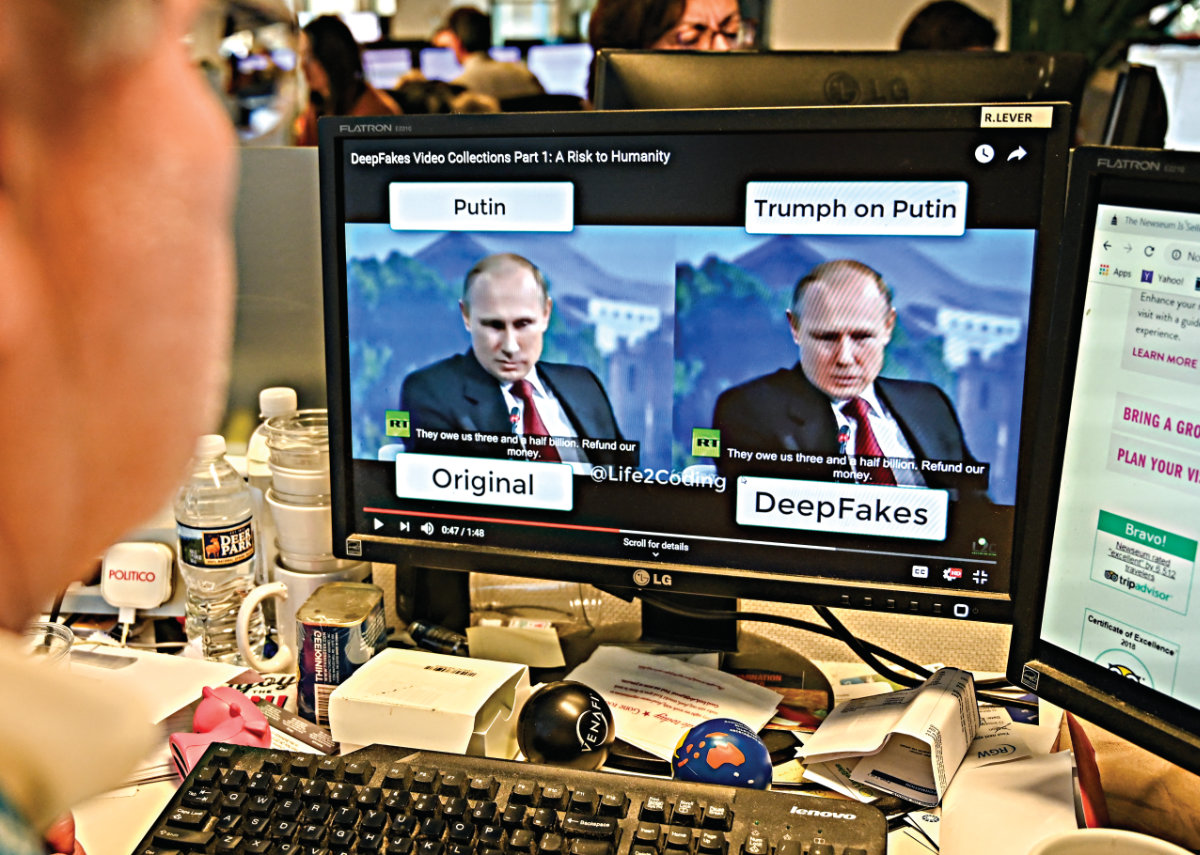
Crimes in the digital realm can be easily shared, repeated, and even sold, allowing criminal techniques to be marketed.
“If even a small fraction of visual evidence is proven to be convincing fakes, it becomes much easier to discredit genuine evidence, undermining criminal investigation and the credibility of political and social institutions that rely on trustworthy communications,” the report stated.
The UCL report goes on to note that awareness and changes in people’s behaviors toward the spread and creation of these videos might be the only effective line of defense.
“Social media platforms need to understand the threats and act on them. Unfortunately there is no trust in governments in our region to do the right thing; my assumption is that they will use this to restrict more speech and criminalize it, which will lead to more closure of civic spaces,” Najem said.
While so far many of the videos popping up on social media are fun — of politicians singing and dancing, say, or Nicholas Cage’s face on Wonder Woman’s body — things may take a sharper, darker turn soon.


