AS IT HAPPENED: Pope Francis arrives in Iraq

1 / 11
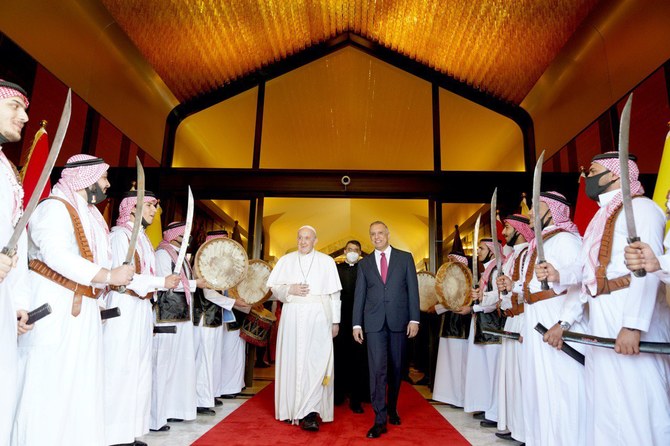
Pope Francis greeted by Iraq prime minister Mustafa Al-Kadhimi are greeted by traditional dancing shortly after the pontiff's arrival in Iraq. (@IraqiPMO)
2 / 11
Pope Francis and the Iraqi prime minister Mustafa Al-Kadhimi are greeted by traditional dancing shortly after the pontiff's arrival in Iraq. (@IraqiPMO)
3 / 11
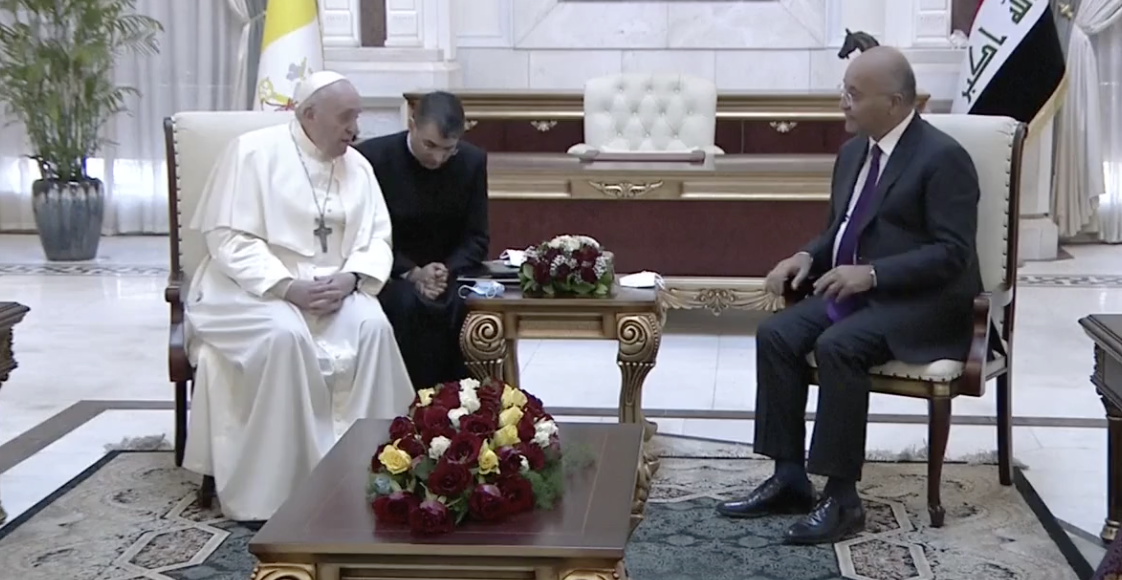
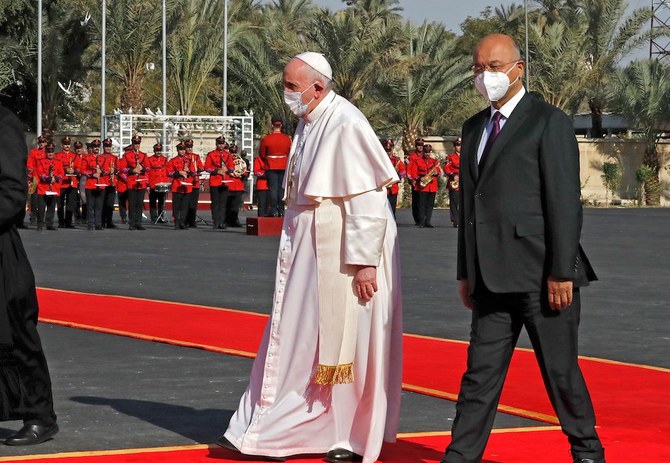
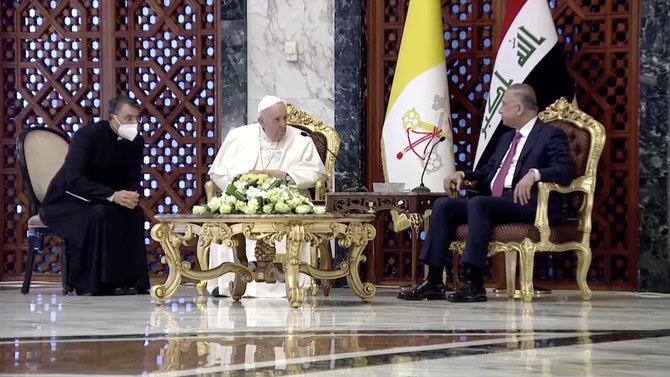
Pope Francis during an official welcome ceremony at the Presidential Palace in Baghdad, where he met with President Salih. (AFP)
4 / 11
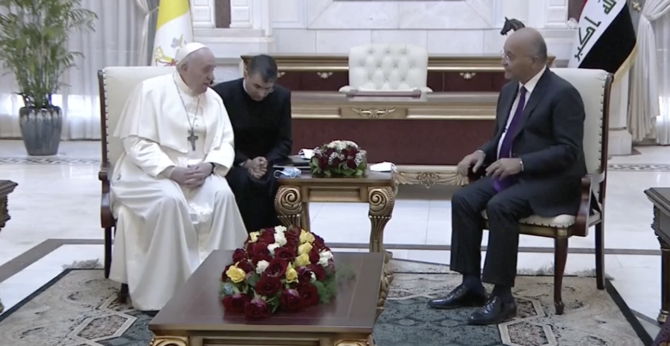
Pope Francis is in Iraq on Friday for the start of a historic trip to the war-battered country, defying security fears and the coronavirus pandemic. (Screenshot)
5 / 11
Pope Francis is in Iraq on Friday for the start of a historic trip to the war-battered country, defying security fears and the coronavirus pandemic. (Screenshot)
6 / 11
Pope Francis is in Iraq on Friday for the start of a historic trip to the war-battered country, defying security fears and the coronavirus pandemic. (Screenshot)
7 / 11
Pope Francis is in Iraq on Friday for the start of a historic trip to the war-battered country, defying security fears and the coronavirus pandemic. (Screenshot)
8 / 11
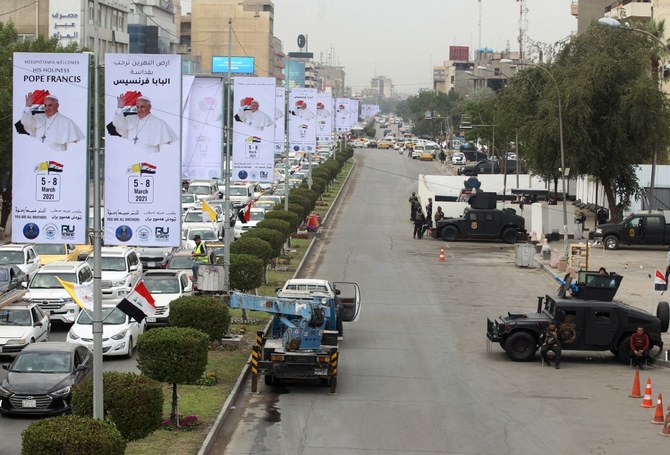
Heavy security has been implemented in the Iraqi capital of Baghdad for Pope Francis’s first visit to the country. (AFP)
9 / 11
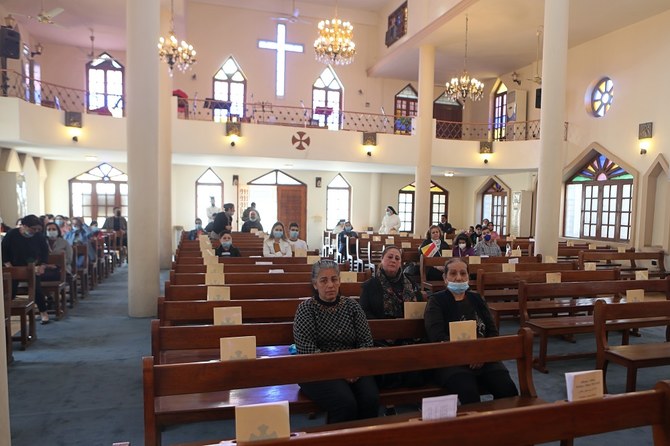
Christian families gather outside St. George Chaldean Church as they wait for the arrival of Pope Francis in Baghdad on March 5, 2021. (Reuters)
10 / 11
Iraqi Christians gather at the Church of the Virgin Mary before going to the airport to welcome Pope Francis in Baghdad on Friday, March 5, 2021. (AP)
11 / 11
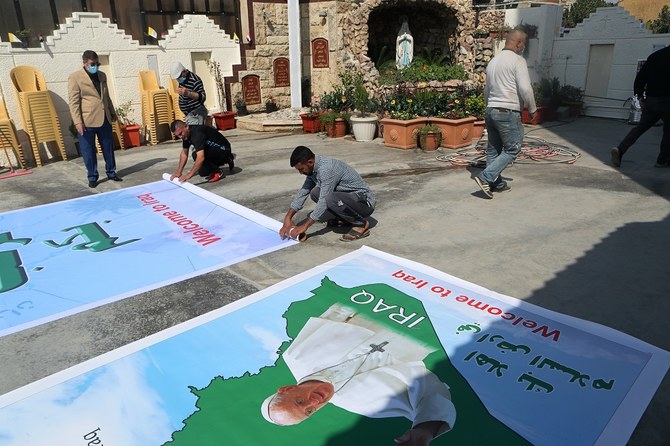
Iraqi Christians prepare posters welcoming Pope Francis to St. Joseph’s Chaldean Church in Baghdad on March 2, 2021. (AP)
Short Url
Updated 05 March 2021
Follow

AS IT HAPPENED: Pope Francis arrives in Iraq

  • Holy Father’s first public event will be with authorities, civil society and the diplomatic corps

DUBAI: Pope Francis called for an end to extremism and violence in his opening address Friday on the first-ever papal visit to Iraq, long scarred by war and now gripped by coronavirus.

The 84-year-old pontiff, who said he was making the first-ever papal visit to Iraq as a ‘pilgrim of peace,’ will also reach out to Shiite Muslims when he meets Iraq’s top cleric, Grand Ayatollah Ali Al-Sistani.

The Pope landed in the afternoon at Baghdad's International Airport, where he was greeted by Prime Minister Mustafa Al-Kadhimi, as well as groups showcasing Iraq's diverse folklore music and dance.

He then met with President Barham Saleh, who had extended the official invitation to the pontiff in 2019, as well as other government and religious figures.

“May there be an end to acts of violence and extremism, factions and intolerance!” he urged in the stirring address, his first after arriving in the country.

Follow live coverage of his first day itinerary below... (All times GMT)

16:30 - WATCH: Before the 2003 US invasion, there were an estimated 1 million Christians living in Iraq, but now their numbers are believed to be in the low thousands or even the hundreds. 

Rev. Nadhir Dako of Baghdad’s St. Joseph’s Cathedral, which the Pope will visit during his trip, explains in the video below why so many Christians continue to leave.


15:00 - That concludes the public engagement of the Pope on the first day of his trip.

On Saturday, Pope Francis will travel by plane to the cities of Najaf and Ur, where he will meet Grand Ayatollah Ali Al-Sistani, the spiritual leader of Iraq’s Shiites.

READ MORE

Go to Arab News' dedicated In Focus section on the Pope's visit to Iraq for coverage of the historic trip. Click here.
 

14:15 - During his flight from Rome to Baghdad, the Pope sent telegrams while flying over Palestine, Israel, and finally Jordan, to each of the respective heads of state.

Overflight Palestine

HIS EXCELLENCY MAHMOUD ABBAS - PRESIDENT OF THE STATE OF PALESTINE

AS I FLY OVER PALESTINIAN TERRITORY ON MY APOSTOLIC JOURNEY TO IRAQ, I EXTEND CORDIAL GREETINGS TO YOUR EXCELLENCY AND YOUR FELLOW CITIZENS, AND I PRAY THAT THE MOST HIGH GOD WILL BLESS ALL PALESTINIANS WITH PEACE AND WELL-BEING. FRANCISCUS PP.

Overflight Israel

HIS EXCELLENCY REUVEN RIVLIN - PRESIDENT OF THE STATE OF ISRAEL

ENTERING ISRAELI AIRSPACE ON MY APOSTOLIC JOURNEY TO IRAQ, I SEND WARM GREETINGS TO YOU AND THE PEOPLE OF THE NATION, PRAYING THAT ALMIGHTY GOD WILL BLESS ALL WITH HIS GIFTS OF HARMONY AND PEACE. FRANCISCUS PP.

Overflight Jordan

HIS MAJESTY ABDULLAH II - KING OF JORDAN

I OFFER CORDIAL GREETINGS TO YOUR MAJESTY, THE MEMBERS OF THE ROYAL FAMILY AND THE PEOPLE OF JORDAN AS I FLY OVER JORDANIAN AIRSPACE ON MY APOSTOLIC JOURNEY TO IRAQ. UPON THE ENTIRE NATION, I INVOKE THE ABUNDANT BLESSINGS OF THE MOST HIGH. FRANCISCUS PP. 

14:00 - Next, Pope Francis visits Our Lady of Salvation Syro-Catholic Cathedral in Bagdhad, where he will meet with worshippers, bishops & religious figures. Video below.

13:45 - WATCH - ICYMI: Pope Francis and the Iraqi prime minister Mustafa Al-Kadhimi are greeted by traditional dancing shortly after the pontiff's arrival in Iraq.


13:30 - Pope Francis' address at the Presidential Palace touches upon the need for Iraq's internal differences to be resolved and how its institutions fighting corruption must be strengthened.

13:00 - After a brief discussion, and exchange of symbolic gifts and a look at some of the artifacts of the Presidential Palace, Pope Francis and Salih now hold a short briefing.
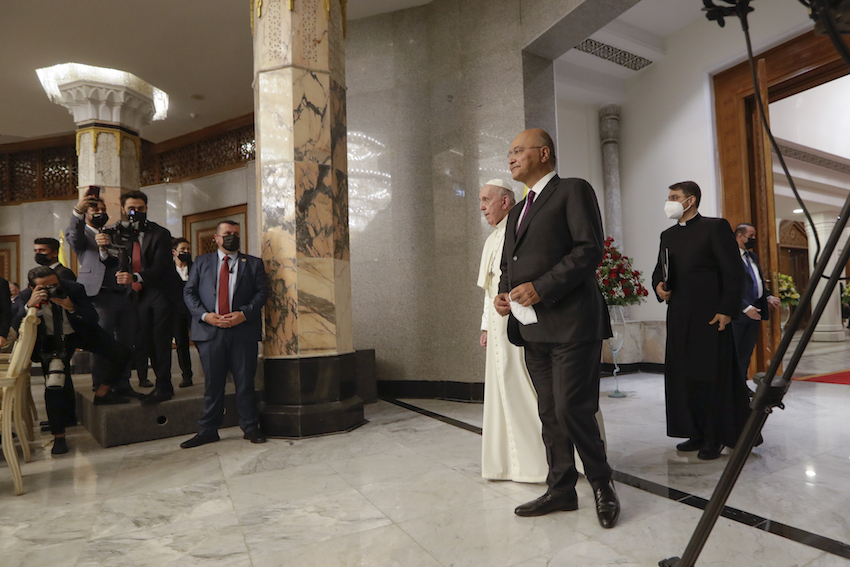
12:15 - President Barham Salih greets the Holy Father and, as a symbol of peace, doves are released into the Baghdad sky...
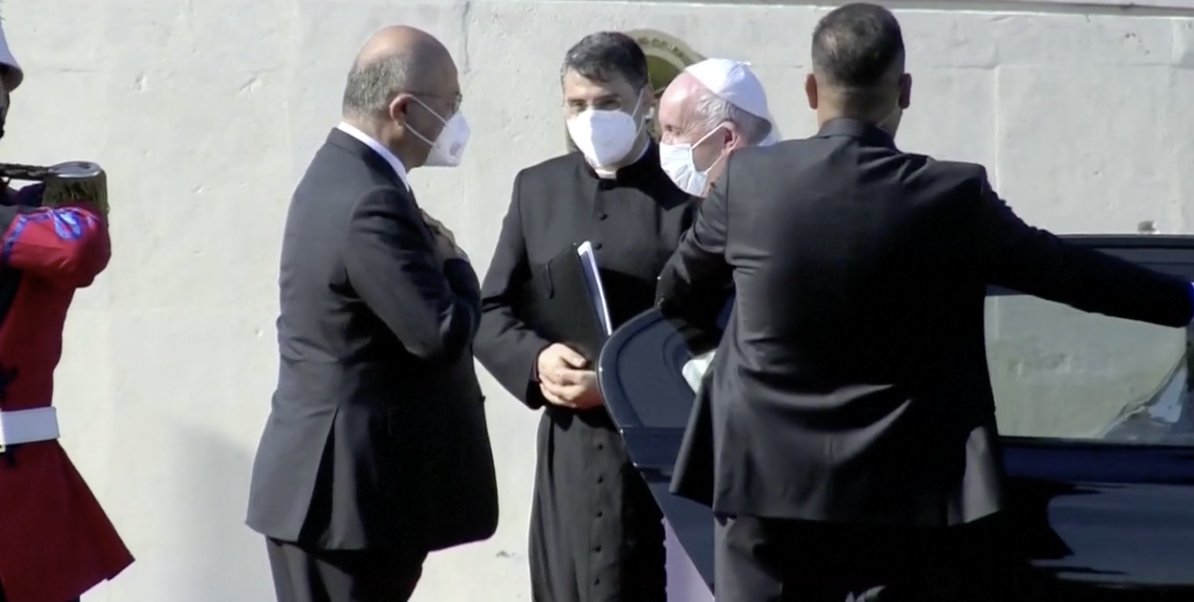
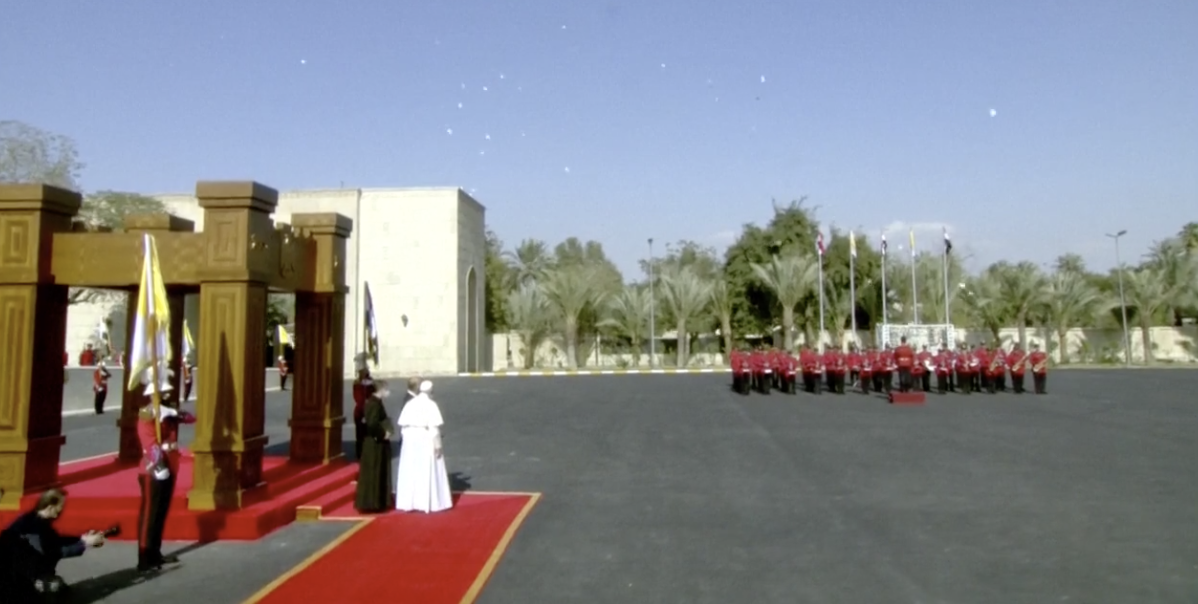
12:00 - Next on the Pope's agenda is an official welcome ceremony at the Presidential Palace in Baghdad, where he will meet with President Salih in the private office of the palace.

11:30 - Following a brief discussion with the Iraq prime minister, the Pope will head to the Presidential Palace for a reception with President Salih. On leaving the airport, the Pope was treated to traditional Iraqi dance.
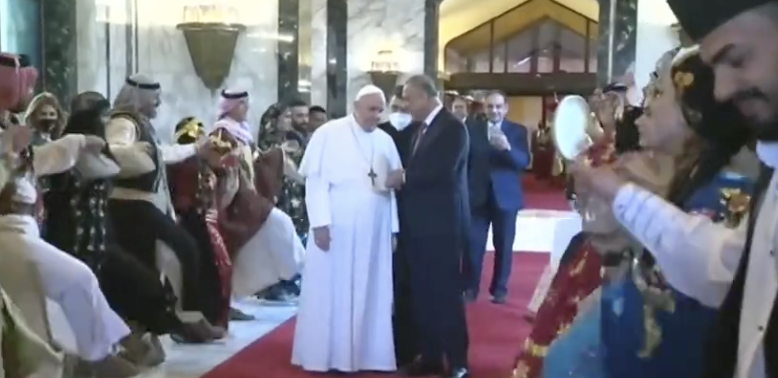
11:15 - Pope Francis and Al-Kadhimi now head into a VIP hall within the airport for an official reception and welcome.
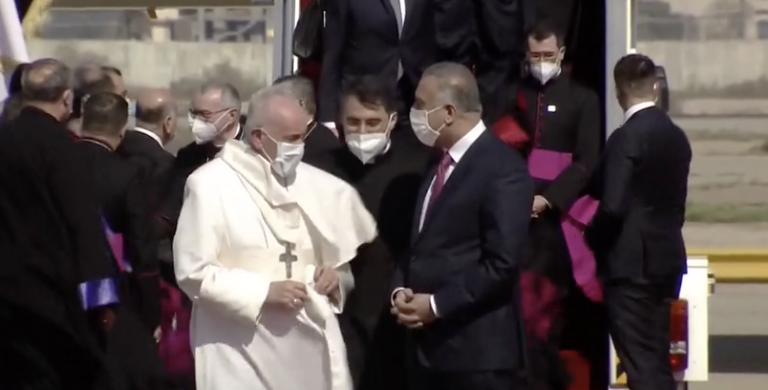
11:00 - The Pope touches down at Baghdad International Airport, where he will receive an official welcome and meet with Iraqi prime minister Al-Kadhimi.

09:45 - Here is what to expect during his four days of stay in Iraq:

Day 1: Baghdad

Upon arrival in Iraq, Pope Francis will meet privately with Prime Minister Mustafa Al-Kadhimi.

Then, following an official welcome ceremony at the Presidential Palace, Pope Francis will visit President Barham Salih. The Holy Father’s first public event will be with authorities, civil society and the diplomatic corps at 3:45 p.m. in the Presidential Palace.

Afterwards, he will travel to the Syriac-Catholic Cathedral of “Our Lady of Salvation” and meet with Bishops, priests, religious persons, seminarians and catechists.

READ: Massive security preparations in Iraq to protect Pope Francis during his four-day visit

Day 2: Najaf, Ur, Baghdad

On Saturday, Pope Francis will travel by plane to the cities of Najaf and Ur, before returning to Baghdad.

The Pope’s first event of the day is a courtesy visit in Najaf to Grand Ayatollah Ali Al-Sistani, the spiritual leader of Iraq’s Shiites.

He will then depart for Nasiriya to lead an interreligious meeting at the Plain of Ur.

The Pope will then return to Baghdad, where he will celebrate the Divine Liturgy at the Chaldean Cathedral of Saint Joseph.

WATCH: Preparations for Pope Francis’s Holy Mass at the Chaldean Cathedral of Saint Joseph, video below

READ: Pope Francis’ visit to give hope and comfort to Iraqis of all faiths

Day 3: Irbil, Mosul, Qaraqosh

On Sunday, his third day in Iraq, Pope Francis will travel to Irbil, Mosul and Qaraqosh.

He is due to be welcomed upon his arrival in Irbil by the President of the autonomous region of Iraqi Kurdistan and the civil authorities of the region.

He will then meet with Nechirvan Barzani and Masrour Barzani, respectively President and Prime Minister of the autonomous region, privately, before departing by helicopter for Mosul.

Opinion

This section contains relevant reference points, placed in (Opinion field)

In Mosul, Pope Francis will lead a prayer of suffrage for war victims at Hosh Al-Bieaa.

He will then travel to Qaraqosh where he will visit the faithful at the Church of the Immaculate Conception.

Afterwards, he will return to Irbil where he will celebrate Holy Mass at the ‘Franso Hariri’ stadium. The Pope will then travel back to Baghdad after the Holy Mass.

WATCH: Iraqi Christians in California watch Pope Francis’s visit from afar, video below

READ: Papal visit brings joy and sadness for Iraq’s dwindling Christian community

Day 4: Baghdad, Rome

Pope Francis will depart from Baghdad International Airport following a brief farewell ceremony. He is expected to arrive at Rome’s Ciampino Airport at late evening.


Aoun hails disarmament progress: ‘Lebanon achieved in 1 year what it had not seen in 4 decades’

Updated 20 January 2026
Follow

Aoun hails disarmament progress: ‘Lebanon achieved in 1 year what it had not seen in 4 decades’

  • President Joseph Aoun highlights achievements during first year in office despite many challenges
  • Army announced this month it had successfully disarmed Hezbollah in the south of the country

BEIRUT: Lebanese President Joseph Aoun confirmed on Tuesday that the country’s armed forces “are now the sole operational authority south of the Litani River, despite doubts, accusations of treason, insults and slander.”

Speaking at the Presidential Palace in Baabda during a traditional New Year meeting with members of the diplomatic corps and the heads of international missions, he highlighted what he viewed as Lebanon’s achievements since he took office on Jan. 9, 2025.

The government’s approval in August and September last year of plans to bring all weapons in the country under state control, and ensure the authority of the state across all Lebanese territory using its own forces, was “no minor detail,” he said.

“Lebanon achieved in one year what it had not seen in four decades,” he added, as he recalled taking office in a “deeply wounded state” that has suffered decades of institutional paralysis and economic crises.

Despite campaigns of distortion, intimidation and misinformation, and Israel’s failure to abide by the November 2024 ceasefire agreement, the changed reality on the ground over the past 12 months speaks for itself, he said.

“The truth is what you see, not what you hear,” Aoun said, pointing out that “not a single bullet was fired from Lebanon during my first year in office, except for two specific incidents recorded last March, the perpetrators of which were swiftly arrested by official authorities.”

The army carried out “extensive operations” to clear large areas of the country of illegal weapons regardless of who controlled them, the president continued, in line with the terms of the Nov. 27 ceasefire agreement with Israel, which he described as “an accord Lebanon respects and that was unanimously endorsed by the country’s political forces.”

These efforts reflected a determination to spare the country a return to the “suicidal conflicts that have come at a heavy cost in the past,” he added.

Aoun stressed his commitment during the second year of his presidency to restoring control of all Lebanese territory to the exclusive authority of the state, securing the release of prisoners, and the reconstruction of war-ravaged areas.

He said that southern Lebanon, like all of the country’s international borders, would fall under the sole control of the Lebanese Armed Forces, putting a definitive end to any attempts “to draw us into the conflicts of others, even as those same parties pursue dialogue, negotiations and compromises in pursuit of their own national interests.”

The Lebanese Army Command announced early this month the completion of the first phase of its plans to disarm nonstate groups south of the Litani River. The government is now awaiting an army report next month detailing its next steps.

Gen. Rodolphe Haykal, the army’s commander, has said that the plan “does not have a specific time frame for completing this phase, which encompasses all Lebanese regions.”

A Lebanese official confirmed to Arab News that the army now has exclusive control of territory south of the Litani River, and no other armed forces or military factions have a presence there.

Aoun’s affirmation of his determination to “stay on course” came two days after Hezbollah leader Naim Qassem gave a sharply worded speech that delivered both implicit and explicit rebukes aimed at the president and Foreign Minister Youssef Raji.

His criticisms focused on their efforts to take control of weapons north of the Litani River, following a declaration by Aoun that “the time for arms is over,” a position that Hezbollah vehemently rejects in what appears to be an attempt to derail the gradual, phased disarmament strategy embraced by the Lebanese government and the international community.

Progress in the efforts of the military to take control of all weapons in the country hinges on securing vital logistical support for the country’s armed forces, a condition tied to the International Conference for Supporting the Lebanese Army and Internal Security Forces, which is due to take place on March 5 in Paris.

Aoun told the diplomats that the conference is the result of efforts led by the international Quintet Committee supporting Lebanon: the US, Saudi Arabia, France, Qatar and Egypt.

Archbishop Paolo Borgia, the papal ambassador to Lebanon, speaking in his role as dean of the diplomatic corps, said that the current crisis in the country serves “as a harsh test” that must remind political leaders of their duty to prevent history from repeating itself.

He called for respect for all electoral processes as a vital part of any nation’s democratic life, and for “genuine peace without weapons, one that can disarm enemies through the convincing power of goodness and the strength of meeting and dialogue.”

He added: “Those holding the highest public offices must give special attention to rebuilding political relationships peacefully, both nationally and globally, a process grounded in mutual trust, honest negotiations and faithful adherence to commitments made.”