

Fresh unrest in Lebanon as dollar exchange rate hits record high

1 / 3
Demonstrators set tires aflame at the Martyrs’ Square in Beirut on Tuesday during a protest against deteriorating economic and social conditions. (AFP)
2 / 3
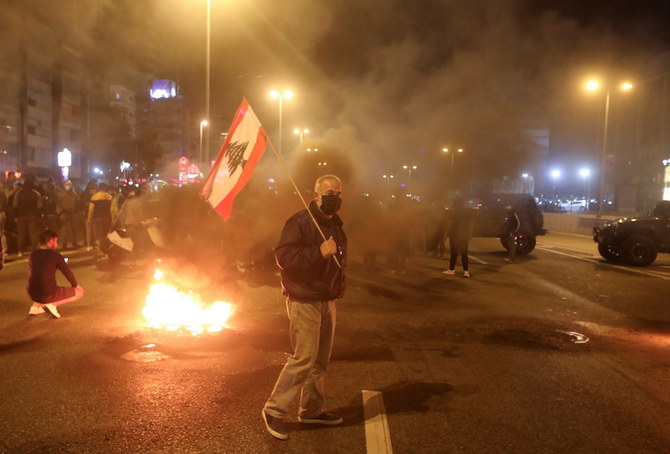
A demonstrator holds the Lebanese flag during a protest against the fall in Lebanese pound currency and mounting economic hardship, in Jal El-Dib, Lebanon March 2, 2021. (Reuters)
3 / 3
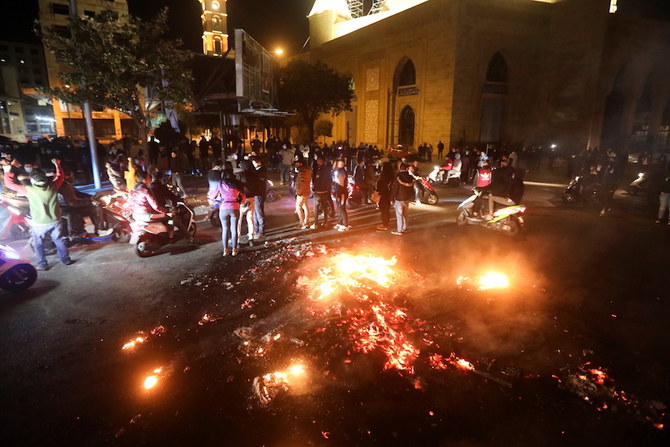
Demonstrators gather and ride on motorbikes during a protest against the fall in Lebanese pound currency and mounting economic hardship, in Beirut, Lebanon March 2, 2021. (Reuters)
Short Url
Updated 03 March 2021
Follow

Fresh unrest in Lebanon as dollar exchange rate hits record high

  • A number of politicians have warned of escalating chaos if the stalemate in efforts to form a new government is not broken, and if the reforms are not implemented
  • Thousand of protesters once again take to the streets across the country as the rate tops 10,000 Lebanese pounds

BEIRUT: Thousands of people once again took to the streets across Lebanon on Tuesday as the dollar exchange rate hit a record high of more than 10,000 Lebanese pounds. Currency exchanges closed as protesters gathered and blocked roads in Beirut and many other parts of the country.

Demonstrators returned to Martyrs’ Square in the heart of the capital where they expressed their anger at the devastating effect the soaring exchange rate is having on daily life, chanting for another revolution and banging on metal sheets.
Roads there and in other Beirut neighborhoods were blocked with rocks, as protesters complained that the situation is intolerable and the state is collapsing while politicians do nothing. Their chants soon turned into insults directed at the ruling authority.
Protests also broke out on the outskirts of the southern suburbs of Beirut, where the Old Airport Road near the Great Prophet Hospital was blocked in both directions.
They reached Dora and Jounieh, and all the way to Tripoli on the northern coast. They spread south to Choueifat, Khalde, Jiyeh, Sidon and the Zahrani highway. The Qaaqaait Al-Jisr road in Nabatieh was also blocked.
There were also demonstrations in the city of Tyre and in Marjayoun, and protesters in Souk El-Khan in Hasbaya district blocked the road linking the Bekaa Valley to the south.
The protests spread east to Bhamdoun in Mount Lebanon, Taalabaya, Chtoura in the Bekaa Valley, and Baalbek, where the Rayak to Baalbek road was blocked. Tires were burned in some places.
The protesters called for a revival of the Oct. 17, 2019 revolution, when people from all regions took to the streets in protests sparked by government plans to impose a tax on the use of messaging service WhatsApp.
Footage of Tuesday’s demonstrations was broadcast live. It showed protesters calling on people who had remained in their homes to join them on the streets, telling them: “We will starve, so what are you waiting for?”
As the Lebanese Armed Forces worked to reopen blocked roads, there were confronted by protesters who chanted: “We are protesting for you, too.”
One of the protesters said: “We can no longer put bread on the table.”
The latest rise in the dollar exchange rate has decreased the minimum monthly wage in Lebanon to about $67.
The scarcity of usable reserves at the Banque du Liban, the Lebanese central bank, has forced it to strictly ration the supply of dollars, for example by suspending the financing of some food subsidies and the payment of bills for some types of medical supplies.
The Banque du Liban also has a complex procedure for securing financing in dollars for imports, which has prompted importers to turn to the parallel market, increasing the already high demand for dollars.
A number of politicians have warned of escalating chaos if the stalemate in efforts to form a new government is not broken, and if the reforms required by the international community to unlock financial aid for Lebanon are not implemented.
The Free Patriotic Movement (FPM) refuses to form a government without a blocking third in favor of the president under the slogan of “restoring the rights of Christians and the powers of the president of the Republic.”
Meanwhile, Prime Minister-designate Saad Hariri insists on a government of 18 ministers and no blocking third.
Parliament Speaker Nabih Berri and the leader of the Progressive Socialist Party, Walid Jumblatt, agree with this. Hezbollah has not objected to this form of government but has requested an understanding be reached with its ally, the FPM.


Trump says Iran government change ‘best thing that could happen’

Updated 14 February 2026
Follow

Trump says Iran government change ‘best thing that could happen’

  • US president's comments come after he ordered a second aircraft carrier to head to the Middle East

FORT BRAGG, United States: US President Donald Trump said a change of government in Iran would be the “best thing that could happen,” as he ordered a second aircraft carrier to head to the Middle East.
“Seems like that would be the best thing that could happen,” Trump told reporters at the Fort Bragg military base in North Carolina when a journalist asked if he wanted “regime change” in Iran.
“For 47 years, they’ve been talking and talking and talking. In the meantime, we’ve lost a lot of lives while they talk,” he told reporters.

Trump declined to say who he would want to take over in Iran from supreme leader Ayatollah Ali Khamenei, but he added that “there are people.”
He has previously backed off full-throated calls for a change of government in Iran, warning that it could cause chaos, although he has made threats toward Khamenei in the past.
Speaking earlier at the White House, Trump said that the USS Gerald R. Ford — the world’s largest warship — would be “leaving very soon” for the Middle East to up the pressure on Iran.
“In case we don’t make a deal, we’ll need it,” Trump said.
The giant vessel is currently in the Caribbean following the US overthrow of Venezuela’s Nicolas Maduro. Another carrier, the USS Abraham Lincoln, is one of 12 US ships already in the Middle East.

When Iran began its crackdown on protests last month — which rights groups say killed thousands — Trump initially said that the United States was “locked and loaded” to help demonstrators.
But he has recently focused his military threats on Tehran’s nuclear program, which US forces struck last July during Israel’s unprecedented 12-day war with Iran.
The protests have subsided for now but US-based Reza Pahlavi, the son of Iran’s last shah, urged international intervention to support the Iranian people.
“We are asking for a humanitarian intervention to prevent more innocent lives being killed in the process,” he told the Munich Security Conference.
It followed a call by the opposition leader, who has not returned to his country since before the revolution, for Iranians at home and abroad to continue demonstrations this weekend.
Iran and the United States, who have had no diplomatic relations since shortly after the revolution, held talks on the nuclear issue last week in Oman. No dates have been set for new talks yet.
The West fears the program is aimed at making a bomb, which Tehran denies.
The head of the UN nuclear watchdog, Rafael Grossi, said Friday that reaching an accord with Iran on inspections of its processing facilities was possible but “terribly difficult.”

Trump said after talks with Israeli Prime Minister Benjamin Netanyahu earlier this week that he wanted to continue talks with Iran, defying pressure from his key ally for a tougher stance.
The Israeli prime minister himself expressed skepticism at the quality of any agreement if it didn’t also cover Iran’s ballistic missiles and support for regional proxies.
According to the US-based Human Rights Activists News Agency, 7,008 people, mostly protesters, were killed in the recent crackdown, although rights groups warn the toll is likely far higher.
More than 53,000 people have also been arrested, it added.
The Norway-based Iran Human Rights (IHR) NGO said “hundreds” of people were facing charges linked to the protests that could see them sentenced to death.
Figures working within the Iranian system have also been arrested, with three politicians detained this week from the so-called reformist wing of Iranian politics supportive of President Masoud Pezeshkian.
The three — Azar Mansouri, Javad Emam and Ebrahim Asgharzadeh — were released on bail Thursday and Friday, their lawyer Hojjat Kermani told the ISNA news agency.