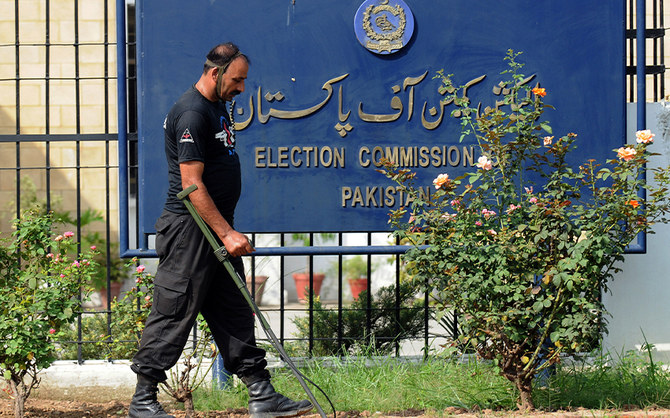
ISLAMABAD: A day after the Pakistani Supreme Court ruled that upcoming senate elections would continue to be held through a secret ballot as per the constitution, the election commission said on Tuesday polls on March 3 would be held “as per past practice.”
The court’s ruling on Monday came in response to a presidential reference filed on December 23, 2020 seeking the court’s opinion on whether voting in senate elections could be held through an open ballot.
The government of Prime Minister Imran Khan has argued that open balloting would introduce transparency into a voting process that has long been plagued by irregularities, with national and provincial lawmakers accused of selling their votes.
Leaders of an 11-party opposition alliance, the Pakistan Democratic Movement (PDM), have opposed the government’s move to try to hold senate elections through an open ballot, and one of the major parties in the alliance, the Jamiat-e-Ulema Islam, had filed a petition in the supreme court against a presidential election amendment ordinance.
“Due to time constraint, ensuing Senate Election scheduled for 3rd March, 2021, will be conducted as provided in the Constitution and Law as per past practice,” the election commission said in a statement.
In it’s ruling on Monday, the court had directed the election commission to use technology to check against corrupt practices in the election and “to ensure that the election is conducted honestly, justly, fairly, and in accordance with law and that corrupt practices are guarded against.”
Attorney General Khalid Javed Khan said it was now up to the election commission to select what method to use in the upcoming elections to check corruption.
“The ECP is bound to investigate and trace the ballot to see whether any corrupt practice occurred,” he said in a statement after the verdict, adding that the election commission was “constitutionally bound” to follow the opinion of the Supreme Court and implement it without any amendments to existing rules or legislation.
In its statement on Tuesday, the election commission said it had decided to constitute a three-member committee to gather input on the use of technology in senate elections, saying it would prepare recommendations based on the input within four weeks.
Senate elections are scheduled to be held on March 3 for 48 seats. Each member of the Upper House of the Parliament is elected for a six-year term. Half of the senate members retire after every three years and new one are elected. The house has equal representation from all four provinces.


![]()

Election Commission of Pakistan rules senate polls to be held ‘as per past practice’
Short Url
https://arab.news/j8ebx
Election Commission of Pakistan rules senate polls to be held ‘as per past practice’
- On Monday supreme court said upcoming senate elections would continue to be held through a secret ballot as per the constitution
- Election commission says forming three-member committee to come up with recommendations on how to use technology to check against corruption in elections
Latest updates





© 2026 SAUDI RESEARCH & PUBLISHING COMPANY, All Rights Reserved And subject to Terms of Use Agreement.