


GAZA CITY: Mohammed Rashwan is worried for his family of 10 after a decision from the UN Relief and Works Agency (UNRWA) to reduce aid to Palestinian refugees in the Gaza Strip.
He was diagnosed with cancer about seven years ago and relies on the relief aid provided by the agency.
“A single basket of aid is not enough for us for a month, but it used to fill part of our needs, in addition to relief aid from local institutions,” he told Arab News.
He qualified as being a member of the poorest group of beneficiaries and so received double aid, known as the “Yellow Coupon.”
But on Feb. 20 UNRWA said it was canceling this coupon, which helps 770,000 Palestinian refugees in the Gaza Strip. The strip is home to 2 million Palestinians.
Rashwan described the decision as “unjust” because it did not take different living conditions into consideration.
Under the new system, he will lose about half the aid he used to receive every three months, and there will instead be a unified food basket system for all beneficiaries.
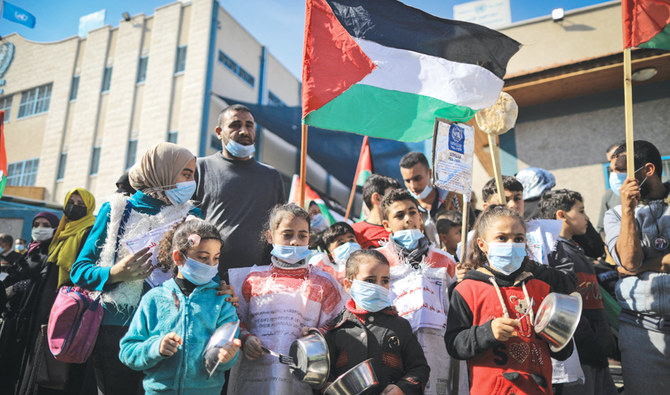
Last Sunday he, along with other angry refugees, protested the coupon’s cancellation by closing UNRWA supply centers.
A meeting held last Monday by the Joint Committee for Refugees with the director of UNRWA’s operations in Gaza, Matthias Schmale, failed to dissuade the agency from its decision.
FASTFACT
Cancer victim Mohammed Rashwan describes the UN Relief and Works Agency’s decision as ‘unjust’ because it does not take different living conditions into consideration.
Committee member Bakr Abu Safiya said there was agreement between different refugee representative bodies about challenging the UNRWA decision, with the agency being given a Monday deadline to pledge a written letter rescinding its decision.
Abu Safiya added that it was too early to talk about options if UNRWA stuck to its guns, but stressed there would be “a program of action and we will not violate the rights of refugees, and the matter may reach the point of demanding the firing of Schmale.”
Schmale, who was appointed to the post in Oct. 2017, has not enjoyed a good relationship with refugee representatives in Gaza.
Abu Safiya described Schmale as “elusive” since taking office and said he had made decisions that were “harmful to refugees, such as reducing services, stopping employment, and fabricating a crisis of employees’ salaries.”
The meeting with Schmale was “stormy and did not produce a result,” he said.
“We will wait for an official position until Monday, after which the response will be considered.”
UNRWA was established in 1949 by a UN General Assembly resolution. It provides services in various sectors to about 5.6 million Palestinian refugees registered with it in its five fields of operations: Jordan, Lebanon, Syria, the West Bank, including East Jerusalem, and the Gaza Strip.
UNRWA media adviser, Adnan Abu Hasna, said the agency would adhere to its decision and not back down.
“UNRWA, in its new vision for the distribution of foodstuffs, wants to produce a fairer and more transparent system for new groups that will be included in the base of beneficiaries of food aid.”
According to Abu Hasna, the new system would benefit tens of thousands more refugees, with an increase of 10 kilos of flour per person.
But Abu Safiya described the new system as a “crime against refugees” and accused the agency of manipulating the numbers of beneficiaries.


