


LONDON: It must be strange for artists to hear people theorizing about their art. Talking to Tammam Azzam, you get the sense that, while he is happy to engage and listen, the Syrian artist is not particularly interested in adding layers of rumination to what he has already expressed on canvas.
“Sometimes even the artist cannot realize the message because there is no message — just a visual language,” he says. “Even I don’t know exactly what it means.”
Part of the reason that people want to talk about the ‘meaning’ or ‘message’ in Azzam’s work is that his images are so powerful. When you look at his photomontage “Bon Voyage” — showing a shattered Syrian apartment block suspended by balloons in front of the burning Twin Towers — you feel a flood of mixed emotions. Azzam explains the thinking behind the piece: “This image is about the evil and imbalance in our world. Every life is important, whether American or Syrian, and it is right that 9/11 is commemorated every year. But who is commemorating the Syrian casualties?”
Part of the reason that people want to talk about the ‘meaning’ or ‘message’ in Azzam’s work is that his images are so powerful. (SUPPLIED)
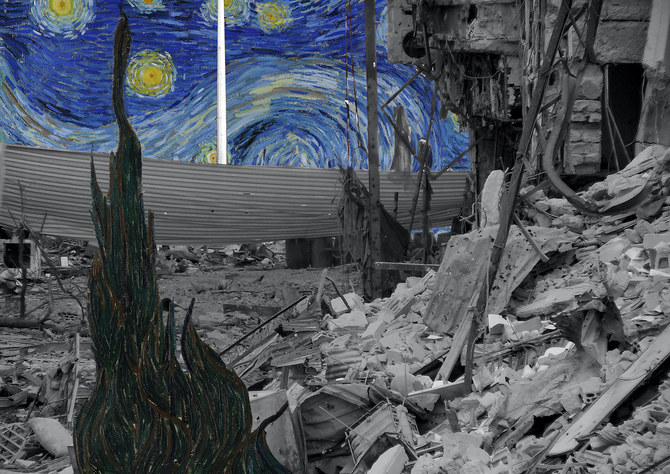
Azzam’s 2013 “Syrian Museum” photomontage series, in which he inserted famous masterpieces into scenes of destruction from the ongoing civil war in his country, garnered international attention. Asked why he juxtaposed Vincent van Gogh’s “The Starry Night” with the mangled wreckage of a bombed-out building, he answers: “Besides my love and admiration for Van Gogh, I chose to show his night sky — full of energy and movement — to make a sharp contrast between beauty and destruction.”
Another striking image from the same series shows Paul Gauguin’s “Tahitian Women on the Beach” transplanted into an arid landscape with a UNHCR refugee tent in the background. “This came from seeing women around the camps just sitting and waiting — actually for nothing,” he says. “Gauguin’s women were sitting and contemplating and I just put them in a different location, situation and atmosphere.”
Much of the global attention was focused on “Freedom Graffiti,” which superimposed Gustav Klimt’s “The Kiss” onto a ruined apartment block. It was the final image in the series and Azzam was taken aback by the publicity it attracted.

160x240 cm, paper collage on canvas, 2019 (Supplied)
“It’s strange, because as an artist I was just creating my work. I don’t know the secret behind that,” he says. “I spent a year working on this project and after the Klimt I felt that there was no need to go further,” he said. “I am always questioning myself: ‘How long am I going to use this technique and why?’”
Azzam studied fine art at Damascus University, specializing in oil painting. And after graduating, he went into graphic design. The combination of those two disciplines clearly informs his work, and he mentions the German-based Syrian artist Marwan Kassab Pashi — whose workshop he attended at university — as a major influence.
In 2011, Azzam was forced to flee his country. He was assisted by Ayyam Gallery, which has helped him and other artists start new lives in Dubai and Beirut. For Azzam, the pain of leaving was amplified by the loss of his studio and materials, on top of the cultural shift.

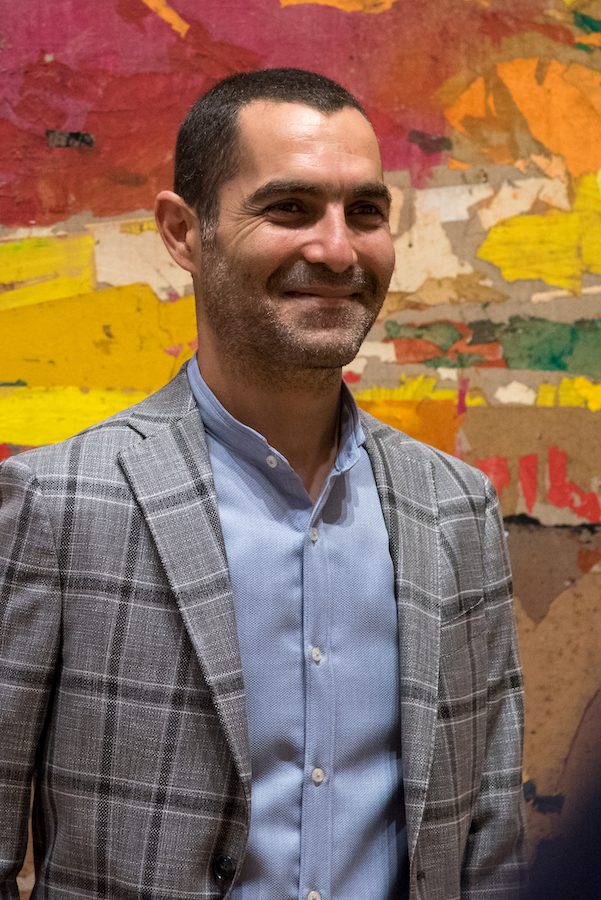
The Syrian artist is not particularly interested in adding layers of rumination to what he has already expressed on canvas. (Supplied)
“It took me three years to adjust to living in Dubai. It’s another system and mentality. Everything was different. And very expensive. In Damascus I had my studio and my materials. In Dubai I felt everything was lost; I couldn’t go anymore to the old souk where I used to get my materials,” he says. “Before Dubai I never thought about creating digital art, but because I was a graphic designer for 10 years in Syria, that helped me make the shift.”
After five years in Dubai, he moved to Germany in 2016 taking up a residency at the Hanse Institute for Advanced Studies in Delmenhorst. Once again, he found himself grappling with the challenges of adapting to a new environment, culture and language. In 2018, he moved to Berlin where he now lives. His family is scattered due to the war.
“Like so many Syrian families, we are dispersed around the world,” he says. “It’s sad, but it’s nothing compared to what’s happening to people still in the country and unable to leave. My parents are still in the village where my father, a writer, has his library. He is still writing. They are not in a conflict area, but daily life is difficult with just a few hours of electricity each day and no gas for heating.”

His next show is at Berlin’s Kornfeld gallery in April and that is the focus of Azzam’s carefully structured days at the moment. (Supplied)
His parents, he says, were always supportive of his desire to be an artist. “I was lucky,” he says. “It was my dream from a young age. To be an artist is an endless dream.”
In Germany, his focus recently has been on collage. “It was a new step for me — a big challenge to use a new medium,” he says. Even in this new medium, however, the message remains consistent. One recent work is a representation of a building with its façade blown out, revealing glimpses of wallpaper, painted walls, and fabrics, all exposed to the elements. “I saw so many building like this,” he says. “Totally destroyed with interiors that used to be full of life and color.”
His next show is at Berlin’s Kornfeld gallery in April and that is the focus of Azzam’s carefully structured days at the moment.
“I work every day, alone. It is very important to me to work otherwise I can’t do anything,” he says. “I feel optimistic even with all the bad daily news. We will find good things alongside the bad.”


