Gunmen kidnap 300 schoolgirls in increasingly lawless northwest Nigeria

Sign post of the Government Girls Junior Secondary School in Jangebe, Nigeria, which was attacked by gunmen on Feb. 25, 2021. (AP Photo/ Ibrahim Mansur)
Short Url
Updated 27 February 2021
Follow

Gunmen kidnap 300 schoolgirls in increasingly lawless northwest Nigeria

  • School abduction is Nigeria’s third since December
  • Kidnappings fueled by government ransoms, say officials

KANO, Nigeria: An operation to rescue more than 300 girls kidnapped in Nigeria had failed to pinpoint their location by late on Friday, almost 24 hours after gunmen seized them in a raid on their school.
The raid in Zamfara state, where the governor ordered all boarding schools to close immediately, was the second such kidnapping in little over a week in the country’s northwest, a region increasingly targeted by militants and criminal gangs.
Zamfara police said they had begun search-and-rescue operations with the army to find the “bandits” who took the 317 girls from the Government Girls Science Secondary School in the town of Jangebe.
“There’s information that they were moved to a neighboring forest, and we are tracking and exercising caution,” Zamfara police commissioner Abutu Yaro told a news conference.
All the abductees remained at large, but the parent of one of them, Mohammed Usman Jangebe, said seven of their schoolmates had resurfaced after escaping the raiders by hiding in gutters.
The assailants stormed in at around 1 a.m., firing sporadically, said Zamfara’s information commissioner, Sulaiman Tanau Anka.
“Information available to me said they came with vehicles and moved the students. They also moved some on foot,” he told Reuters.
By late Friday, there had been no claim of responsibility for the raid.
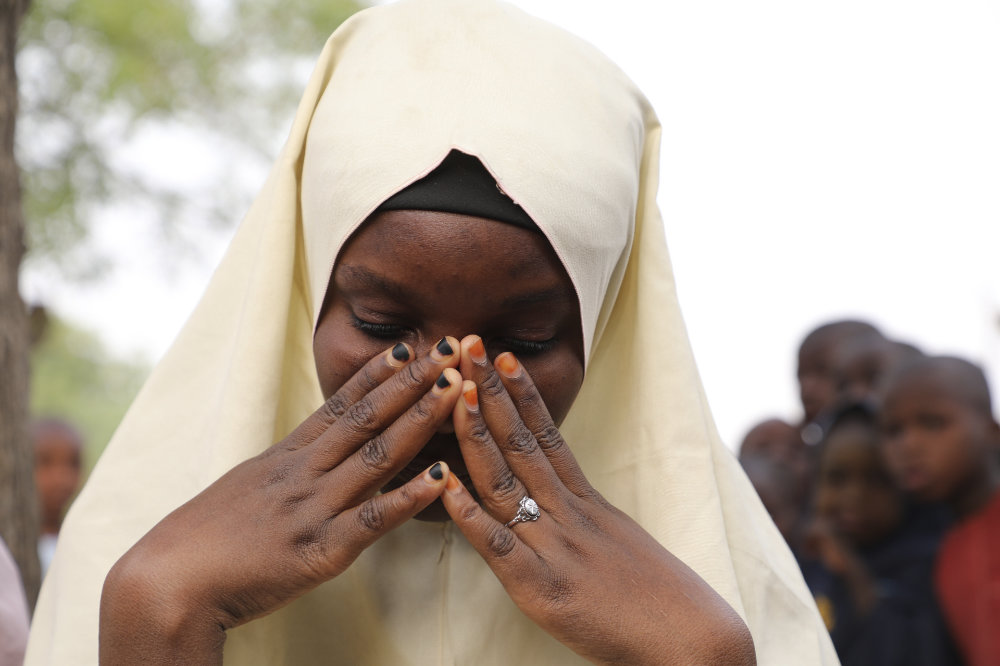


One of the students of a boarding school in Jangebe, Nigeria, was lucky enough to have missed by kidnappers who raided a secondary school on Feb. 26, 2021.  (AP Photo/ Ibrahim Mansur) 

School kidnappings were first carried out by jihadist groups Boko Haram and Islamic State West Africa Province but the tactic has now been adopted by other militants whose agenda is unclear.
They have become endemic around the increasingly lawless north, to the anguish of families and frustration of Nigeria’s government and armed forces. Friday’s was the third such incident since December.
The rise in abductions is fueled in part by sizeable government payoffs in exchange for child hostages, catalizing a broader breakdown of security in the north, officials have said, speaking on condition of anonymity.
The government denies making such payouts, and President Muhammadu Buhari reiterated on Friday that it would will not succumb to blackmail.
In a statement isued late on Friday, he also appealed to state administrations not to reward bandits with money or vehicles.

Rage and frustration
Jangebe town seethed with anger over the abduction, said a government official who was part of the delegation to the community.
Young men hurled rocks at journalists driving through the town, injuring a cameraman, the official said, speaking on condition of anonymity.
“People mobilized to block security operatives, journalists and government officials from getting access to the main town,” he said.
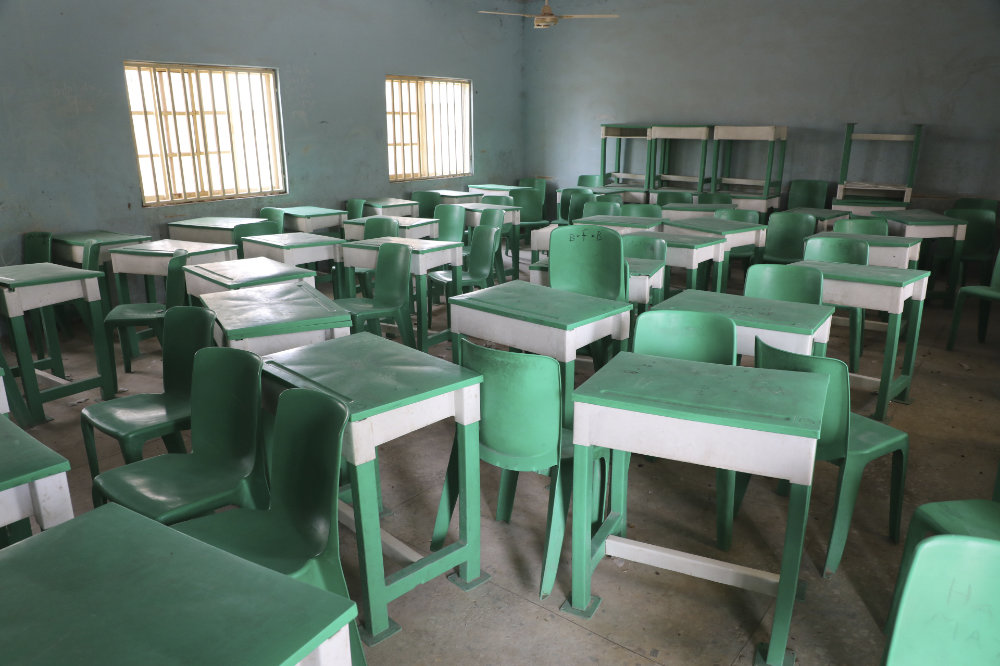


Empty classroom at a girls school in Jangebe, Nigeria, where gunmen abducted 317 girls on Feb. 25, 2021. (AP Photo/ Ibrahim Mansur) 

Parents also had no faith in authorities to return their kidnapped girls, said Mohammed Usman Jangebe told Reuters by phone.
“We are going to rescue our children, since the government isn’t ready to give them protection,” he said.
“All of us that have had our children abducted have agreed to follow them into the forest. We will not listen to anyone now until we rescue our children.”

Military shakeup
Buhari replaced his long-standing military chiefs this month amid the worsening violence.
Last week, unidentified gunmen kidnapped 42 people including 27 students, and killed one pupil, in an overnight attack on a boarding school in the north-central state of Niger. The hostages are yet to be released.
In December, dozens of gunmen abducted 344 schoolboys in northwest Katsina state. They were freed after six days but the government denied paying a ransom.
Islamic State’s West Africa branch in 2018 kidnapped more than 100 schoolgirls in northeast Nigeria, all but one of whom — the only Christian — were released. A ransom was paid, according to the United Nations.
Perhaps the most notorious kidnapping in recent years was when Boko Haram militants abducted 276 schoolgirls from Chibok in Borno state in April 2014. The incident drew widespread global attention, with then US first lady Michelle Obama among the prominent figures calling for their return.
Many have been found or rescued by the army, or freed years later after negotiations between the government and Boko Haram, according to sources, but 100 are still missing.
Ikemesit Effiong, head of research at Lagos-based risk consultancy SBM Intelligence, said many northern governors were keen to pay to avoid protracted hostage situations attracting international outrage, which in turn gave an incentive for more abductions.
“When you have these mass abductions now and you see victims are released relatively quickly, unlike Chibok, the one thing that has changed is money,” Effiong said.


Trump downplays importance of Russia reportedly sharing intel with Iran to help it hit US targets

Updated 5 sec ago
Follow

Trump downplays importance of Russia reportedly sharing intel with Iran to help it hit US targets

  • Critics charge that Trump was giving Russia a break that will provide Moscow with badly needed revenue as it looks to keep funding its war machine
  • Ukraine, in the four years since it was invaded by Russia, has received US intelligence to help defend against incoming missiles from Russia as well as to help Kyiv hit certain Russian targets

DORAL, Florida: President Donald Trump said Saturday that it was inconsequential if Russia has provided Iran with information to help Tehran target US military personnel and assets in the Middle East as the week-old war rages.
The president dismissed the import of such information-sharing after he attended the dignified transfer for six Army reservists who were killed in a drone strike in Kuwait the day after the US and Israel launched a war on Iran that has unsettled the global economy.
Trump stopped short of confirming reports by The Associated Press and other news outlets that US intelligence officials believe Russia has provided Iran with such targeting information. But if Moscow is passing on such details, he said Iran was getting little out of it.
“If you take a look at what’s happened to Iran in the last week, if they’re getting information, it’s not helping them much,” Trump told reporters on Air Force One as he flew to Miami, where he’s spending the rest of the weekend.
The president also waved off a question about how Russia assisting Iran in such a way might affect his view of the US-Russia relationship.
“They’d say we do it against them,” Trump responded. “Wouldn’t they say that we do it against them?”
Ukraine, in the four years since it was invaded by Russia, has received US intelligence to help defend against incoming missiles from Russia as well as to help Kyiv hit certain Russian targets.
Downplaying the significance of Russia handing off battlespace intelligence to Iran came after the US Treasury Department announced earlier this week that it was temporarily allowing India to keep buying crude oil and petroleum products from Russia for a month, until April 4.
The administration decision to grant the world’s most populous country a temporary exemption faced bipartisan blowback. Critics charge that Trump was giving Russia a break that will provide Moscow with badly needed revenue as it looks to keep funding its war machine.
Rep. Don Bacon, R-Nebraska, condemned the move, saying in a post on X that “weakness toward Russia is appalling.”
Rep. Ted Lieu, D-Calif., in his own X post directed at Treasury Secretary Scott Bessent, also decried the administration’s decision.
“Reverse your decision to lift oil sanctions on Russia. It is traitorous conduct for you to help Russia,” Lieu said. “Meanwhile, Russia is assisting Iran in targeting American troops.”
Trump has decided to give India leeway on oil purchases from Russia as global oil prices surge and investors across sectors worry about how long the Iran war will last.
The waiver for Prime Minister Narendra Modi’s government followed Trump announcing weeks ago that he was cutting tariffs on India after their officials agreed to reduce its reliance on cheap Russian crude.
India has taken advantage of reduced Russian oil prices as much of the world has sought to isolate Moscow for its February 2022 invasion of Ukraine.
The price of oil has surged higher and shows no signs of halting a week into a war that the US and Israel launched and has widened through the Middle East as Tehran strikes back. Ships that carry roughly 20 million barrels of oil a day are unable to safely pass through the Strait of Hormuz, the narrow mouth of the Arabian Gulf that is bordered on its north side by Iran.
The shipping disruption and damage to key Middle East oil and gas facilities has interrupted supplies from some of the world’s largest oil producers.
Asked whether he was willing to take other steps to ease oil prices, Trump said that “if there were some, I would do it, just to take a little of the pressure off.”
He appeared Saturday to wave off, at least for now, the possibility of tapping the nation’s Strategic Petroleum Reserve, saying the US has a “lot of oil.”
The reserve — a supply of oil that the US government can tap in case of emergencies — held more than 415 million barrels as of the end of last month, up from about 395 million barrels at this time in 2025. In total, when full, the SPR can hold more than 700 million barrels.
“We’ve got a lot of oil. Our country has a tremendous amount,” Trump said. “There’s a lot of oil out there. That’ll get healed very quickly.”