

Libyan authorities undergo training in migrant, refugee protection

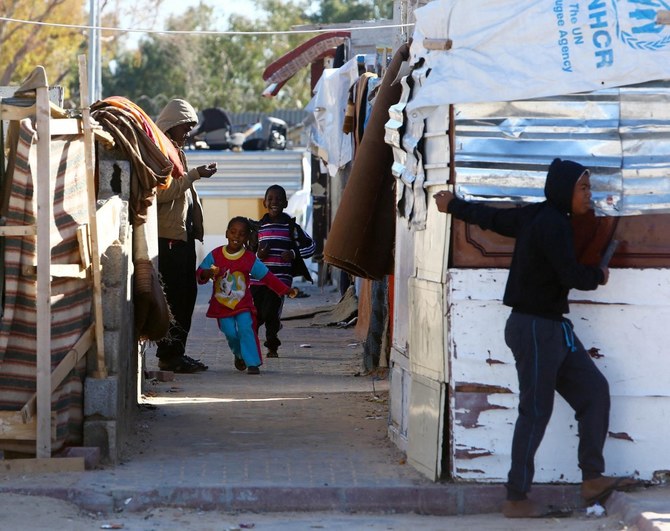
Above, children play at a refugee camp in Tripoli that hosts internally displaced people. (AFP file photo)
Short Url
Updated 24 February 2021
Follow

Libyan authorities undergo training in migrant, refugee protection

  • Participants include representatives of Libya’s defense, interior, justice and labor ministries, as well as other key national institutions

ROME: A course in “migrant and refugee protection” for Libyan authorities has been organized by the Sovereign Order of Malta, a Catholic religious order founded in Jerusalem in the 11th century, in cooperation with the British think tank Forward Thinking.

Participants include representatives of Libya’s defense, interior, justice and labor ministries, as well as other key national institutions.

The Sovereign Order of Malta said the course, which is being carried out online due to the coronavirus pandemic, “stems from the ongoing social and political instability Libya has been experiencing, with the many challenges posed by the migration and refugee crisis.”

The order’s Grand Chancellor Albrecht Boeselager said during the opening session: “Libya is facing a global challenge, with regional implications, driven by factors beyond its borders.”

The order has diplomatic relations with over 100 states and the EU, and has permanent observer status at the UN.

It is neutral, impartial and apolitical, and is active in 120 countries, providing medical, social and humanitarian aid for people in need.

“In the many meetings held starting from 2015 with a group of Libyan policymakers, representatives of government and institutions, as well as international stakeholders, what emerged is that the only way forward is to engage the many actors involved in the region in a capacity-building process to enable the country to address multiple urgent matters,” Boeselager said.

The course is being held over five days, with sessions facilitated by the International Institute of Humanitarian Law based in Sanremo, Italy.


Algeria inaugurates strategic railway to giant Sahara mine

President Tebboune attended an inauguration ceremony in Bechar. (AFP file photo)
Updated 02 February 2026
Follow

Algeria inaugurates strategic railway to giant Sahara mine

  • The mine is expected to produce 4 million tons per year during the initial phase, with production projected to triple to 12 million tons per year by 2030
  • The project is financed by the Algerian state and partly built by a Chinese consortium

ALGEIRS: Algerian President Abdelmadjid Tebboune on Sunday inaugurated a nearly 1,000-kilometer (621-mile) desert railway to transport iron ore from a giant mine, a project he called one of the biggest in the country’s history.
The line will bring iron ore from the Gara Djebilet deposit in the south to the city of Bechar located 950 kilometers north, to be taken to a steel production plant near Oran further north.
The project is financed by the Algerian state and partly built by a Chinese consortium.
During the inauguration, Tebboune described it as “one of the largest strategic projects in the history of independent Algeria.”
This project aims to increase Algeria’s iron ore extraction capacity, as the country aspires to become one of Africa’s leading steel producers.
The iron ore deposit is also seen as a key driver of Algeria’s economic diversification as it seeks to reduce its reliance on hydrocarbons, according to experts.
President Tebboune attended an inauguration ceremony in Bechar, welcoming the first passenger train from Tindouf in southern Algeria and sending toward the north a first charge of iron ore, according to footage broadcast on national television.
The mine is expected to produce 4 million tons per year during the initial phase, with production projected to triple to 12 million tons per year by 2030, according to estimates by the state-owned Feraal Group, which manages the site.
It is then expected to reach 50 million tons per year in the long term, it said.
The start of operations at the mine will allow Algeria to drastically reduce its iron ore imports and save $1.2 billion per year, according to Algerian media.