North Korean defector undetected for hours after swimming to South

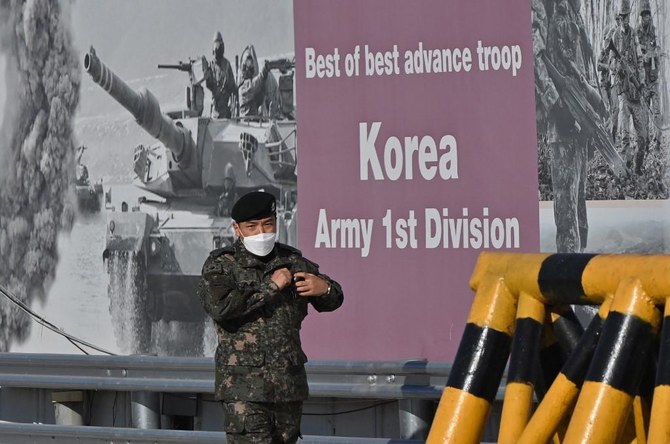
The South Korean military acknowledged troops had ‘failed to abide by due procedures’ and vowed to strengthen border security. (AFP file photo)
Short Url
Updated 24 February 2021
Follow

North Korean defector undetected for hours after swimming to South

  • Bungling South Korean forces did not spot the man’s audacious exploit despite him appearing several times on CCTV
  • Over more than three hours surveillance cameras caught him eight times, audible alarms sounding twice

SEOUL: A North Korean defector wore a diving suit and fins during a daring six-hour swim around one of the world’s most fortified borders, a Seoul official said, and was caught only after apparently falling asleep.
Bungling South Korean forces did not spot the man’s audacious exploit despite him appearing several times on CCTV after he landed and triggering alarms, drawing heavy criticism from media and opposition MPs.
Even after his presence was noticed, the man – who used diving gear to make his way by sea around the Demilitarized Zone that divides the peninsula – was not caught for another three hours.
The man, reportedly in his 20s, landed north of the town of Goseong on the east coast.
“He presumably had swum for about six hours, wearing a padded jacket inside a diving suit and fins. His clothing appeared to have kept him warm and allowed him to stay afloat,” an unnamed Joint Chiefs of Staff official was quoted as saying by Yonhap news agency on Tuesday.
Tidal currents worked in his favor, the official said, and he abandoned most of his equipment before making his way through a drainage channel under the barbed-wire fences that run along the coast.
Over more than three hours surveillance cameras caught him eight times, audible alarms sounding twice, but border guards did not notice.
Eventually a manhunt was launched, and troops found him three hours later, apparently asleep, his facemask hanging in a tree.
Officials say the defector, presumed to have been a civilian in the North, has expressed a desire to defect.
The military acknowledged troops had “failed to abide by due procedures” and vowed to strengthen border security.
And in a parliamentary hearing on Tuesday, Defense Minister Suh Wook acknowledged that surveillance systems in the area were “malfunctioning and outdated.”
Only a handful of Northern defectors ever directly cross the DMZ or swim past the maritime border – although the last such publicly known incident was in November, when questions about security were also raised.
The vast majority of defectors instead first travel to neighboring China, sometimes staying there for years before making their way on to the South via third countries.
More than 30,000 North Koreans have fled to the South over the decades but numbers plummeted to just 229 last year, after Pyongyang imposed a strict border closure to protect itself from the coronavirus that first emerged in neighbor and key ally China.
The incident was evidence the South Korean military was “close to a near collapse,” the conservative Chosun Ilbo newspaper said Wednesday.
“Is this unit the only unit not doing its job properly? We think not,” it added in an editorial.


US Justice Department official eyes cases against Cuba leaders as Trump floats ‘friendly takeover’

Updated 07 March 2026
Follow

US Justice Department official eyes cases against Cuba leaders as Trump floats ‘friendly takeover’

  • “Working group” formed to build cases against people connected to the Cuban government
  • Trump’s has increasingly displayed aggressive stance against Cuba’s communist leadership

MIAMI: The top Justice Department prosecutor in Miami is considering criminal investigations of Cuban government officials, according to people familiar with the matter. The inquiry comes as President Donald Trump has raised the possibility of a “friendly takeover” of the communist-run island.
Jason Reding Quiñones, the US attorney for the Southern District of Florida, has created a “working group” that includes federal prosecutors and officials from the Drug Enforcement Administration and other agencies to try to build cases against people connected to the Cuban government and its Communist Party, according to one of the people. They spoke on the condition of anonymity because they were not authorized to publicly discuss the effort.
It was not immediately clear which Cuban officials the office is targeting or what criminal charges prosecutors may be looking to bring.
The Justice Department said in a statement Friday that “federal prosecutors from across the country work every day to pursue justice, which includes efforts to combat transnational crime.”
The effort is taking place against the backdrop of Trump’s increasingly aggressive stance against Cuba’s communist leadership.
Emboldened by the US capture of Cuba’s close ally, Venezuelan President Nicolás Maduro, Trump last month said his administration was in high-level talks with officials in Havana to pursue “a friendly takeover” of the country. He repeated those claims this week, saying his attention would turn back to Cuba once the war with Iran winds down.
“They want to make a deal so bad,” Trump said of Cuba’s leadership.
While Cuba has faded from Washington’s radar as a major national security threat in recent decades, it remains a priority in the US Attorney’s office in Miami, whose political, economic and cultural life is dominated by Cuban-American exiles.
The FBI field office has a dedicated Cuba group that in 2024 was instrumental in the arrest of former US Ambassador Victor Manuel Rocha on charges of serving as a secret agent of Cuba stretching back to the 1970s.
In recent weeks, several Miami Republicans, in addition to Florida Sen. Rick Scott, have called on the Trump administration to reopen its criminal investigation into the 1996 shootdown of four planes operated by anti-communist exiles.
In a letter to Trump on Feb. 13, lawmakers including Reps. Maria Elvira Salazar and Carlos Gimenez highlighted decades-old news reports indicating that former President Raúl Castro — the head of Cuba’s military at the time — gave the order to shoot down the unarmed Cessna aircraft.
“We believe unequivocally that Raúl Castro is responsible for this heinous crime,” lawmakers wrote. “It is time for him to be brought to justice.”
While no indictment against Castro has been announced, Florida’s attorney general said this week that he would open a state-level investigation into the crime.
The Trump administration has also accused Cuba of not cooperating with American counterterrorism efforts, adding it alongside North Korea and Iran to a select few nations the US considers state sponsors of terrorism.
The designation stems from Cuba’s harboring of US fugitives and its refusal to extradite several Colombian rebel leaders while they were engaged in peace talks with the South American nation.