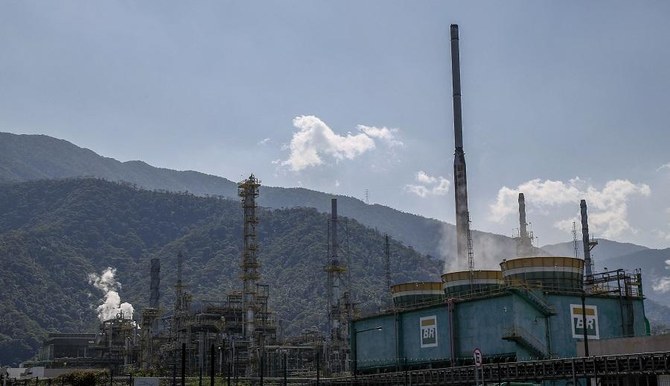
SAU PAULO: Shares in Brazil’s state-run oil company, Petrobras, partly regained their losses Tuesday after diving by more than 20 percent on news that President Jair Bolsonaro was changing the firm’s chief executive.
The company’s ordinary shares closed up nine percent, while preferential shares gained back 12.2 percent on the Sao Paulo stock exchange.
Those shares plunged by 20.5 percent and 21.5 percent respectively Monday, erasing 74 billion reais ($13.5 billion) off the company’s market value.
Bolsonaro on Friday named army reserve general Joaquim Silva e Luna, a former defense minister, as the new president of Petrobras, replacing Roberto Castello Branco, an economist well-regarded by the business sector.
The move fueled fears the far-right leader would try to intervene in energy prices as he eyes re-election next year.
It also appeared to widen a growing rift between Bolsonaro and the business sector, which helped him win election in 2018 thanks to his promises — many still unfulfilled — of investor-friendly reforms and free-market policies.
Bolsonaro said shortly before the change was announced that Petrobras, Brazil’s biggest company, should not be constantly “surprising people” with price increases, and lashed out at Castello Branco’s management.
He hinted Tuesday at more shake-ups to come at Petrobras.
“Whatever changes we have to make, we’ll make them,” he told supporters outside the presidential palace in Brasilia.
He later downplayed the turmoil around the company.
“We’re not fighting with Petrobras. We just want them to be more transparent and predictable. There’s no need to hide increases or what the impact will be on the final price of fuel,” he said.
Traders had been watching for news on a closed-door meeting Tuesday of the Petrobras board, which must decide whether to accept Silva e Luna’s appointment.
However, there was no word on the meeting by the close of the Sao Paulo stock exchange, whose Ibovespa index gained 2.3 percent overall.
Shortly afterwards, the board meeting ended with authorization for an extraordinary general assembly to be convened on a date yet to be determined, in order to remove Castello Branco and analyze Bolsonaro’s new appointee, the company said in a statement.
Petrobras has increased fuel prices four times so far in 2021 — a cumulative rise of nearly 35 percent — as global oil prices have climbed back to pre-coronavirus pandemic levels.
The price hikes have triggered backlash in Brazil, a top 10 oil producer with output of 3.67 million barrels per day in 2019.
In an attempt to ease jitters and show his commitment to his promised reforms, Bolsonaro went to Congress on Tuesday to deliver a provisional decree with which he intends to accelerate the discussion of the privatization of Eletrobras, the state-owned electricity company.
“Our privatization agenda continues at full steam,” he said. “We do want to reduce the size of the state, so that our economy can provide the response that society needs.”
The president also reiterated his support for the minister of the economy, the liberal Paulo Guedes, a key figure for the markets.


![]()

Brazil’s Petrobras rebounds partly from stock plunge
Short Url
https://arab.news/wry4h
Brazil’s Petrobras rebounds partly from stock plunge
- The company’s ordinary shares closed up nine percent, while preferential shares gained back 12.2 percent


Latest updates


© 2026 SAUDI RESEARCH & PUBLISHING COMPANY, All Rights Reserved And subject to Terms of Use Agreement.