

Mob storms south Iran governor office after border violence

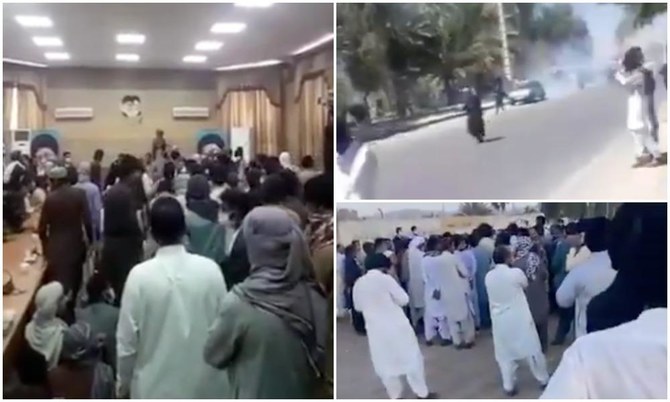
Videos showed the men screaming “Allahu Akbar” as they punched through glass doors, yanked out air-conditioning units and smashed office furniture against the walls. Video also showed security officials firing tear gas. (Screenshot)
Short Url
Updated 24 February 2021
Follow

Mob storms south Iran governor office after border violence

  • Following two violent incidents near the border, dozens of protesters descended on the Iranian governors’ office in Saravan

DUBAI: An angry mob has stormed a district governor’s office in southeastern Iran on Tuesday, footage widely circulating on social media showed, a day after shootings at the border with Pakistan left at least two dead and six wounded.
Following two violent incidents near the border, dozens of protesters descended on the Iranian governors’ office in Saravan, one of the major cities in Sistan-Baluchestan, a desert province that is one of the most restive and least developed parts of Iran.

Videos showed the men screaming “Allahu Akbar” as they punched through glass doors, yanked out air-conditioning units and smashed office furniture against the walls. Once inside, protesters waded through piles of overturned chairs and shattered glass, throwing objects all over the place.
The Associated Press verified the footage based on geographic data.


Mohammad Hadi Marashi, deputy governor of the Sistan and Baluchestan province, told Iranian state TV on Tuesday that the outrage at the governors’ office stemmed from the shooting of several fuel smugglers on the Pakistani side of the border near Saravan the day before.
Marashi pointed a finger at Pakistan, saying its forces had opened fire on a gathering of fuel smugglers that had been trying to cross back into Iran, killing one and wounding four.
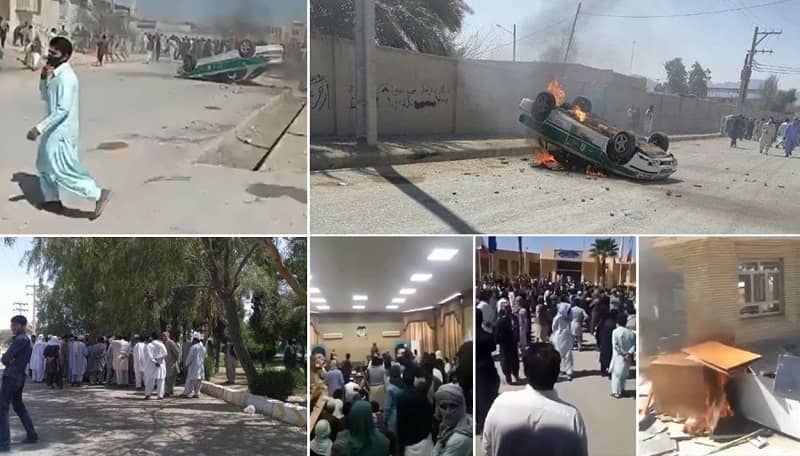


Photo: National Council of Resistance of Iran (NCRI)


Following the shooting, violent clashes erupted Monday at a police station in Saravan, according to Marashi. Iranian border guards opened fire at fuel smugglers trying to storm the station, wounding several. They were taken to nearby hospitals, he added, without providing further details.


Pakistani officials reported that one smuggler was killed and several more wounded in what they called a “firing incident” at the border town of Taftan in southwestern Baluchistan. None of the wounded were taken into Pakistan, they said, speaking on condition of anonymity because they were not authorized to speak to media.


Taftan is a well-worn smuggling route, mostly for subsidized diesel fuel from Iran to Pakistan. The impoverished province has seen occasional clashes between Iranian forces and militants, drug traffickers and small separatist groups.

Soleimani’s shadow
Qassem Soleimani left a trail of death and destruction in his wake as head of Iran’s Quds Force … until his assassination on Jan. 3, 2020. Yet still, his legacy of murderous interference continues to haunt the region

Enter


keywords

Syrian Alawites protest in coastal heartland after mosque bombing

Updated 59 min 20 sec ago
Follow

Syrian Alawites protest in coastal heartland after mosque bombing

  • Syrian Alawites took to the streets on Sunday in the coastal city of Latakia to protest after a mosque bombing that killed eight people in Homs two days before

LATAKIA: Syrian Alawites took to the streets on Sunday in the coastal city of Latakia to protest after a mosque bombing that killed eight people in Homs two days before.
The attack, which took place in an Alawite area of Homs city, was the latest against the religious minority, which has been the target of several episodes of violence since the December 2024 fall of longtime ruler Bashar Assad, himself an Alawite.
Security forces were deployed in the area, and intervened to break up clashes between demonstrators and counter-protesters, an AFP correspondent witnessed.
“Why the killing? Why the assassination? Why the kidnapping? Why these random actions without any deterrent, accountability or oversight?” said protester Numeir Ramadan, a 48-year-old trader.
“Assad is gone, and we do not support Assad... Why this killing?“
Sunday’s demonstration came after calls from prominent spiritual leader Ghazal Ghazal, head of the Islamic Alawite Council in Syria and Abroad, who on Saturday urged people to “show the world that the Alawite community cannot be humiliated or marginalized.”
“We do not want a civil war, we want political federalism. We do not want your terrorism. We want to determine our own destiny,” he said in a video message on Facebook.
Protesters carried pictures of Ghazal along with banners expressing support for him, while chanting calls for decentralized government authority and a degree of regional autonomy.
“Our first demand is federalism to stop the bloodshed, because Alawite blood is not cheap, and Syrian blood in general is not cheap. We are being killed because we are Alawites,” Hadil Salha, a 40-year-old housewife said.
Most Syrians are Sunni Muslim, and the city of Homs — where Friday’s bombing took place — is home to a Sunni majority but also has several areas that are predominantly Alawite, a community whose faith stems from Shiite Islam.
The community is otherwise mostly present across their coastal heartland in Latakia and Tartus provinces.
Since Assad’s fall, the Syrian Observatory for Human Rights monitor and Homs province residents have reported kidnappings and killings targeting members of the minority community.
Alawite massacres 
The country has also seen several bloody flare-ups of sectarian violence.
Syria’s coastal areas saw the massacre of Alawite civilians in March, with authorities accusing armed Assad supporters of sparking the violence by attacking security forces.
A national commission of inquiry said at least 1,426 members of the minority were killed, while the Syrian Observatory for Human Rights monitor put the toll at more than 1,700.
Late last month, thousands of people demonstrated on the coast to protest fresh attacks targeting Alawites in Homs and other regions.
Before and after the March bloodshed, authorities carried out a massive arrest campaign in predominantly Alawite areas, which are also former Assad strongholds.
Protesters on Sunday also demanded the release of detainees.
On Friday, Syrian state television reported the release of 70 detainees in Latakia “after it was proven that they were not involved in war crimes,” saying more releases would follow.
Despite assurances from Damascus that all Syria’s communities will be protected, the country’s minorities remain wary of their future under the new Islamist authorities, who have so far rejected calls for federalism.