OFW remittances especially from Gulf countries to remain weak

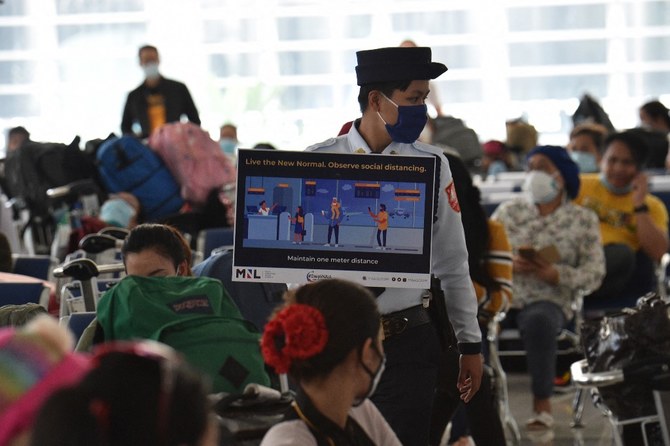
Half a million overseas Filipino workers were displaced from work in 2020, and most of them have been repatriated. (AFP file photo)
Short Url
Updated 23 February 2021
Follow

OFW remittances especially from Gulf countries to remain weak

  • Remittances from overseas Filipino workers slipped 0.8 percent to $29.903 billion in 2020
  • Half a million OFWs were displaced from work last year

DUBAI: Remittances from overseas Filipino workers (OFWs) in the Gulf region will remain depressed until 2022 as the financial impact of the coronavirus pandemic lingers.

Recruitment consultant Manuel Geslani said remittances would - at best - grow by two percent as workers’ deployment is countervailed by the repatriation of workers from crucial Filipino labor centers such as Saudi Arabia, the UAE, Kuwait, Bahrain, Qatar and Oman, where the majority of OFWs were deployed in 2018-2019.

“More than 400,000 domestic workers were sent to the Middle East, representing 70 percent of new hires in both years,” Geslani said, in a report from business daily BusinessMirror.

Remittances from overseas Filipino workers slipped 0.8 percent to $29.903 billion in 2020 from the $30.133 billion registered in 2019 as money sent from Saudi Arabia, the UAE and Kuwait went down.

There has been an exodus of expatriate workers from Gulf countries with the economic fallout from COVID-19, although credit ratings agency Standard & Poor’s in a report expects foreign workers to return as the economic cycle recovers.

Emerging countries including the Philippines are heavily reliant on money sent from abroad to support domestic consumption and the countercyclical nature of remittances, wherein migrant workers tend to remit more amounts to their families in times of crises, have cushioned the economic impact of the pandemic.

Half-a-million OFWs were displaced from work last year, with close to 380,000 repatriated to the country and another 100,000 more expected to arrive this year, Geslani said.

“The remaining 80,000 to 100,000 out-of-work OFWs have decided to remain in their jobs sites buoyed by unemployment insurance which expects to last a few more months of 2021.”

Latest figures from the Philippine government’s migrant welfare agency put the number of repatriated OFWs to 449,568 individuals thus far.

The Economist Intelligence Unit earlier said that the growth in remittances of emerging economies such as the Philippines remains vulnerable, as labor-hosting countries were similarly affected by the pandemic.

“The fall in remittances, and their expected continued decline in 2021, present significant challenges for these countries – particularly if their reliance on remittances grows in the immediate term,” said the report.

“This places these countries at increased risk of experiencing financial crises that would only prolong their post-pandemic recovery. If one emerging economy experiences such a crisis, financial contagion could ensue and destabilize other developing countries.”


UAE bank assets rise 0.8% to $1.43tn as credit expands: CBUAE data 

Updated 4 sec ago
Follow

UAE bank assets rise 0.8% to $1.43tn as credit expands: CBUAE data 

RIYADH: UAE bank assets rose 0.8 percent in November to 5.25 trillion Emirati dirhams ($1.43 trillion), extending growth in the sector as credit and deposits continued to expand, central bank data showed.  

Gross banking assets increased from 5.2 trillion dirhams in October, according to the Central Bank of the UAE’s Monetary and Banking Developments report. Gross credit rose 0.7 percent to 2.53 trillion dirhams, supported by growth in both domestic and foreign lending. 

The domestic expansion included a 0.4 percent rise in credit to the private sector, aligning with the UAE’s “Projects of the 50” agenda to stimulate private investment and reduce the economy's reliance on hydrocarbons. 

In its latest report, CBUAE stated: “Gross credit increased due to the combined growth in domestic credit by 9 billion dirhams and in foreign credit by 8.7 billion dirhams.” 

It added: “The growth in domestic credit was due to the increases in credit to the government sector by 2.6 percent, in the private sector by 0.4 percent, and in credit to the non-banking financial institutions by 3.6 percent, overshadowing the decrease in credit to the public sector (government-related entities) by 1 percent.” 

A notable shift was observed in the money supply data. While the narrow money supply aggregate M1 decreased by 1.7 percent due to a drop in monetary deposits, broader measures saw significant growth.  

The report stated: “The money supply aggregate M2 increased by 1.5 percent,” primarily due to a substantial 58.2 billion dirhams growth in quasi-monetary deposits.

Similarly, M3, which includes government deposits, also rose by 1.5 percent, “amplified by 8.6 billion dirhams increase in government deposits.” 

The simultaneous fall in M1 and rise in M2 and M3 suggests a liquidity transformation within the system, with money moving from checking accounts into savings, time deposits, and government accounts, which can be used for longer-term lending. 

The foundation of the banking system also strengthened, as “the monetary base increased by 1.7 percent.” This growth was driven by the growth in reserve account by 21.5 percent, in currency issued by 2.6 percent, and in monetary bills and Islamic certificates of deposit by 8.8 percent. 

On the deposits side, the report noted that “banks’ deposits increased by 1 percent,” totaling 3.23 trillion dirhams.

This growth was “driven by the growth in resident deposits by 1.4 percent,” which reached 2.97 trillion dirhams. Within resident deposits, the private sector led with a 1.2 percent increase, while deposits in government-related entities saw a significant 3 percent rise.