

Imperial birthday celebrations from past to present

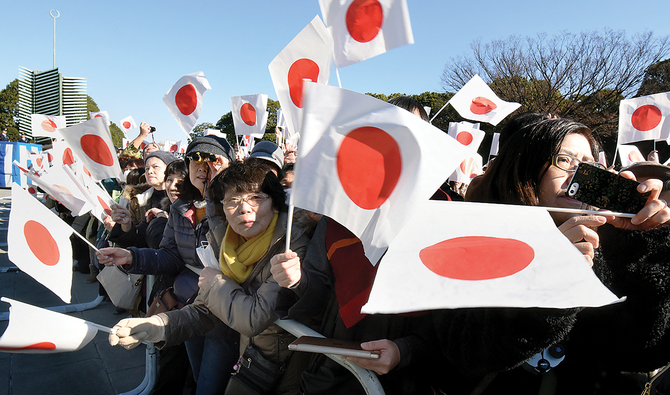
The emperor’s birthday is a national celebration across Japan. (AFP)
Short Url
Updated 23 February 2021
Follow

Imperial birthday celebrations from past to present

  • This year, like many events, the celebration will not play out in the usual way

DUBAI: The Japanese emperor’s birthday has long been celebrated within Japan and beyond, but the festivities surrounding it have been redefined due to the coronavirus pandemic.

This year, like many events, the celebration will not play out in the usual way. Traditionally, members of the public would take part in the event by visiting the palace, where they would offer good wishes to the emperor and sign a guest book — a practice that dates back to 1948. 

Given the restrictions in place, members of the public will not be able to enter the palace gates this year, but in previous years it was common for the emperor and members of the imperial family to address visitors from the balcony of the palace. 

This caution will also extend to the Japanese Embassy in Saudi Arabia, which has opted to upload a special page on their website that will include the ambassador’s message.

Emperor Naruhito’s 60th birthday, celebrated on Feb. 23, was honored last year at the Japanese Embassy in Saudi Arabia at an event attended by diplomats, government officials, Deputy Governor of Riyadh Prince Mohammed bin Abdulrahman bin Abdul Aziz and Japanese Ambassador to Saudi Arabia Uemura Tsukasa.

Last year, Uemura’s opening speech was in Arabic, highlighting the growing relations between Japan and Saudi Arabia.

This bond was epitomized by the prince and Uemura jointly cutting the ceremonial cake featuring the flags of both countries.

Japanese cuisine including tempura, yakisoba, sushi and maki was served, and a traditional Japanese dance was performed.

Prior to Naruhito ascending to the throne on May 1, 2019 — becoming the 126th Japanese emperor — the birthday of his father, Emperor Akihito, was commemorated on Dec. 23.

In 2015, Saudi Arabia demonstrated its respect by hosting a reception for the emperor’s 82nd birthday at the residence of the consul general of Japan in Jeddah.

The consul-general’s spoke of a “deep friendship” between the two countries, founded on “mutual respect and appreciation between the Japanese imperial family and the Saudi royal family.” Children singing the anthems of both countries added to the occasion.

This national holiday, referred to as Tenno Tanjobi, traditionally features a congratulatory ceremony, a luncheon hosted by the emperor and empress, as well as a tea reception to receive birthday greetings from special invitees. Diet members, the prime minister, speaker and vice-speaker of the House of Representatives, president and vice president of the House of Councillors and ministers of state attend the luncheon, while the tea reception is held primarily to welcome diplomatic missions in Japan.

Historically, members of the imperial family would not appear before the people gathered outside but this shifted in 1950 when Emperor Showa and Empress Kojun made their first appearance.

The opportunity for palace visits during the holiday would attract an influx of people. In 2016 about 38,588 people attended Emperor Akihito’s birthday celebration, and this number rose to 82,850 in 2018.

Despite this year’s restricted circumstances, the sentiment behind the emperor’s birthday celebrations remains unchanged. It encapsulates Japan’s rich culture, history and dedication to tradition, while also reinforcing the bond between Japan and Saudi Arabia that remains strong despite the unpredictability of the global landscape.


Trump-backed candidate Nasry Asfura declared winner of Honduras’ presidential vote

Updated 3 sec ago
Follow

Trump-backed candidate Nasry Asfura declared winner of Honduras’ presidential vote

  • The election is continuing Latin America’s swing to the right, coming just a week after Chile chose the far-right politician José Antonio Kast as its next president

TEGUCIGALPA: Trump-backed candidate Nasry Asfura won Honduras’ presidential election, the country’s electoral authorities said Wednesday afternoon, ending a weeks-long count that has whittled away at the credibility of the Central American nation’s fragile electoral system.
The election is continuing Latin America’s swing to the right, coming just a week after Chile chose the far-right politician José Antonio Kast as its next president.
Asfura, of the conservative National Party received 40.27 percent of the vote in the Nov. 30, edging out four-time candidate Salvador Nasralla of the conservative Liberal Party, who finished with 39.39 percent of the vote.
Asfura, the former mayor of Honduras’ capital Tegucigalpa, won in his second bid for the presidency, after he and Nasralla were neck-and-neck during a weeks-long vote count that fueled international concern.
On Tuesday night a number of electoral officials and candidates were already fighting and contesting the results of the election.
The results were a rebuke of the current leftist leader, and her governing democratic socialist Liberty and Re-foundation Party, known as LIBRE, whose candidate finished in a distant third place with 19.19 percent of the vote.
Asfura ran as a pragmatic politician, pointing to his popular infrastructure projects in the capital. Trump endorsed the 67-year-old conservative just days before the vote, saying he was the only Honduran candidate the US administration would work with.
Nasralla has maintained that the election was fraudulent and called for a recount of all the votes just hours before the official results were announced.
On Tuesday night, he addressed Trump in a post on X, writing: “Mr. President, your endorsed candidate in Honduras is complicit in silencing the votes of our citizens. If he is truly worthy of your backing, if his hands are clean, if he has nothing to fear, then why doesn’t he allow for every vote to be counted?”
He and others opponents of Asfura have maintained that Trump’s last-minute endorsement was an act of electoral interference that ultimately swung the results of the vote.
The unexpectedly tumultuous election was also marred by a sluggish vote count, which fueled even more accusations.
The Central American nation was stuck in limbo for more than three weeks as vote counting by electoral authorities lagged, and at one point was paralyzed after a special count of final vote tallies was called, fueling warnings by international leaders.
Ahead of the announcement, Organization of American States Secretary General Albert Rambin on Monday made an “urgent call” to Honduran authorities to wrap up a special count of the final votes before a deadline of Dec. 30. The Trump administration warned that any attempts to obstruct or delay the electoral count would be met with “consequences.”
For the incumbent, progressive President Xiomara Castro, the election marked a political reckoning. She was elected in 2021 on a promise to reduce violence and root out corruption.
She was among a group of progressive leaders in Latin American who were elected on a hopeful message of change in around five years ago but are now being cast out after failing to deliver on their vision. Castro said last week that she would accept the results of the elections even after she claimed that Trump’s actions in the election amounted to an “electoral coup.”
But Eric Olson, an independent international observer during the Honduran election with the Seattle International Foundation, and other observers said that the rejection of Castro and her party was so definitive that they had little room to contest the results.
“Very few people, even within LIBRE, believe they won the election. What they will say is there’s been fraud, that there has been intervention by Donald Trump, that we we should tear up the elections and vote again,” Olson said. “But they’re not saying ‘we won the elections.’ It’s pretty clear they did not.”