

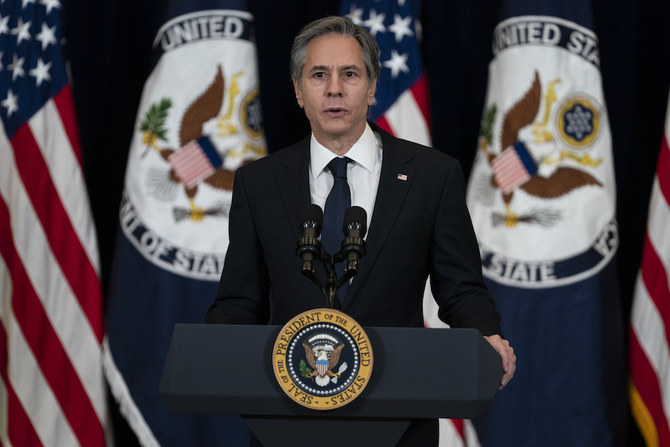

LONDON: The United States will seek to strengthen and extend the agreement between world powers and Iran aimed at curbing its nuclear program, Secretary of State Antony Blinken said on Monday.
It’s a new sign of Washington’s ambition to revive the 2015 nuclear deal rejected by former President Donald Trump even as Tehran appears to be backing further away from it.
The UN nuclear watchdog said on Sunday it had struck a deal with Iran to cushion the blow of steps Tehran plans to take this week that include ending snap inspections, with both sides agreeing to keep “necessary” monitoring for up to three months.
The announcement by International Atomic Energy Agency (IAEA) chief Rafael Grossi, made at Vienna airport after a weekend trip to Iran, confirmed that Tehran would go ahead with its plan to slash cooperation with the agency on Tuesday.
Blinken, addressing the UN-sponsored Conference on Disarmament in Geneva, said in a pre-recorded speech: “The United States remains committed to ensuring that Iran never acquires a nuclear weapon. Diplomacy is the best path to achieve that goal.”
US President Joe Biden has said that if Iran comes back into “strict compliance” with the 2015 pact, his administration will do the same, Blinken said.
“Working with allies and partners, we will also seek to lengthen and strengthen the JCPOA (Joint Comprehensive Plan of Action) and address other areas of concern, including Iran’s destabilizing regional behavior and ballistic missile development and proliferation,” Blinken said.
“Iran must comply with its safeguards agreements with the IAEA and its international obligations,” he added.
White House press secretary Jenn Psaki said USallies in Europe are still waiting a response from Iran on the European Union’s offer to host an informal meeting between current members of the nuclear deal and the US.
Iran has slowly walked away from all the nuclear deal’s limitations on its stockpile of uranium and has begun enriching up 20%, a technical step away from weapons-grade levels.
Supreme Leader Ayatollah Ali Khamenei said on Monday Iran might enrich uranium up to 60% purity if the country needed it and would never yield to US pressure over its nuclear activity, state television reported.
Iran’s 2015 nuclear deal with six powers caps the fissile purity to which Tehran can refine uranium at 3.67%, well under the 20% achieved before the agreement and far below the 90% suitable for a nuclear weapon.
“Iran’s uranium enrichment level will not be limited to 20%. We will increase it to whatever level the country needs...We may increase it to 60%,” the TV quoted Khamenei as saying.
Khamenei also repeated a denial of any Iranian intent to weaponize uranium enrichment.
“Our respected government did not abandon its commitments and gradually reduced some of them, which are still reversible in the case that they return to their responsibilities,” he said.
Moreover, Iran said on Monday it will end at 2030 GMT the implementation of the Additional Protocol that allows the UN nuclear watchdog to carry out snap-inspections at sites not declared to the agency, the semi-official Tasnim news agency reported.
“As of midnight tonight (2030 GMT), we will not have... commitments beyond safeguards. Necessary orders have been issued to the nuclear facilities,” Tasnim quoted Kazem Gharibabadi, Iran’s envoy at the IAEA as saying.
US State Department spokesman Ned Price said Khamenei’s comment about uranium enrichment “sounds like a threat” and declined to respond to what he described as “hypotheticals” and “posturing.”
Price also reiterated US willingness to engage in talks with Iran.
French Foreign Affairs Minister Jean-Yves Le Drian told his EU colleagues during a meeting in Brussels that the situation regarding Iran’s nuclear program is “worrying,” his ministry said on Monday.
(With AP, AFP and Reuters)

keywords


