

Pakistan confident has met action plan, will exit FATF's grey list this week

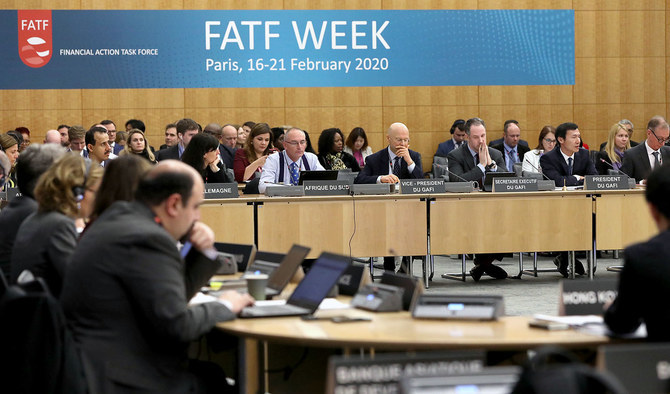
In this file photo, members of the Financial Action Task Force (FATF) meet for a plenary meeting on February 19, 2020, in Paris, France. (Photo courtesy: FATFNews/Twitter)
Short Url
Updated 22 February 2021
Follow

Pakistan confident has met action plan, will exit FATF's grey list this week

  • Pakistan says has made significant regulatory progress to comply with the financial watchdog's requirements
  • Experts say all will depend on Pakistan's diplomatic outreach as it may face resistance from US and France

ISLAMABAD: Pakistan is hopeful this week's meeting of the Financial Action Task Force (FATF) will remove it from an international “grey list” of nations falling short of global money laundering rules, officials said on Sunday.

The global watchdog put Pakistan onto the list in 2018 at the urging of the United States. In the last plenary meeting in October, FATF announced that Pakistan would remain on its grey list until February for not meeting six out of 27 action plan items on curbing money laundering that benefited terrorism groups.

FATF's upcoming virtual plenary meeting will be held in Paris from Monday to Thursday.

"We hope that the FATF plenary would acknowledge and appreciate our actions,” Pakistan’s foreign office spokesperson Zahid Hafeez Chaudhri told Arab News.

"FATF is a technical body, and we expect it to take a decision based on the merits of our case," he said, adding that Islamabad has been fully committed to implementing the remaining points and undertook "painstaking efforts" towards this end.

"In the remaining six partially addressed items, significant progress has been made by Pakistan, which is duly acknowledged by the wider FATF membership," Chaudhri said.

To comply with the watchdog's requirements, Pakistan last year passed new legislations that include actions for freezing and seizure of assets and travel bans and arms embargoes on entities and individuals designated on UN sanctions' lists. They also introduce measures to impose heavy fines and long-term jail sentences on those involved in terror financing.

According to Dr. Abid Qayyum Sulehri, member of the government’s Economic Advisory Council, Pakistan's regulatory processes have been very satisfactory and now all will depend on diplomacy.
 
"There is no major bottleneck in the legislations or other action plans. It is now purely depending upon diplomatic outreach by Pakistan. Islamabad has to increase its diplomatic efforts to get required 13 votes to come out of the grey list," he said, adding that Pakistan may face some resistance from France and the US.

France, Sulehri told Arab News, may want to keep Pakistan on the grey list as earlier this month Islamabad reached an agreement with a hardline religious party to discuss in parliament severing ties with Paris as French President Emmanuel Macron recently defended the publication of cartoons depicting Prophet Muhammad.

Resistance from the US, Sulehri added, may come "due to its concern over the acquittal of Omar Sheikh one of the accused in Daniel Pearl murder case."

In late January, a top Pakistani court ordered the release of Ahmed Omar Sheikh, a British-born Pakistani convicted of the 2002 kidnapping and beheading of American journalist Daniel Pearl.

Dr. Zubair Khan, an economist and financial politics expert, said pressure to keep Pakistan on the grey list may also be due to regional politics as the US and India "want to keep Pakistan under pressure for their regional gains."

"We have laws in place which are being implemented. The laws are passed by the parliament and the FATF member countries, which themselves campaign for democratic norms, should give the Pakistani parliament its due time to complete its process on legislation," Khan said.

"It is high time to make FATF a meaningful body and stop using it for political purposes."


PIA owner says airline in talks with Boeing as privatization deal formally concludes

Updated 7 sec ago
Follow

PIA owner says airline in talks with Boeing as privatization deal formally concludes

  • PIA’s new owner Arif Habib vows to improve service delivery for passengers, buy new planes in days ahead 
  • Arif Habib Group secured 75 percent stake in PIA last month for $482 million after several rounds of bidding

ISLAMABAD: The new owner of the Pakistan International Airlines (PIA) said on Thursday that the airline was in talks with aerospace manufacturer Boeing as he vowed to expand its current fleet and ensure service revamp as the government formally concluded its privatization process.

A Pakistani consortium led by the Arif Habib Group secured a 75 percent stake in the PIA last month for Rs135 billion ($482 million) after several rounds of bidding, valuing the airline at Rs180 billion ($643 million). Pakistan had previously attempted to reform the debt-ridden airline, which had accumulated more than $2.8 billion in financial losses over the years. 

The Pakistani government and the Arif Habib Consortium signed the transaction documents for the PIA’s privatization during a televised ceremony in Islamabad. The event was attended by Prime Minister Shehbaz Sharif, senior cabinet members and Chief of Defense Forces Field Marshal Syed Asim Munir. 

“The money that will go into the airline will improve its services, new planes will be bought and you will see a big difference very soon,” Arif Habib, the chairman of the consortium, said. 

“We have held a very extensive meeting with Boeing, we are holding a meeting with Airbus tomorrow (Friday). We are also exploring other options,” he added. 

Habib vowed the airline will meet the prime minister’s expectations as far as the PIA’s performance is concerned, saying the government’s patronage would be “critical.”

Sharif congratulated the nation on the signing of the transaction documents, hoping Habib and his team would ensure PIA improves its performance, punctuality, cabin service and ground service in the days to come. 

Once considered among Asia’s leading carriers, PIA struggled with chronic mismanagement, political interference, overstaffing, mounting debt and operational issues that led to a 2020 ban on flights to the European Union, UK and the US after a pilot licensing scandal. The EU and the UK lifted the bans, providing fresh momentum to the carrier.

In an exclusive interview to Arab News last month, Habib said PIA’s new management plans to more than triple its fleet to 64 aircraft from the existing 19 in up to eight years.

He also said the consortium may look to buy the government’s remaining 25 percent stake and offer part of it to a “strategic investor,” preferably a foreign airline, to make PIA more competitive.