

Malnutrition ‘very critical’ in Tigray, says UN agency

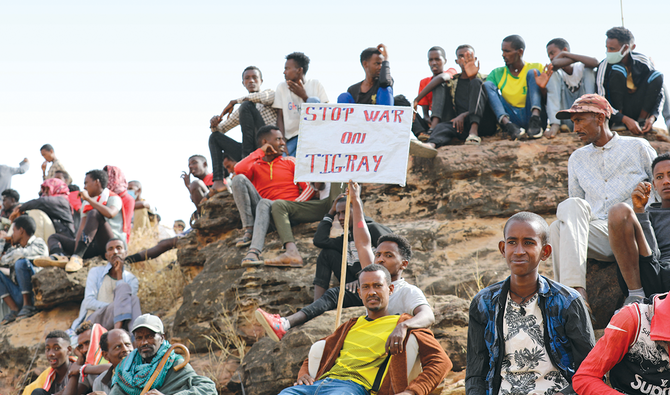
Ethiopian refugees gather on Friday to celebrate the 46th anniversary of the Tigray People’s Liberation Front at a refugee camp in Gedaref, eastern Sudan. (File/AFP)
Short Url
Updated 21 February 2021
Follow

Malnutrition ‘very critical’ in Tigray, says UN agency

  • Report cites ‘bureaucratic obstacles’ and complications in delivery of aid to vast rural areas

NAIROBI: The UN says Ethiopia’s embattled Tigray region faces a “very critical malnutrition situation” as vast rural areas where many people fled during three months of fighting remain out of reach of aid.

The UN humanitarian agency also said in a new report that Ethiopian defense forces continue to occupy a hospital in the town of Abi Adi, “preventing up to 500,000 people from accessing health services” in a region where the health system has largely collapsed under looting and artillery fire.

Alarm is growing over the fate of the Tigray region’s some 6 million people as fighting is reportedly as fierce as ever between Ethiopian and allied forces and those supporting the now-fugitive Tigray leaders who once dominated Ethiopia’s government.

“The needs are tremendous, but we cannot pretend that we do not see or hear what is unfolding,” Ethiopian President Sahle-Work Zewde said in a statement after visiting the Tigray capital, Mekele.

In one of the frankest public comments yet by Ethiopia’s government, she noted “significant delays that remain in reaching people in need.”

Ethiopia on Friday said humanitarian aid has reached 2.7 million people in Tigray.

But the UN report calls the current response “drastically inadequate,” even as some progress is made.

With some 80 percent of the population still unreachable, according to the Ethiopian Red Cross earlier this month, fears are growing that more people are starving to death.

“Next few weeks decisive to prevent famines,” Germany’s Foreign Office said in a brief statement last week after hearing accounts of a EU envoy’s visit to Ethiopia.

The new UN report released on Friday says even in areas that can be reached, a screening of 227 children under the age of five showed “staggeringly high malnutrition,” though it did not mention the number of cases.

It also says a screening of more than 3,500 children found 109 with severe acute malnutrition. The World Health Organization describes that condition as “when a person is extremely thin and at risk of dying.”

“Malnutrition (in Tigray) is expected to deteriorate as households are limited to fewer meals every day,” the UN report says.

The Tigray conflict began at a vulnerable time, just before the harvest and after months of a regional locust outbreak. The majority of the population is subsistence farmers.

The UN report cites “bureaucratic obstacles” and the presence of “various armed actors” as complications in the delivery of aid.

Humanitarian workers have described trying to navigate a patchwork of authorities that include ones from the neighboring Amhara region who have settled in some Tigray communities, as well as soldiers from neighboring Eritrea whom witnesses have accused of widespread looting and burning of crops.

Ethiopia’s government denies the presence of Eritrean soldiers, though the Tigray region’s interim government has confirmed it and accused them of looting food aid, according to a recent Voice of America interview.

The UN report describes a “dire” situation in which “COVID-19 services have stopped” in the Tigray region, displaced people in some cases are sleeping 30 to a single classroom and host communities are under “incredible strain.”


Pakistan killed over 80 militants in strikes on TTP camps in Afghanistan — official

Updated 5 sec ago
Follow

Pakistan killed over 80 militants in strikes on TTP camps in Afghanistan — official

  • Saturday’s airstrikes followed a series of attacks inside Pakistan amid a surge in militancy
  • The Afghan Taliban authorities accuse Pakistani forces of killing civilians in the airstrikes

ISLAMABAD: Pakistan’s airstrikes in Afghanistan destroyed seven Tehreek-e-Taliban Pakistan (TTP) camps and killed over 80 militants, a Pakistani security official said on Sunday, with the Afghan Taliban accusing Pakistani forces of killing civilians in the assault.

Saturday’s airstrikes followed a series of attacks inside Pakistan amid a surge in militancy. Authorities say the attacks, particularly in Khyber Pakhtunkhwa province and the Pakistani capital of Islamabad, were carried out by the TTP and allied groups that Islamabad alleges are operating from sanctuaries in Afghanistan. Kabul denies this.

According to Pakistan’s information ministry, recent incidents included a suicide bombing at a Shiite mosque in Islamabad, separate attacks in Bajaur and Bannu, and another recent incident in Bannu during the holy month of Ramadan, which started earlier this week. The government said it had “conclusive evidence” linking the attacks to militants directed by leadership based in Afghanistan.

“Last night, Pakistan’s intelligence-based air strikes destroyed seven centers of Fitna Al-Khawarij TTP in three provinces of Nangarhar, Paktika and Khost, in which more than eighty Khawarij (TTP militants) have been confirmed killed, while more are expected,” a Pakistani security official, who spoke on condition of anonymity, told Arab News.

An earlier statement from Pakistan’s information ministry said the targets included a camp of a Daesh regional affiliate, the Islamic State Khorasan Province (ISKP), which claimed a suicide bombing at an Islamabad Shiite mosque that killed 32 people this month.

In an X post, Afghan government spokesperson Zabihullah Mujahid said Pakistani forces had violated Afghan territory.

“Pakistani special military circles have once again trespassed into Afghan territory,” Mujahid said. “Last night, they bombed our civilian compatriots in Nangarhar and Paktika provinces, martyring and wounding dozens of people, including women and children.”

 The Afghan Taliban’s claims of civilian casualties could not be independently verified. Pakistan did not immediately comment on the allegation that civilians had been killed in the strikes.

In a post on X, Afghanistan’s foreign ministry said it had summoned Pakistan’s charge d’affaires to Afghanistan Ubaid-ur-Rehman Nizamani and lodged protest through a formal démarche in response to the Pakistani military strikes.

“IEA-MoFA (The Islamic Emirate of Afghanistan’s Ministry of Foreign Affairs) vehemently condemns the violation of Afghanistan’s airspace and the targeting of civilians, describing it as a flagrant breach of Afghanistan’s territorial integrity & a provocative action,” it said in a statement.

“The Pakistani side was also categorically informed that safeguarding Afghanistan’s territorial integrity is the religious responsibility of the Islamic Emirate of Afghanistan; henceforth, the responsibility for any adverse consequences of such actions will rest with the opposing side.”

Tensions between Islamabad and Kabul have escalated since the Afghan Taliban returned to power in 2021. Pakistan says cross-border militant attacks have increased since then and has accused the Taliban of failing to honor commitments under the 2020 Doha Agreement to prevent Afghan soil from being used for attacks against other countries. The Taliban deny allowing such activity and have previously rejected similar accusations.

Saturday’s exchange of accusations marks one of the most direct confrontations between the two neighbors in recent months and risks further straining already fragile ties along the volatile border.