

Abbas orders Palestinian public freedoms boosted before vote

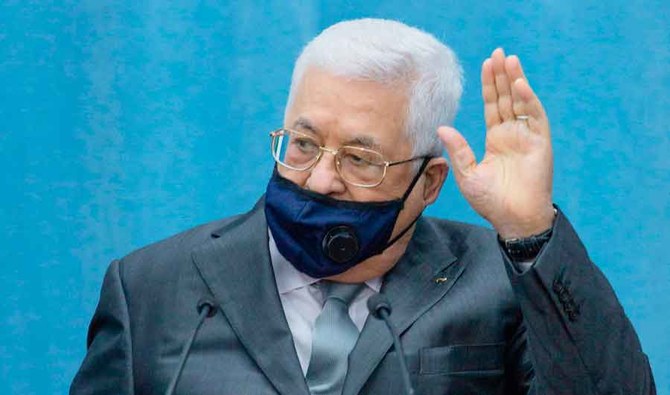
Palestinian President Mahmoud Abbas upon arriving to head the Palestinian leadership meeting at his headquarters, in the West Bank city of Ramallah, during the COVID-19 pandemic on May 7, 2020. (AFP)
Short Url
Updated 21 February 2021
Follow

Abbas orders Palestinian public freedoms boosted before vote

  • The PA is struggling with financial crisis and failure to reach a peace deal with Israel to create Palestinian statehood

GAZA CITY: Palestinian President Mahmoud Abbas has issued a decree ordering the respect of freedom of expression ahead of legislative elections in May, a step demanded by Palestinian factions who discussed the polls in Egypt-hosted talks this month.
The decree dispels some of the doubts overshadowing what would be the first Palestinian national elections in 15 years, although other hurdles remain unsolved.
The presidential decree bans all police pursuits and detentions in the West Bank and the Gaza Strip, which is controlled by Hamas, for “reasons related to freedom of expression and political affiliation.” Prisoners held on such justifications must be freed, says the decree.
The elections on May 22 are hoped to be the first in the Palestinian territories since the Hamas movement won the last vote in the Palestinian territories in 2006.
A year later, Hamas fought deadly street battles with pro-Abbas forces, culminating with Hamas taking over Gaza and separating it politically from the Israeli-occupied West Bank, where the Palestinian Authority administers autonomous enclaves.
Through 14 years of division, rights groups accused Hamas and the PA of cracking down on each side’s adversaries and opponents.

FASTFACT

The presidential decree bans all police pursuits and detentions in the West Bank and the Gaza Strip, which is controlled by Hamas, for ‘reasons related to freedom of expression and political affiliation.’

Hamas has urged the halt of all politically related arrests in the West Bank, and Abbas’ Fatah party demanded the same in Gaza.
The call for elections came in response to a series of crises Fatah and Hamas face that weakened the standing of the Palestinian cause in the turbulent regional and international spectrum.
The PA is struggling with financial crisis and failure to reach a peace deal with Israel to create Palestinian statehood.
In Gaza, Hamas has held power under a crippling Israeli-Egyptian blockade meant to isolate it and weaken its weaponry, rendering it unable to deliver the minimum of basic services.
Palestinian factions are heading to Cairo next month for another round of talks in a bid to settle thorny issues that have blocked them from mending their rift, including security, employees, judiciary and expanding the Palestine Liberation Organization.


Deadly attacks by Sudanese paramilitary forces on a Darfur town displace over 3,000, group says

Updated 2 sec ago
Follow

Deadly attacks by Sudanese paramilitary forces on a Darfur town displace over 3,000, group says

  • Misteriha is a stronghold of Arab tribal leader Musa Hilal, who also hails from the Rizeigat Arab tribe as do the majority of the members of the RSF
  • In October, the RSF overran el-Fasher, the provincial capital of North Darfur, after 18 months of siege
CAIRO: Deadly attacks by Sudanese paramilitary forces on a town in Sudan’s western Darfur region have displaced more than 3,000 people in the past few days, a doctors group said Thursday as the war in the African country nears its three-year mark with no end in sight.
The statement from the Sudan Doctors Network, which tracks the country’s brutal war, followed a statement earlier this week on Facebook in which the group said that the latest attack on Misteriha in North Darfur province left at least 28 people dead and 39 wounded.
The group said at the time the casualty tolls were an initial finding and that the real number of killed and wounded is likely higher.
The town is a stronghold of Arab tribal leader Musa Hilal who also hails from the Rizeigat Arab tribe as the majority of the members of the paramilitary Rapid Support Forces, or RSF. Motives for the attack were not known and the RSF could not be contacted for comment.
The conflict between the RSF and the Sudanese military erupted into war in April 2023 that has so far killed at least 40,000 people and displaced 12 million, according to the World Health Organization. Aid groups say the true toll could be many times higher, as the fighting in vast and remote areas impedes access.
The doctors group said the displaced families fled from Misteriha in the night, without any belongings and now lack shelter and food. It said most of the displaced are women, including pregnant women, facing “extremely severe” health conditions. It appealed for “immediate and urgent assistance.”
The paramilitary RSF on Monday intensified their attack on the town and subsequently seized it, a takeover that is likely to strengthen the RSF fighters’ hold over Darfur.
In October, the RSF overran el-Fasher, the provincial capital of North Darfur, after 18 months of siege. The paramilitary killed more than 6,000 people between Oct. 25 and Oct. 27 in the city — atrocities that UN-backed experts say bore ” the hallmarks of genocide.”
Meanwhile, UN High Commissioner for Human Rights Volker Türk said Thursday that his office has documented a sharp spike — more than two and a half times — in killings of civilians in 2025 in Sudan, compared with the previous year with thousands still missing or unidentified.
“This war is ugly. It’s bloody. And it’s senseless,” Türk said during a human rights council session in Geneva. “If much of the international community continues to act as a passive bystander, then something is fundamentally wrong with our collective moral compass.”
Repeated efforts by various countries and organizations to broker peace have failed to end the war.