Asylum seekers begin entering US under Biden reforms

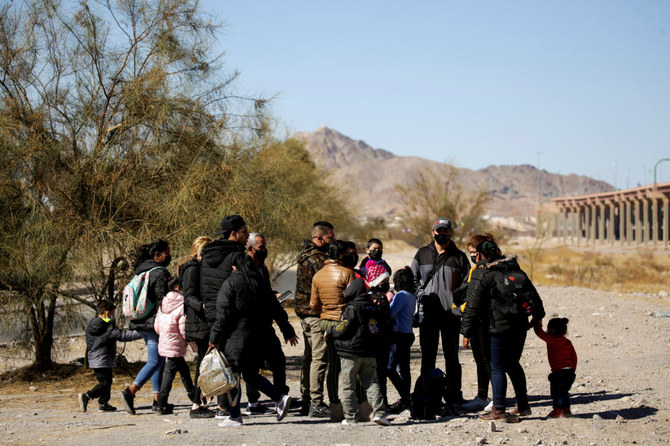
Migrants stand near the Rio Bravo river in Ciudad Juarez, Mexico before crossing it to turn themselves in to request for asylum in El Paso, Texas on February 5, 2021. (REUTERS/Jose Luis Gonzalez/File Photo)
Short Url
Updated 20 February 2021
Follow

Asylum seekers begin entering US under Biden reforms

TIJUANA, Mexico: A first group of 25 asylum seekers crossed the US border Friday under President Joe Biden’s sweeping immigration reforms, while thousands more waited in Mexico hoping that they, too, would be allowed in.
Under former president Donald Trump’s “Remain in Mexico” program, tens of thousands of non-Mexican asylum seekers — mostly from Central America — were sent back over the border pending the outcome of their applications.
Biden’s administration moved quickly to start dismantling the controversial policy, officially called the Migrant Protection Protocols (MPP), with a first stage that began on Friday.
A group of 25 migrants crossed the border by bus from the Mexican city of Tijuana accompanied by representatives of UN refugee agency UNHCR, according to an AFP journalist.
A shelter official in San Diego, who asked not to be named, later confirmed that they had arrived at a hotel there, although their final destinations were unknown.
The American Civil Liberties Union welcomed their arrival as “an important step in rebuilding” the US asylum system.
“But thousands are still suffering right now stuck in limbo under this inhumane policy,” ACLU San Diego spokesman Edward Sifuentes said.
“We urge the administration to quicken the process to safely welcome all people who suffered under MPP. For the families who have been forced to live in danger, there is no more time to wait.”
According to the US Department of Homeland Security (DHS), there are approximately 25,000 active cases. Mexico says 6,000 remain on its territory.
Candidates are tested for the coronavirus before crossing, a senior DHS official said.
Only those who have begun the process of applying for asylum will be considered for entry.
Tensions were high on the border as migrants waited to see if they would be allowed to cross over.
“Nobody knows anything. There’s tension. Stress is mounting,” Cuban lawyer Joel Fernandez said.
The 52-year-old crossed 11 countries to arrive in January 2020 in a camp in Matamoros across the border from Texas where he is staying with hundreds more migrants.
“I’ve withstood all the tests that God put in front of me on this difficult journey,” he said.
“Now I want the prize: to have my residency, to work, to bring my wife, my children.”
In Tijuana, hundreds of migrants spent the night next to the border fence hoping to be allowed in.
But most recognized that they had not yet initiated an asylum procedure.
“The truth is I don’t have an appointment,” said Haitian migrant Geraldine Nacice, who has family waiting for her in the United States.
“I can’t go back to my country any more. There’s war in Haiti right now,” she said, referring to the political turmoil shaking her country.
The “Remain in Mexico” program was part of Trump’s hard-line plan to fight undocumented immigration, along with the construction of a border wall and a policy which separated children from thousands of migrant families.
After Biden took office on January 20, his administration announced that it would reverse the most controversial measures.
On Thursday, Biden’s Democrats unveiled legislation for his plan to create a path to citizenship for 11 million undocumented immigrants already living in the United States.
In the Mexican border city of Ciudad Juarez, a 37-year-old who fled domestic abuse in El Salvador with her four children said she was optimistic things would get better under Biden.
The woman, who asked not to be named for safety reasons, had a US court hearing in December 2019.
But the pandemic and Trump’s tough immigration policies mean her asylum case has seen little progress.
Her dream is for her children to have a good education.
“It’s hard to tell your children that everything is going to be fine when you feel like the world is crashing down on you,” she said.


More than 200 political prisoners in Venezuela launch hunger strike

Updated 3 sec ago
Follow

More than 200 political prisoners in Venezuela launch hunger strike

GUATIRE: More than 200 Venezuelan political prisoners were on hunger strike Sunday to demand their release under a new amnesty law that excludes many of them.
The inmates at the Rodeo I prison, about 40 kilometers (25 miles) east of capital Caracas, shouted to their loved ones as part of the protest, an AFP journalist witnessed.
“Freedom!,” “release us all!” and “Rodeo I on strike” were among the cries from the prisoners that were audible from outside the facility.
The amnesty law was approved by Venezuela’s congress on Thursday as part of a wave of reforms encouraged by the United States after it ousted and captured former president Nicolas Maduro on January 3.
The hunger strike, which began Friday night, came about after inmates complained they would not benefit from the law because it excludes cases involving the military, which are the most common ones at that facility.
“Approximately 214 people in total, including Venezuelans and foreigners, are on hunger strike,” said Yalitza Garcia, mother-in-law of a prisoner named Nahuel Agustin Gallo.
Gallo, an Argentine police officer, is accused of terrorism, another category that is excluded.
“They decided Friday to go on hunger strike because of the scope of the amnesty law, which excludes many of them,” said Shakira Ibarreto, the daughter of a policeman arrested in 2024.
On Sunday, a team from the International Committee of the Red Cross (ICRC) visited the Rodeo I prison.
“This is the first time they have allowed us to approach that prison,” Filippo Gatti, the ICRC’s health coordinator for Venezuela, told family members. “It’s a first step, and I think we’re on the right track.”
Not all the inmates at the prison were joining the hunger strike, the relatives said.

- Amnesty law criticized -

The amnesty law was engineered by interim leader Delcy Rodriguez under pressure from Washington after US commandos attacked Venezuela on January 3, snatched Maduro and his wife and took them to the United States for trial on drug trafficking charges.
Opposition figures have criticized the new legislation, which appears to include carve-outs for some offenses previously used by authorities to target Maduro’s political opponents.
The law also excludes members of the security forces convicted of activities related to what the government considered terrorism.
But the amnesty extends to 11,000 political prisoners who, over nearly three decades, were paroled or placed under house arrest.
More than 1,500 political prisoners in Venezuela have already applied for amnesty under the bill, the head of the country’s legislature said Saturday.
Hundreds of others had already been released by Rodriguez’s government before the amnesty bill was approved.
On Sunday, a handful of inmates were released from Rodeo I, carrying release papers in their hands. They were greeted with applause.
“I’m out, I love you so much, my queen! I’m doing well,” Robin Colina, one of the freed prisoners, said excitedly into a mobile phone.
Armando Fusil, another released prisoner, told AFP: “Right now there are quite a few people on hunger strike because they want to get out.”
The 55-year-old police commissioner from the western state of Maracaibo said he was “arrested for no reason” in October 2024.
He said loved ones came to visit him every Friday since his arrest, taking a nearly 40-hour trip just for a little bit of face time each week.
Now, they’re coming to pick him up for good.
“We all help each other,” Fusil said about his fellow detainees. “It’s created a beautiful brotherhood.”
The NGO Foro Penal, dedicated to the defense of political prisoners, reported 23 releases on Sunday.
Maduro ruled Venezuela between March 2013 and January 2026, silencing opposition and activists under his harsh leftist rule.
Maduro and his wife are in US custody awaiting trial. Maduro, 63, has pleaded not guilty to drug trafficking charges and declared that he is a prisoner of war.