

Algeria frees first democracy activists after presidential pardons

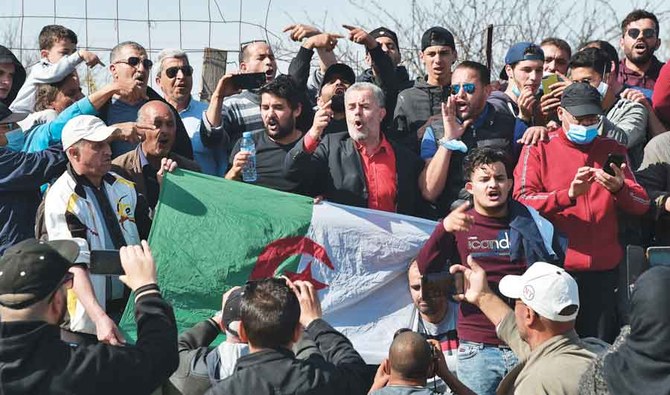
Algerians gather outside the Kolea prison near the city of Tipasa, some 70km west of the capital Algiers on Friday. (AFP)
Short Url
Updated 20 February 2021
Follow

Algeria frees first democracy activists after presidential pardons

  • Algeria is facing political and economic crises, with the coronavirus pandemic adding to the woes of an oil-dependent economy

ALGIERS: Algeria on Friday released a dozen pro-democracy activists from jail, the first batch freed under presidential pardons issued ahead of the second anniversary of a popular uprising.
President Abdelmadjid Tebboune, in a long-awaited speech to the nation late on Thursday, declared dozens of pardons in a gesture of appeasement as the Hirak protest movement gathers momentum once again.
The Hirak mass protests, meaning “movement” in Arabic, swept former President Abdelaziz Bouteflika from power in 2019, but continued after his fall.
Tebboune’s initiative comes on the eve of the Hirak’s second anniversary on Feb. 22, with calls on social media for demonstrations Monday to mark the day.
Algeria is facing political and economic crises, with the coronavirus pandemic adding to the woes of an oil-dependent economy.
The National Committee for the Liberation of Prisoners (CNLD), a rights group, announced the release on Friday, with more detainees expected to be released soon.
Relatives of prisoners and journalists gathered on Friday outside the Kolea prison, west of Algiers.
Among the prisoners in Kolea is journalist Khaled Drareni, sentenced to two years in prison in September, and who has become a symbol of the fight for press freedom in Algeria.

FASTFACT

Among the prisoners in Kolea is journalist Khaled Drareni, sentenced to two years in prison in September, and who has become a symbol of the fight for press freedom in Algeria.

“Behind the fence, we are waiting for Khaled,” said fellow journalist Mohamed Sidoummou. “We are all optimistic.”
It is not confirmed if Drareni, a correspondent for French-language TV5 Monde and press watchdog Reporters Without Borders, will be included in the pardon.
Around 70 people are currently in prison over their links with the Hirak movement or other peaceful opposition political activity, according to the CNLD.
Tebboune said that around 55 to 60 Hirak members would benefit from the amnesty, with their release to start immediately.
However, Drareni is waiting for the Supreme Court to rule on his appeal on February 25, and the pardon applies only to those whose cases are settled entirely, lawyer and rights activist Mostefa Bouchachi said.
Releasing activists whose cases are ongoing “poses a legal problem for the government, unless it is recognized that justice has worked badly,” wrote Abed Charef, on the Middle East Eye website.
The unprecedented protest movement, demanding a sweeping overhaul of the ruling system in place since Algeria’s independence from France in 1962, only suspended its rallies in March last year amid coronavirus restrictions.
On Tuesday, thousands of Algerians rallied in the northern town of Kherrata, where the first major protest erupted in 2019 against Bouteflika’s bid for a fifth presidential term.
Protesters demanded “the fall of the regime” and “the release of prisoners of conscience.”
On Friday, usually the day of Hirak marches, police deployed in large numbers in central Algiers.
“Algerians will continue to demonstrate peacefully to put pressure on the system so that it really changes,” Bouchachi said.
Tebboune on Thursday also announced early elections, calling for the dissolution of parliament and declaring a government reshuffle within 48 hours.
Legislative elections had been scheduled to be held in 2022, but Tebboune wants early polls to take place before year’s end.
But activists said Algeria needed bigger change than an election alone.
“Democracy is not limited to elections but to the exercise of democratic freedoms,” said Said Salhi, from the Algerian League for Human Rights.
“The Hirak calls for a change of the system through an authentic and open democratic process.”


Rubio plans to update Netanyahu on US-Iran talks in Israel next week, officials say

Updated 8 sec ago
Follow

Rubio plans to update Netanyahu on US-Iran talks in Israel next week, officials say

WASHINGTON: Secretary of State Marco Rubio plans to travel to Israel next week to update Israeli Prime Minister Benjamin Netanyahu on the US-Iran nuclear talks, two Trump administration officials said.
Rubio is expected to meet with Netanyahu on Feb. 28, according to the officials, who spoke Wednesday on condition of anonymity to detail travel plans that have not yet been announced.
The US and Iran recently have held two rounds of indirect talks over the Islamic Republic’s nuclear program.
Iran has agreed to draw up a written proposal to address US concerns that were raised during this week’s Geneva talks, according to another senior US official who was not authorized to comment publicly and spoke on the condition of anonymity.
That official said top national security officials gathered Wednesday in the White House Situation Room to discuss Iran, and were briefed that the “full forces” needed to carry out potential military action are expected to be in place by mid-March. The official did not provide a timeline for when Iran is expected to deliver its written response.
Officials from both the US and Iran had publicly offered some muted optimism about progress this week, with Iranian Foreign Minister Abbas Araghchi even saying that “a new window has opened” for reaching an agreement.
“In some ways, it went well,” US Vice President JD Vance said about the talks in an interview Tuesday with Fox News Channel. “But in other ways, it was very clear that the president has set some red lines that the Iranians are not yet willing to actually acknowledge and work through.”
Netanyahu visited the White House last week to urge President Donald Trump to ensure that any deal about Iran’s nuclear program also include steps to neutralize Iran’s ballistic missile program and end its funding for proxy groups such as Hamas and Hezbollah.
Trump is weighing whether to take military action against Tehran as the administration surges military resources to the region, raising concerns that any attack could spiral into a larger conflict in the Middle East.
On Friday, Trump told reporters that a change in power in Iran “seems like that would be the best thing that could happen.” He added, “For 47 years, they’ve been talking and talking and talking.”
The Trump administration has dispatched the USS Gerald R. Ford, the world’s largest aircraft carrier, from the Caribbean Sea to the Mideast to join a second carrier as well as other warships and military assets that the US has built up in the region.
Dozens of US fighter jets, including F-35s, F-22s and F-16s, have left bases in the US and Europe in recent days to head to the Middle East, according to the Military Air Tracking Alliance, a team of about 30 open-source analysts that routinely analyzes military and government flight activity.
The team says it’s also tracked more than 85 fuel tankers and over 170 cargo planes heading into the region.
Steffan Watkins, a researcher based in Canada and a member of the MATA, said he also has spotted support aircraft like six of the military’s early-warning E-3 aircraft head to a base in Saudi Arabia.
Those aircraft are key for coordinating operations with a large number of aircraft. He says they were pulled from bases in Japan, Germany and Hawaii.