Yemeni minister accuses Houthis of using displaced people as human shields in Marib

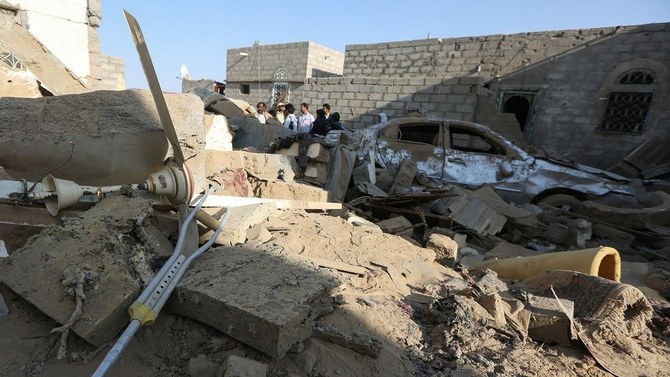
People stand near the site of a ballistic missile attack by the Iran-backed Houthi in the populated Rawda district in Marib, Yemen. (File/Reuters)
Short Url
Updated 19 February 2021
Follow

Yemeni minister accuses Houthis of using displaced people as human shields in Marib

  • Al-Aryani accused the Iran-backed Houthis of targeting displacement camps in Marib
  • The Houthi militia resumed a major offensive to seize control of the oil and gas-rich city of Marib earlier this month

AL-MUKALLA, Yemen: Dozens of Houthis and government troops were killed on Thursday in fierce clashes in Marib with local officials and NGOs warning that the fighting will have a major impact on the humanitarian crisis in Yemen.
Heavy fighting broke out on Thursday in Marib’s Kasara, Serwah, Murad, Jada’an, and Al-Makhdra areas as government forces and allied tribesmen, backed by Arab coalition warplanes, fought off relentless Houthi attacks.
A local military officer, who spoke on condition of anonymity, told Arab News that 27 Houthis died along with four government troops, including a field military commander, Brig. Ahmed Al-Shara’abi. They were killed as the coalition warplanes targeted Houthi fighters and reinforcements heading to the battlefields in Marib.
Amateur videos posted on social media by government supporters showed dozens of dead Houthi fighters abandoned in the desert and mountainous areas in Marib and neighboring Jawf. Official figures say more than 700 Houthis have been killed in a week of fierce fighting in the region.
The current uptick in fighting began earlier this month when the Iran-backed Houthis resumed a major offensive to seize control of the oil and gas-rich city of Marib, the Yemen government’s last major stronghold in the northern half of the country.
Despite aggressive ground attacks and heavy missile and drone strikes on the city, the rebels have failed to advance toward the city after suffering heavy casualties.
On Thursday, Gen. Abdu Abdullah Majili, Yemen’s army spokesman, told Arab News that the army troops and allied tribesmen have prevented the Houthis from making any gains.
The Yemeni army officer hailed the role of the Arab coalition warplanes, which paved the way for the army troops and tribesmen as they pushed the Houthis back on Marib battlefields.
At the same time, Yemeni government officials and rights groups have repeated concerns about the impact the Houthi offensive has had on thousands of displaced people living in Marib.
Yemen’s Minister of Information Muammar Al-Aryani on Thursday accused the Houthis of targeting displacement camps in Marib and using the people as human shields. He warned the rebels’ offensive would displace more than 2 million people sheltered in the city after fleeing the fighting and Houthi suppression in their home provinces.
“We call for an international investigation into the crimes of Houthi militia against displacement camps in Marib province,” the Yemeni minister said in a Twitter post. “This is a clear violation of the rules of international humanitarian law relating to the protection of civilians (during conflicts).”
The Houthi offensive has obstructed the distribution of vital humanitarian assistance to the displaced people and undermined calls for peace, the Yemeni minister said.
The Geneva-based Euro-Mediterranean Human Rights Monitor, along with 30 other local and international human rights and civil society organizations, on Wednesday wrote a joint letter to the EU’s top diplomat Josep Borrell, urging the EU to intervene. The groups warned of a major humanitarian disaster if the Houthis invaded the city.
Abdul Rahman Barman, the president of the American Center for Justice, one of the signatories, told Arab News the rebels would persecute the 2 million displaced people who live in Marib, which would prompt them to seek refuge in other safer areas in Yemen.
“We participated in this letter as Marib hosts the biggest concentration of the displaced people in Yemen,” Barman said. “We demand the international community to use its power to pressure the Houthis and to stop their assault on Marib.”


Japan, UNOPS sign $4.6m project to restore customs capacity at major Yemeni ports

Updated 9 sec ago
Follow

Japan, UNOPS sign $4.6m project to restore customs capacity at major Yemeni ports

  • The notes for the project were signed and exchanged in Riyadh on Thursday

RIYADH: Japan and the United Nations Office for Project Services have signed an agreement for a new grant aid project aimed at improving customs functions at key ports in Yemen.

The notes for the project were signed and exchanged in Riyadh on Thursday by Yoichi Nakashima, Japan’s ambassador to Yemen, and Muhammad Usman Akram, representative and director of the UNOPS Operational Hub in Amman. The grant amounts to 732 million yen (approximately $4.6 million).

The initiative, titled “The Project for the Improvement of Customs Functions at Major Ports,” seeks to address mounting operational challenges facing Yemen’s customs authorities after years of conflict.

Officials said damage to cargo inspection infrastructure, particularly X-ray screening systems, has significantly reduced inspection capacity at customs facilities. As a result, only about 20 percent of cargo entering through affected ports can be scanned, while the remaining shipments are subject to manual inspection.

This imbalance has contributed to prolonged clearance times and increased risks, including the potential smuggling of weapons, narcotics and other prohibited goods, according to statements delivered at the ceremony.

The project will focus on three major entry points: Aden Sea Port in Aden Governorate, Al-Shihn Land Port in Al-Mahra, and Al-Wadiah Land Port in Hadramout.

Under the agreement, Japan will fund the rehabilitation of X-ray inspection systems and the provision of modern detection equipment. The program also includes capacity development measures, including specialized training for Yemeni customs officials.

Speaking at the event, Nakashima said the project was designed to strengthen the operational capabilities of the Yemeni Customs Authority over an 18-month period. Improving inspection efficiency would help accelerate procedures while reducing reliance on manual checks.

Strengthening customs systems was expected to facilitate smoother trade flows and improve the handling of humanitarian shipments, which remain critical amid Yemen’s ongoing humanitarian crisis, he added.

UNOPS representative Akram described the agreement as a significant step forward in supporting Yemen’s customs authorities through Japanese funding.

“Today marks a significant step forward in strengthening the Yemeni Customs Authority through vital and much appreciated funding from our longstanding partner, the Government of Japan,” he said during the ceremony.

He added the project aimed to address key operational challenges facing the Yemen Customs Authority and enhance efficiency by strengthening institutional capacity in cargo inspection and clearance procedures.

According to Akram, the initiative is expected to reduce the time and costs associated with importing goods into Yemen, including humanitarian assistance.

To achieve these objectives, UNOPS will draw on its procurement expertise to acquire cargo inspection devices and critical spare parts required to restore existing vehicle and container scanners, alongside other necessary equipment.

Akram added that the program will also include capacity-building and training components to support effective operationalization of the upgraded systems.

He said Yemen had a historical role as a major trading crossroads linking the Red Sea and the Gulf of Aden, describing the measures under the project as an important step toward revitalizing and modernizing the country’s customs infrastructure.

The improvements, he said, were expected to facilitate trade, strengthen revenue collection and support the Yemeni government’s broader reconstruction and development priorities.

Akram also expressed appreciation to the Government of Japan for its continued partnership, as well as to Yemeni authorities for their cooperation in facilitating operational and logistical processes related to UNOPS projects.

“UNOPS remains committed to supporting the efforts of the Government of Yemen towards reconstruction and sustainable development with the valuable support of the international community,” he said.

Yemen’s Deputy Finance Minister Hani Wahab welcomed the agreement, describing the project as a major step in improving customs infrastructure and operational efficiency.

Speaking during the ceremony, he said the initiative would contribute to modernizing automated inspection systems, providing spare parts for equipment and supporting personnel training. He added improved customs capacity would help facilitate trade, strengthen revenue collection and combat the trafficking of illegal goods.

Nakashima also highlighted Japan’s broader development engagement with Yemen, saying the country had provided technical support in customs management through training programs implemented by JICA in recent years.

With the latest grant, total Japanese assistance to Yemen since 2015 has reached approximately $497 million. Japan said it would continue working with UN agencies and international partners to support peace and institutional resilience in Yemen.

This article also appears on Arab News Japan