Malala asks army, PM how Pakistani Taliban’s ex-spokesperson escaped custody

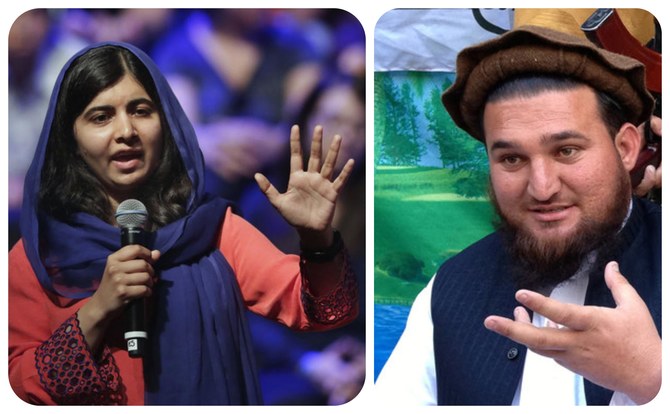
A collage photo of Nobel Prize-winning activist Malala Yousafzai (L) and former spokesperson for the Pakistani Taliban, Ehsanullah Ehsan (R). (Courtesy: Social Media)
Short Url
Updated 17 February 2021
Follow

Malala asks army, PM how Pakistani Taliban’s ex-spokesperson escaped custody

  • Malala responds to account claiming to be Ehsanullah Ehsan, tags PM Khan and Pakistani military and asks how he escaped detention in 2020
  • The handle asks Malala to return to her home in Swat, “we still have a lot of debts to settle with you and your dad“

ISLAMABAD: Nobel Prize winning activist Malala Yousafzai on Tuesday asked the Pakistani government and military how a former spokesperson for the Pakistani Taliban, Ehsanullah Ehsan, had escaped custody last year after an unverified Twitter account posted a veiled death threat to her.
A high-profile local Taliban figure who announced and justified a 2012 attack on Malala for campaigning for women’s education, Ehsan escaped detention in January last year and announced his breakout on social media. He has claimed responsibility on behalf of his group for scores of other Taliban attacks also.
On Tuesday, a social media user who claimed to be Ehsan took to Twitter and tagging Malala and her father, also an activist, said: “Dear Malala! Please pay a visit to your first home [Swat Valley} soon, we still have a lot of debts to settle with you and your dad, the debt that you owe us, we will receive it.”
And then, “This time an expert will be sent for the calculation so that no doubt remains,” he said, in a veiled threat that she would be killed in the next attack.
It was unclear if the user was actually Ehsan or someone impersonating him.
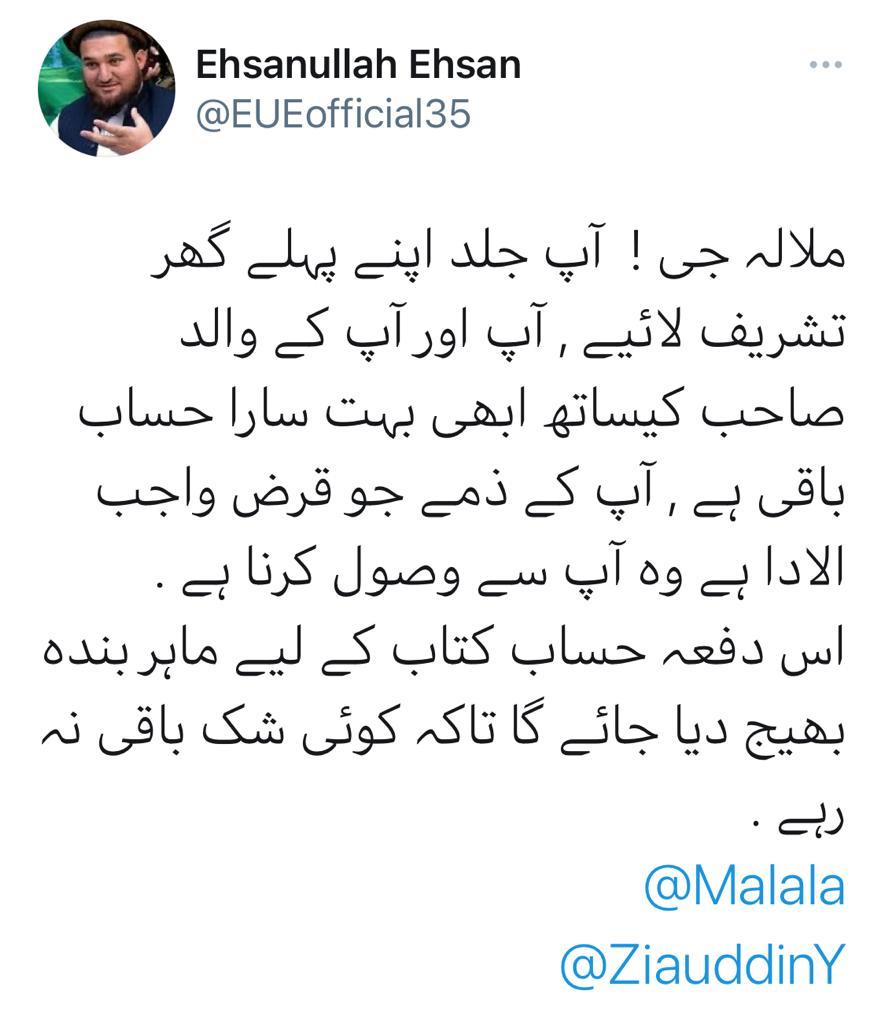
Reacting to the tweet, Malala wrote:
“This is the ex-spokesperson of Tehrik-i-Taliban Pakistan who claims responsibility for the attack on me and many innocent people. He is now threatening people on social media.”
“How did he escape,” she added, tagging Prime Minister Imran Khan and the media wing of the Pakistani military.

Since 2008, Malala has been advocating access to education for women and girls. In 2012, she was shot by a Pakistani Taliban gunman on her way home from school in Swat.
In 2014, she shared the Nobel Peace Prize with Indian children’s rights activist Kailash Satyarthi for her “struggle against the suppression of children and young people and for the right of all children to education.”
Ehsanullah is accused in several terror attacks in Pakistan including the 2014 assault on the Army Public School (APS) in Peshawar in 2014 in which more than 120 school children and 15 staff members were killed.
After Ehsan’s surrender in 2017, local Geo News TV aired an interview he gave in custody in which he asserted that the intelligence services of Pakistan’s arch-rival, India, had been funding and arming Pakistani Taliban fighters.
The Pakistan army pledged to put Ehsan on trial but had not done so until the time he escaped custody in 2020. His whereabouts are uncertain.


Pakistan PM calls privatization top priority, discusses selling power firms after PIA stake sale

Updated 07 January 2026
Follow

Pakistan PM calls privatization top priority, discusses selling power firms after PIA stake sale

  • Government plans to privatize five electricity distributors as part of IMF-backed economic reforms
  • Last year, a consortium led by Arif Habib Group won the bid for a 75 percent controlling stake in PIA

ISLAMABAD: Prime Minister Shehbaz Sharif described the privatization of state-owned enterprises (SOEs) as his administration's top priority on Tuesday, as he discussed the sale of loss-making power distribution companies after the government successfully divested a 75 percent stake in Pakistan International Airlines (PIA) in December.

The push to privatize power utilities follows the government’s efforts to restructure and offload state firms under broader economic reforms recommended by the International Monetary Fund (IMF) under a $7 billion loan program with Pakistan.

The IMF has repeatedly urged Islamabad to reduce fiscal losses by privatizing or restructuring chronically loss-making SOEs.

“Privatization of loss-making state-owned enterprises is among the government’s top priorities,” the prime minister said, according to a statement released by his office after a meeting on privatization. “The successful privatization of 75 percent shares of PIA is the first drop of rain.”

Last month, a consortium led by the Arif Habib Group won the bid for a 75 percent controlling stake in the national flag carrier, offering Rs 135 billion ($482 million) in a transaction the government described as a milestone in its privatization drive.

Building on that momentum, officials said the Privatization Commission plans to divest electricity distribution companies in two batches. The first phase will include Islamabad Electric Supply Company, Gujranwala Electric Power Company and Faisalabad Electric Supply Company, followed by Hyderabad Electric Supply Company and Sukkur Electric Power Company in the second batch.

Prime Minister Shehbaz Sharif also directed the commission to accelerate digitalization and strengthen its public relations and marketing functions to improve transparency, governance and engagement with investors, according to the statement.

The power sector has long been a drain on public finances due to high losses, inefficiencies and mounting subsidies, making it a central focus of Pakistan’s reform agenda under the IMF program.

Prior to the PIA sale, the United Arab Emirates-based International Holding Company acquired a majority stake in First Women Bank Limited under a government-to-government privatization deal.

That transaction was finalized in October 2025, with Pakistani and UAE officials attending the signing ceremony.