Saudi Arabia’s Hadaf spends $93m on training, job initiatives

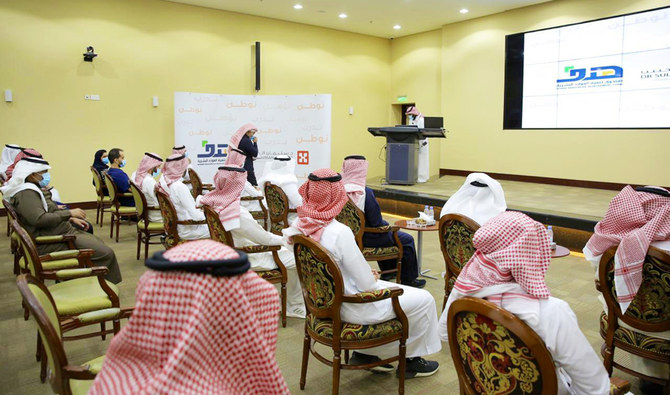
Hadaf provides training, employment and enablement programs to support citizens and facilities in different sectors. (Photo/Twitter)
Short Url
Updated 16 February 2021
Follow

Saudi Arabia’s Hadaf spends $93m on training, job initiatives

  • Hadaf is committed to training and empowering male and female citizens to find job opportunities in different fields required by the Saudi labor market

RIYADH: The Saudi Human Resources Development Fund (Hadaf) has revealed that funding for employment and training initiatives and programs in January reached SR351 million ($93 million), exceeding for the third consecutive month the Hafiz job seekers’ payment support, which reached SR218 million.
The expenditures have been increasing because of the developing and improving quality of programs, and the growing number of beneficiaries, including citizens and private sector enterprises.
At the start of the year, Hadaf implemented a new strategy that focuses on promoting partnership with the private sector, while also developing and improving support initiatives, with the aim of empowering and training citizens.
Hadaf provides training, employment and enablement programs to support citizens and facilities in different sectors, including the employment support program, the on-the-job training program (Tamheer,) the Nine Tenth platform, the program to support professional and technical diplomas, the program to support the transport of working women (Wusul,) and the national e-training platform (Doroob,) as well as many others.
Hadaf is committed to training and empowering male and female citizens to find job opportunities in different fields required by the Saudi labor market, in line with the Vision 2030 reform plan.


Makkah’s urban shift enhances the city’s quality of life

Updated 08 February 2026
Follow

Makkah’s urban shift enhances the city’s quality of life

  • By harmonizing its religious heritage with modern urban development, Makkah is proving that a city can honor its past while vigorously embracing the future

MAKKAH: Islam’s holiest city is currently witnessing a qualitative urban shift, one that seamlessly blends its profound spiritual sanctity with a modern, vibrant lifestyle. By integrating cultural, educational, and entertainment initiatives, Makkah is redefining the visitor experience and significantly enhancing the quality of life for its residents, directly supporting the goals of Saudi Vision 2030.

The city’s transformation was recently highlighted by the success of the Makkah winter season. The event attracted approximately 400,000 visitors — over 60% of whom were locals — demonstrating a strong domestic demand for high-quality public spaces.

The season revitalized community interaction, driving a 35% increase in visits to recreational sites and creating more than 1,200 temporary jobs for the local workforce.

Central to this urban renaissance is the Hira Cultural District. Since opening its doors in January 2023 near the historic Mount Hira, the district has become a definitive landmark that bridges Islamic history with contemporary identity.

Makkah’s Hira Cultural District has become a definitive landmark that bridges Islamic history with contemporary identity. (SPA photo)

Far from being a static monument, the district has cultivated a thriving creative economy. Its craftsmanship program, which features over 100 artisans, has generated up to SAR 3 million in sales and attracted 130,000 visitors to live workshops. These interactive spaces allow visitors to engage directly with the region’s heritage, moving beyond passive observation to active participation.

A living legacy 

The shift extends to Makkah’s broader ecosystem of museums and cultural sites, which are now positioned as key pillars of cultural tourism. Facilities like the Revelation Exhibition use cutting-edge technology and multilingual content to narrate the story of the Holy Quran’s revelation, offering an immersive experience that complements the spiritual journey of pilgrims.

These efforts align with the “Makkah: A Living Legacy” campaign, which seeks to document the city’s historical narrative and preserve its collective memory. Recent months have seen a surge in educational workshops for university students and tour guides, ensuring that the human element of Makkah’s history is conveyed with accuracy and depth.

City’s transformation recently highlighted by the success of the Makkah winter season. (SPA photo)
 

Economic and social impact 

The results of this integrated approach are tangible. Specialized museums and restored historic sites now attract up to 1.6 million annual visitors. Crucially, this cultural enrichment is encouraging pilgrims to linger longer, increasing the average duration of stay by 18%.

By harmonizing its religious heritage with modern urban development, Makkah is proving that a city can honor its past while vigorously embracing the future, offering a holistic experience that nourishes both the soul and the community.