

Saudi Arabia, UAE biggest contributors as Pakistan remittances exceed $2 bln for eighth month

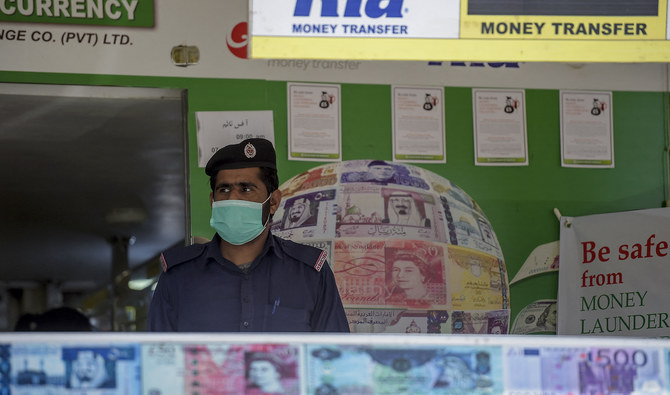
A security guard wearing a facemask stands guard outside a currency exchange shop in Rawalpindi, Pakistan, on March 18, 2020. (AFP/File)
Short Url
Updated 15 February 2021
Follow

Saudi Arabia, UAE biggest contributors as Pakistan remittances exceed $2 bln for eighth month

  • Central bank says largest share of remittances during Jul-Jan FY21 from Saudi Arabia ($4.5 billion), UAE ($3.4 billion), UK ($2.2 billion), US ($1.4 billion)
  • Pakistan received $16.5 billion total remittances during July to January, a 24 percent increase compared to same period last year

ISLAMABAD: Remittances from Pakistani workers employed abroad exceeded $2.0 billion for the eighth straight month in January at $2.3 billion, up 19% from a year earlier, the country's central bank said on Monday, with the highest inflows from Saudi Arabia and the United Arab Emirates.

In a tweet on Monday, Prime Minister Imran Khan said this was a “record” for Pakistan, thanking the diaspora.

The South Asian nation of 220 million relies heavily on remittances to boost the country’s depleted foreign exchange reserves and mitigate a recurrent balance of payments crisis.

The State Bank said Pakistan had received $16.5 billion in total in remittances during July to January of this fiscal year, a 24 percent increase compared to the same period last year.  

The bank said the largest remittances during Jul-Jan FY21 came from Saudi Arabia ($4.5 billion), the United Arab Emirates ($3.4 billion), the United Kingdom ($2.2 billion) and the United States ($1.4 billion).

Official statistics show that around four million Pakistanis live and work in Saudi Arabia and the UAE.

The sustained increase in remittances largely reflects the growing use of banking channels, the central bank said in a statement, saying Pakistan was making continued efforts to attract inflows through official channels.

Limited cross-border travel due to a second wave of coronavirus pandemic, and a flexible exchange rate regime also boosted remittances, it added.

Travel restrictions and introduction of digital apps for transferring money are the main reasons behind higher remittances among others, Samiullah Tariq, head of research and development at Pakistan Kuwait Investment Company, told Reuters.

Remittances to Pakistan increased from over five percent of GDP in 2009 to almost eight percent in 2019, according to the World Bank. Their contribution to GDP could be well above nine percent of GDP if they cross the $28 billion mark by the end of this fiscal year.

Experts said the boost in remittances was not only helping stabilize the balance of payments crisis and the currency parity and exchange rate, but also contributing significantly to the country’s economic revival.

“The increase in remittances ultimately helps boost local investment in different sectors especially in real estate, creates job opportunities and extends livelihood support to tens of thousands of families,” Tariq told Arab News.


Pakistan says it seized 32 square kilometers inside Afghanistan as border clashes escalate

Updated 6 sec ago
Follow

Pakistan says it seized 32 square kilometers inside Afghanistan as border clashes escalate

  • Security official describes ‘limited tactical action’ in Gudwana after Afghan assaults
  • Islamabad accuses Kabul of sheltering militants as UN, China and Russia urge restraint

ISLAMABAD: Pakistan has seized a 32-square-kilometer area inside Afghanistan following overnight fighting, a security official said on Saturday, as cross-border clashes between the two countries escalated sharply.

A Pakistani security official, speaking on condition of anonymity, said troops carried out a “limited tactical action” in the Gudwana area opposite the Zhob sector along the frontier, capturing Afghan territory after responding to attacks on Pakistani positions.

“On the night of Feb. 26/27, posts opposite the Zhob sector launched anticipated physical attacks on multiple Pakistani positions,” the official said, referring to fighters linked to Afghanistan’s Taliban authorities, whom Islamabad identifies as Tehreek-e-Taliban Afghanistan (TTA).

“In response to aggressive unprovoked fire and physical attacks, Pakistan security forces launched a limited tactical action on the night of Feb. 27/28 in the general area of Gudwana with a view to capture TTA Tahir Post,” he continued, adding that 32 square kilometers of Afghan territory were seized.

The official said special combat teams crossed the border after preparatory bombardment, supported by intelligence, surveillance and reconnaissance assets providing “real-time battlefield awareness.”

He said 24 Afghan Taliban fighters were killed and 37 wounded, with no Pakistani casualties reported.

The claims could not be independently verified, and there was no immediate confirmation from Taliban authorities in Kabul of any territorial loss in the Gudwana area.

The latest clashes erupted after Pakistani airstrikes targeted what Islamabad described as militant hideouts inside Afghanistan over the weekend, triggering retaliatory fire along the frontier and sharply escalating long-running tensions. Islamabad accuses Kabul of sheltering Pakistani Taliban militants responsible for attacks inside Pakistan, an allegation that Afghanistan denies.

Pakistan’s Information Minister Attaullah Tarar said on Saturday evening that 352 Afghan Taliban fighters had been killed and more than 535 wounded since the latest phase of hostilities began.

Tarar said Pakistani strikes had destroyed 130 check posts, 171 tanks and armored vehicles and targeted 41 locations across Afghanistan by air. Those figures could not be independently verified.

The United Nations, as well as China and Russia, have called for restraint.

The United States said Pakistan has the right to defend itself against cross-border militancy.