

Afghan Taliban reject report chief Hibatullah killed in Pakistan

Top Taliban officials arrive in Doha, Qatar, for talks on the intra-Afghan dialogue on July 7, 2019. (AFP/File)
Short Url
Updated 14 February 2021
Follow

Afghan Taliban reject report chief Hibatullah killed in Pakistan

  • Afghan daily claims Mullah Hibatullah Akhundza was killed in an explosion at a safe house in Quetta several months ago
  • Report about Hibatullah's death comes as the US plans to review its last year's agreement with the Taliban to withdraw troops from Afghanistan

KABUL: The Taliban on Sunday rejected a media report claiming that the group's chief, Mullah Hibatullah Akhundza, had been killed in a blast in Quetta, southwest Pakistan.

A prominent Afghan daily, Hashte Subh, citing anonymous sources, said on Sunday that the explosion had occurred in a safe house several months ago, killing Hibatullah, the group's intelligence head Matitullah and Hafiz Abdul Majid, their chief of finance.

The Quetta house, according to Hashte Subh, had been used as the main headquarters for Taliban leaders since their ouster in a US-led invasion of Afghanistan in 2001.

“This report is utterly fake and far from reality," Zabihullah Mujahid, a spokesman for the Taliban, told Arab News over the phone from an undisclosed location.

"We reject this report ... the enemy is under pressure and is trying to create worry through spreading such rumors,” he said. "Neither our leaders are in Pakistan nor such incident can be kept hidden."

Last year, an explosion ripped a mosque in Quetta, which according to press reports was used by Hibatullah. While Reuters back then reported that his brother, Ahmadullah, was killed by the blast, Hibatullah apparently had not been present in the mosque at that time.
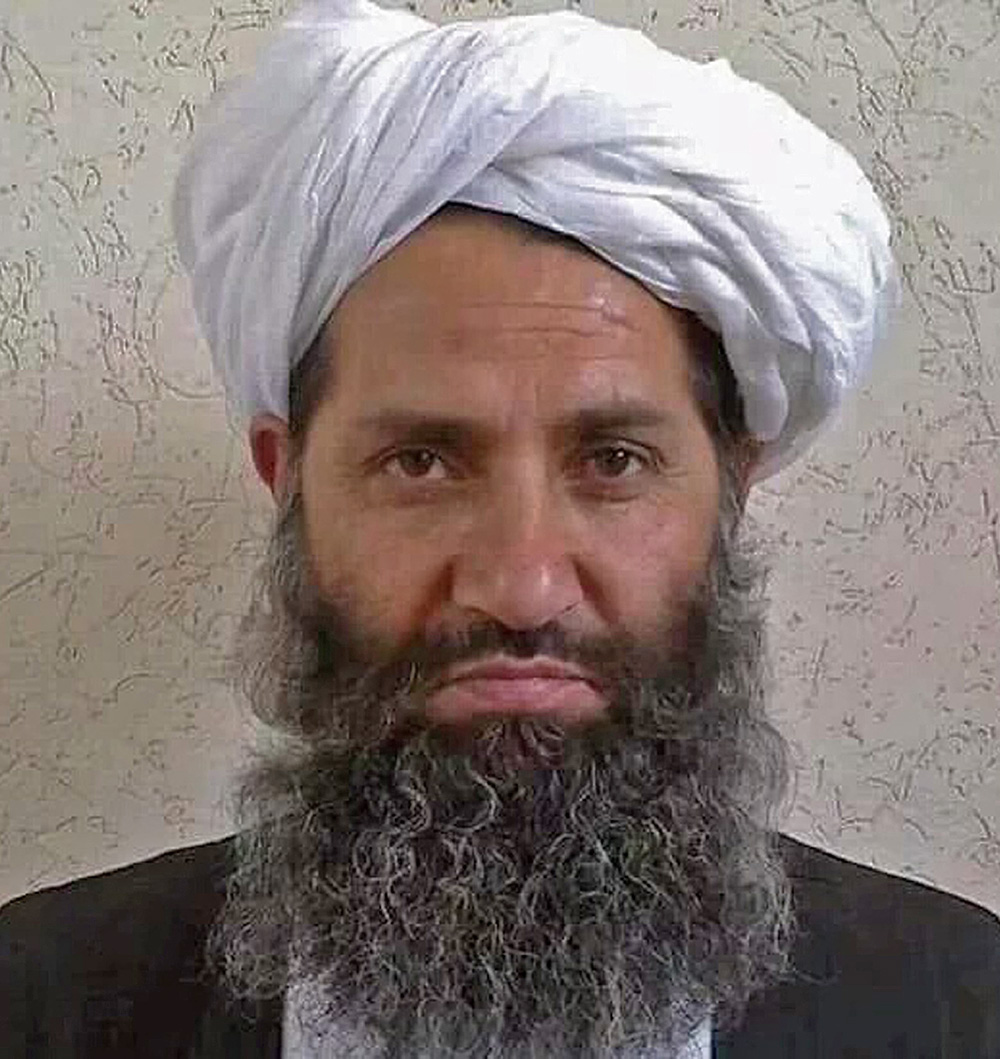


This undated handout photograph released by the Afghan Taliban on May 25, 2016 shows, Mullah Haibatullah Akhundzada posing for a photograph at an undisclosed location. (AFP/File)

In May 2016, Hibatullah, 60, succeeded Mullah Akhtar Mansoor who was killed in a US drone strike near Quetta. Mansoor became the group's chief in 2015, after Mullah Mohammad Omar, the founder of the Taliban movement, died of an illness in a Pakistani hospital in 2013.

Haji Agha Lalai, a provincial council member of Kandahar, the birthplace of the Taliban movement and the group’s seat of power, told Arab News that he had heard that months ago some people wanted to see Hibatullah but "were not able to do so and instead a message attributed to him was read to them."

A senior Afghan security official in Kabul said on condition of anonymity that he had heard months ago that Hibatullah had been killed last summer, but he could neither confirm nor deny it.

There have been no statements by Hibatullah for months, despite ongoing intra-Afghan negotiations between the Taliban and Kabul government in Doha, Qatar, to end decades of armed conflict in Afghanistan.

The news about Hibatullah's reported killing comes amid a halt in the talks and plans by the new US administration to review its last year's agreement with the Taliban to withdraw all US-led NATO troops from Afghanistan by May.

The Afghan government insists that the troops remain and NATO members are set to discuss the forces withdrawal this week.

The Taliban, meanwhile, have repeatedly urged Washington to honor the deal signed by the previous US administration.

"Our message to the upcoming NATO ministerial meeting is that the continuation of the occupation and war is neither in your interest nor in the interest of your and our people," the group said in a statement on Saturday.



Pakistan, global crypto exchange discuss modernizing digital payments, creating job prospects 

Updated 05 December 2025
Follow

Pakistan, global crypto exchange discuss modernizing digital payments, creating job prospects 

  • Pakistani officials, Binance team discuss coordination between Islamabad, local banks and global exchanges
  • Pakistan has attempted to tap into growing crypto market to curb illicit transactions, improve oversight

ISLAMABAD: Pakistan’s finance officials and the team of a global cryptocurrency exchange on Friday held discussions aimed at modernizing the country’s digital payments system and building local talent pipelines to meet rising demand for blockchain and Web3 skills, the finance ministry said.

The development took place during a high-level meeting between Finance Minister Muhammad Aurangzeb, Pakistan Virtual Assets Regulatory Authority (PVARA) Chairman Bilal bin Saqib, domestic bank presidents and a Binance team led by Global CEO Richard Teng. The meeting was held to advance work on Pakistan’s National Digital Asset Framework, a regulatory setup to govern Pakistan’s digital assets.

Pakistan has been moving to regulate its fast-growing crypto and digital assets market by bringing virtual asset service providers (VASPs) under a formal licensing regime. Officials say the push is aimed at curbing illicit transactions, improving oversight, and encouraging innovation in blockchain-based financial services.

“Participants reviewed opportunities to modernize Pakistan’s digital payments landscape, noting that blockchain-based systems could significantly reduce costs from the country’s $38 billion annual remittance flows,” the finance ministry said in a statement. 

“Discussions also emphasized building local talent pipelines to meet rising global demand for blockchain and Web3 skills, creating high-value employment prospects for Pakistani youth.”

Blockchain is a type of digital database that is shared, transparent and tamper-resistant. Instead of being stored on one computer, the data is kept on a distributed network of computers, making it very hard to alter or hack.

Web3 refers to the next generation of the Internet built using blockchain, focusing on giving users more control over their data, identity and digital assets rather than big tech companies controlling it.

Participants of the meeting also discussed sovereign debt tokenization, which is the process of converting a country’s debt such as government bonds, into digital tokens on a blockchain, the ministry said. 

Aurangzeb called for close coordination between the government, domestic banks and global exchanges to modernize Pakistan’s payment landscape.

Participants of the meeting also discussed considering a “time-bound amnesty” to encourage users to move assets onto regulated platforms, stressing the need for stronger verifications and a risk-mitigation system.

Pakistan has attempted in recent months to tap into the country’s growing crypto market, crack down on money laundering and terror financing, and promote responsible innovation — a move analysts say could bring an estimated $25 billion in virtual assets into the tax net.

In September, Islamabad invited international crypto exchanges and other VASPs to apply for licenses to operate in the country, a step aimed at formalizing and regulating its fast-growing digital market.