

British Muslim human rights lawyer elected new ICC chief prosecutor

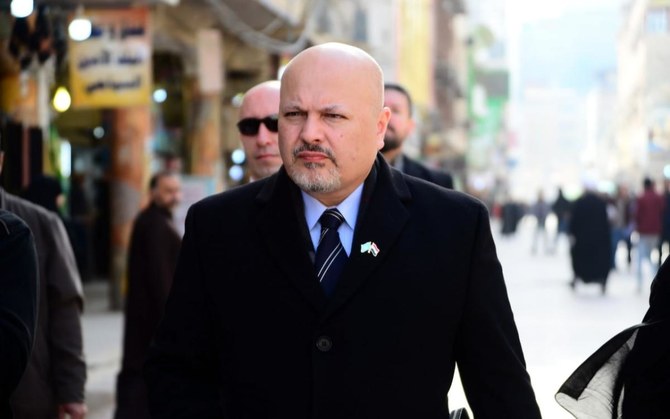
British human rights lawyer Karim Khan was elected Friday to be the new prosecutor of the International Criminal Court. (AFP/File Photo)
Short Url
Updated 13 February 2021
Follow

British Muslim human rights lawyer elected new ICC chief prosecutor

  • Khan, 50, led a UN probe into atrocities by the Daesh group
  • The lawyer won a secret ballot against three other candidates to replace lead prosecutor Fatou Bensouda

LONDON: Parties to the International Criminal Court on Friday elected Britain’s Karim Khan as the new prosecutor for a nine-year term starting on June 16.
Khan won a secret ballot against three other candidates to replace lead prosecutor Fatou Bensouda. The 123-member Hague-based court, which began work nearly 20 years ago, handles war crimes, crimes against humanity, genocide and crimes of aggression.
British barrister Karim is best known for heading the United Nations’ special investigative team looking into Daesh crimes in Iraq.
In his 27-year law career Khan, who is also Queens Counsel, has worked for almost every international criminal tribunal in roles in prosecution, defence and as counsel for victims. At the ICC Khan is best known for being a lead defense counsel who has worked on cases from Kenya, Sudan and Libya.
There was intense political jostling for the top ICC job at a time of heightened scrutiny of the prosecutor’s office.
Former US President Donald Trump’s administration imposed sanctions last year on court staff including Bensouda over investigations by her office into possible war crimes committed in Afghanistan, including by American troops. The United States is not a member of the court.
New US President Joe Biden’s administration will "thoroughly review" the sanctions on ICC officials, a State Department spokesman said last month.
Then last week the court said it has jurisdiction over war crimes committed in the Palestinian territories, which could lead to an inquiry strongly opposed by non-ICC member Israel and the US.
One of the first decisions by Khan could be whether to press ahead with a full investigation into the Palestinian territories, where Bensouda said there is a reasonable basis to conclude war crimes may have been committed by both Israeli forces and Palestinian armed groups.
“Karim’s extensive experience in international law will be pivotal in ensuring we hold those responsible for the most heinous crimes to account and gain justice for their victims,” Britain’s Foreign Secretary Dominic Raab posted on Twitter. 


US Justice Department official eyes cases against Cuba leaders as Trump floats ‘friendly takeover’

Updated 07 March 2026
Follow

US Justice Department official eyes cases against Cuba leaders as Trump floats ‘friendly takeover’

  • “Working group” formed to build cases against people connected to the Cuban government
  • Trump’s has increasingly displayed aggressive stance against Cuba’s communist leadership

MIAMI: The top Justice Department prosecutor in Miami is considering criminal investigations of Cuban government officials, according to people familiar with the matter. The inquiry comes as President Donald Trump has raised the possibility of a “friendly takeover” of the communist-run island.
Jason Reding Quiñones, the US attorney for the Southern District of Florida, has created a “working group” that includes federal prosecutors and officials from the Drug Enforcement Administration and other agencies to try to build cases against people connected to the Cuban government and its Communist Party, according to one of the people. They spoke on the condition of anonymity because they were not authorized to publicly discuss the effort.
It was not immediately clear which Cuban officials the office is targeting or what criminal charges prosecutors may be looking to bring.
The Justice Department said in a statement Friday that “federal prosecutors from across the country work every day to pursue justice, which includes efforts to combat transnational crime.”
The effort is taking place against the backdrop of Trump’s increasingly aggressive stance against Cuba’s communist leadership.
Emboldened by the US capture of Cuba’s close ally, Venezuelan President Nicolás Maduro, Trump last month said his administration was in high-level talks with officials in Havana to pursue “a friendly takeover” of the country. He repeated those claims this week, saying his attention would turn back to Cuba once the war with Iran winds down.
“They want to make a deal so bad,” Trump said of Cuba’s leadership.
While Cuba has faded from Washington’s radar as a major national security threat in recent decades, it remains a priority in the US Attorney’s office in Miami, whose political, economic and cultural life is dominated by Cuban-American exiles.
The FBI field office has a dedicated Cuba group that in 2024 was instrumental in the arrest of former US Ambassador Victor Manuel Rocha on charges of serving as a secret agent of Cuba stretching back to the 1970s.
In recent weeks, several Miami Republicans, in addition to Florida Sen. Rick Scott, have called on the Trump administration to reopen its criminal investigation into the 1996 shootdown of four planes operated by anti-communist exiles.
In a letter to Trump on Feb. 13, lawmakers including Reps. Maria Elvira Salazar and Carlos Gimenez highlighted decades-old news reports indicating that former President Raúl Castro — the head of Cuba’s military at the time — gave the order to shoot down the unarmed Cessna aircraft.
“We believe unequivocally that Raúl Castro is responsible for this heinous crime,” lawmakers wrote. “It is time for him to be brought to justice.”
While no indictment against Castro has been announced, Florida’s attorney general said this week that he would open a state-level investigation into the crime.
The Trump administration has also accused Cuba of not cooperating with American counterterrorism efforts, adding it alongside North Korea and Iran to a select few nations the US considers state sponsors of terrorism.
The designation stems from Cuba’s harboring of US fugitives and its refusal to extradite several Colombian rebel leaders while they were engaged in peace talks with the South American nation.