

Tajikistan quake shakes north India, Pakistan, no major damage

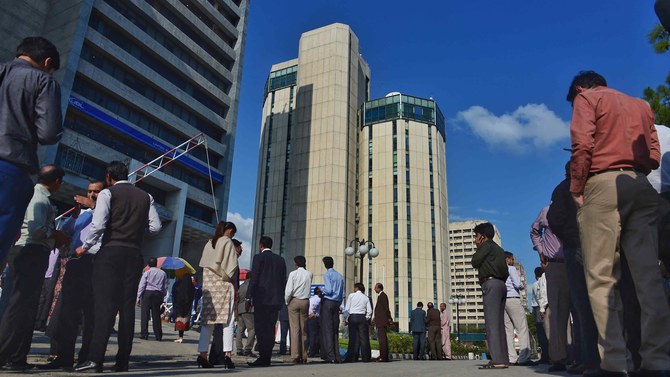
Pakistani federal employees gather outside their offices after a 7.5-magnitude earthquake in Islamabad on October 26, 2015. (AFP/File)
Short Url
Updated 13 February 2021
Follow

Tajikistan quake shakes north India, Pakistan, no major damage

  • The US Geological Survey put the quake's magnitude at 5.9
  • In Muzaffarabad, where a 2005 earthquake wreaked serious destruction, many people rushed out of their homes in fear

NEW DELHI: Strong tremors were felt in northern India and Pakistan on Friday as a result of an earthquake in Tajikistan, witnesses said. Many residents ran out of their homes, but no major damage was reported.

The US Geological Survey put the quake's magnitude at 5.9 and centered 35 km (55 miles) west of Murghob in Tajikistan, central Asia.

The Tajikistan Emergency Situations Ministry said the epicenter was 420 km (260 miles) east of the Tajik capital Dushanbe near the border with China.

Tremors were felt in Dushanbe but the epicenter was in a sparsely populated area.

Cracks were reported in some homes in northern Kashmir, the Indian Meteorological Department said. A witness also reported a wall collapse near the northern Indian city of Amritsar, but there were no reports of casualties.

A resident in Indian-administered Kashmir's Baramulla district said it felt like a strong wind had lashed his house. "My whole house shook and cracks appeared in a corner of one of the rooms," Firdous Ahmad Khan said.

Tremors were felt across Pakistan including the capital, Islamabad, and northwestern Peshawar, and even as far as the eastern city of Lahore, which borders India.

In Muzaffarabad, the capital of Pakistani Kashmir, where a 2005 earthquake wreaked serious destruction, there was panic, according to witnesses, and many people rushed out of their homes in fear.

"I thought it's the same like what had hit us in 2005. My children started crying," said Asif Maqbool, a resident in Madina Market, a neighborhood of Muzaffarabad that was almost flattened in the 2005 quake.

Saima Khalid, a resident of the Khawaja Muhalla district of Muzaffarabad, said everyone in the neighborhood came out onto the streets.

"They were crying, reciting verses from the Holy Quran," she said.


‘No to the war’: Spain digs in as rift with US deepens

Updated 10 sec ago
Follow

‘No to the war’: Spain digs in as rift with US deepens

  • Pedro Sanchez: ‘We will not be complicit in something that is harmful to the world and contrary to our values and interests’
  • US forces use the Rota naval base and Moron air base in southern Spain under an agreement signed in 1953 under the dictatorship of General Francisco Franco

MADRID: Spain’s prime minister defiantly posted “No to the war” on Wednesday, deepening a rift with the United States after Madrid refused the use of its bases to attack Iran and Washington threatened trade reprisals.
Spain’s Socialist Prime Minister Pedro Sanchez had already angered US President Donald Trump with a series of other policies.
Sanchez has refused to join NATO allies in a pledge to boost defense spending to five percent of GDP as demanded by Trump, and has fiercely criticized Israel’s war in Gaza.
Trump lashed out at Sanchez’s government on Tuesday, calling Spain a “terrible” ally and threatening to sever all trade with Spain.
Sanchez defended his position on Wednesday, saying his government’s position “can be summed up in four words: no to the war.”
“We will not be complicit in something that is harmful to the world and contrary to our values and interests, simply out of fear of retaliation,” he added in a televised address.
Spain is part of the European Union, which allows goods to move freely between its 27 countries. This would complicate any bid to impose trade restrictions on a single member state.
“Trump’s words don’t always become policy. We will have to see if he follows through, and how,” said Angel Saz Carranza, director of the Esade Center for Global Economy and Geopolitics, a Spanish think tank.
European Council chief Antonio Costa wrote on X that he had called Sanchez to “express the EU’s full solidarity with Spain.”
“The EU will always ensure that the interests of its member states are fully protected,” Costa said.
French President Emmanuel Macron also called to “express France’s European solidarity in response to the recent threats of economic coercion targeting Spain,” his office said.

‘Oppose this disaster’

US forces use the Rota naval base and Moron air base in southern Spain under an agreement signed in 1953 under the dictatorship of General Francisco Franco.
During the 2003 invasion of Iraq, Spain, then led by conservative prime minister Jose Maria Aznar, staunchly backed the United States by sending troops.
Spain’s participation in the Iraq war sparked huge street demonstrations and many Spaniards blame it for the March 11, 2004 Madrid train bombings that killed nearly 200 people.
A branch of Al-Qaeda claimed responsibility for the attacks and called for the withdrawal of Spanish forces from Iraq.
Sanchez on Wednesday compared the Iran attacks to the Iraq war, which he said increased terrorism, increased energy prices and led to a less secure world.
“We oppose this disaster,” he said in reference to the Iran war.
In contrast, neighboring Portugal authorized the United States to “conditionally” use an air base on the Azores archipelago in the Atlantic Ocean for the Iran strikes, Prime Minister Luis Montenegro told parliament on Wednesday.
The authorization was granted as long as “these operations are defensive or retaliatory, are necessary and proportionate, and exclusively target military objectives,” Montenegro said.
The conservative leader said those conditions were “aligned with international law,” but he declined to openly support Sanchez or take a stance on the US-Israeli strikes on Iran.

Rally his base

The Spanish prime minister has emerged as a prominent figure for Europe’s disillusioned progressives, who see him as one of the few remaining openly leftist voices in a continent increasingly dominated by right-wing politics.
His opposition to the use of the bases is seen by some analysts as an attempt to rally his supporters around an issue that unites the Spanish left.
Sanchez, in power since 2018, heads a minority coalition government that struggles to pass legislation.
The popularity of his Socialist party has taken a hit from a string of sexual harassment and graft scandals ahead of the next general election due in 2027.
Many on Spain’s right consider Sanchez’s opposition to Trump as motivated more by domestic politics than by a moral compass.
The head of the main opposition conservative Popular Party which tops opinion polls, Alberto Nunez Feijoo, accused Sanchez on X of using foreign policy for “partisan” purposes.
Left-leaning daily newspaper El Pais urged Sanchez in an editorial on Wednesday to “resist the temptation” to “exploit widespread hostility toward Trump in Spanish society to boost his popularity.”