

Pakistanis turn to mobile app to background check domestic help

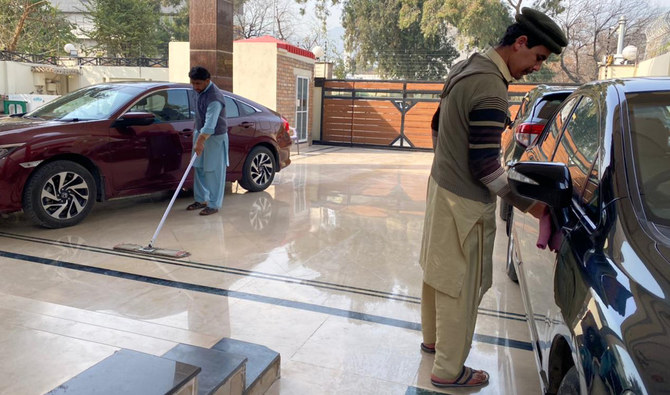
Domestic helpers clean the floor and cars at a house in Islamabad on February 12, 2021 (AN Photo)
Short Url
Updated 13 February 2021
Follow

Pakistanis turn to mobile app to background check domestic help

  • The Safe Pakistan Welfare Trust launched Tasdeeq in collaboration with Karachi’s Citizens-Police Liaison Committee and police last August
  • Police say 60% “robberies, banditry, kidnapping and murders” are carried out with the direct or indirect involvement of domestic staff

KARACHI: Last November, Laeeq Akbar decided to use an app called Tasdeeq to background check a new employee she was hiring at a spa she runs in an upmarket neighborhood in Pakistan’s financial hub of Karachi.
It turned out the man had a criminal record and had been involved in a series of muggings.
“Technology helped me save myself from falling prey to a criminal at my workplace,” Akbar told Arab News, saying the man she almost hired had a record of robbing commuters at traffic signals at night while working for various employers.
“We are relieved to have this digital vetting,” she said.
The Safe Pakistan Welfare Trust, which launched Tasdeeq in collaboration with Karachi’s Citizens-Police Liaison Committee (CPLC) and police last August, aims to bring over 50 million blue-collar workers out of poverty, its founders said.
In December, the campaign went nationwide with a launch event inaugurated by interior minister Sheikh Rasheed Ahmad in Islamabad. The Trust has also signed a memorandum of understanding with the Ministry of Economic Affairs Division of the government of Pakistan.
Around 61,230 people have downloaded the application since its launch, of which 11,784 users are from Karachi’s south district. Around 21,766 workers are registered, and 602 people with criminal records have been identified through the app.
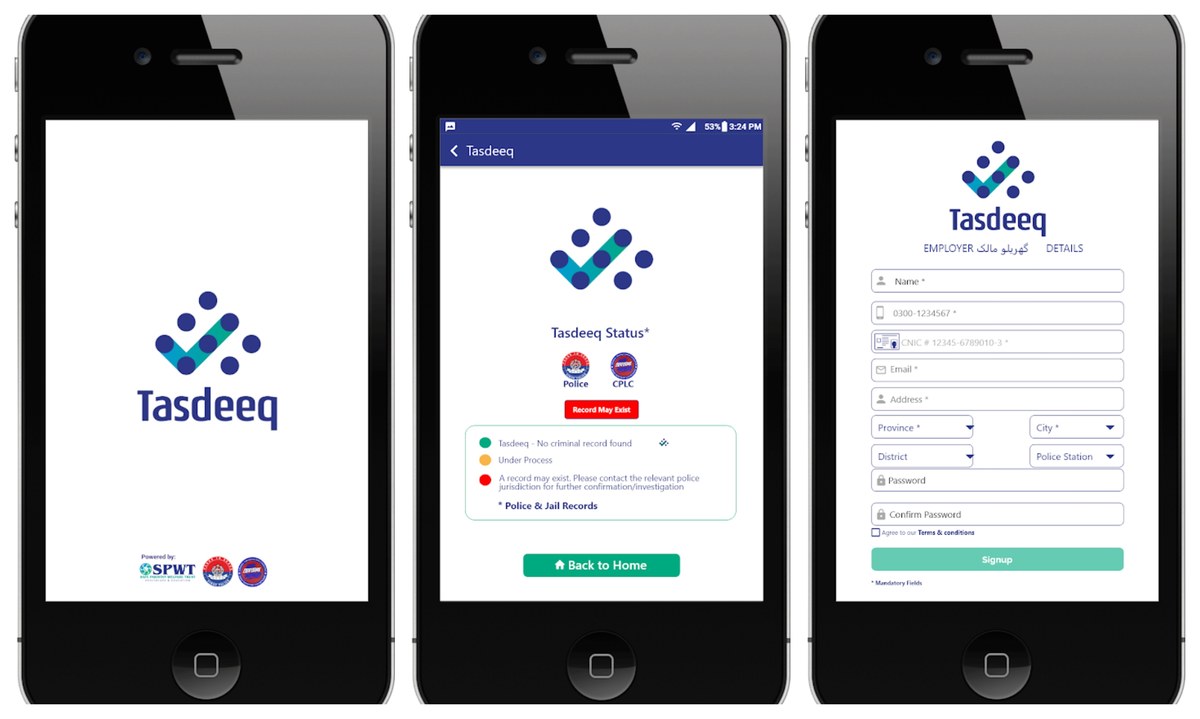


This combination of photos taken on 12 February 2021 shows the interface of a mobile app called Tasdeeq, launched by the Safe Pakistan Welfare Trust in collaboration with Karachi’s Citizens-Police Liaison Committee (CPLC) and police to check the background of new domestic staff in Pakistan. (Photo courtesy: Tasdeeq)

The app is already being used in the provinces of Sindh, Punjab and Balochistan as well as the capital, Islamabad, and the Trust plans to sign agreements with authorities in the Khyber Pakhtunkhwa province, as well as Azad Kashmir and Gilgit-Baltistan.
“The next phase will engage employers to work toward poverty alleviation,” Asfandyar Janjua, co-founder of the Trust, told Arab News.


“Tasdeeq Pakistan is a multiphase, multipronged social impact initiative, which aims to change on one hand the way domestic worker and blue-collar labor are hired, and on the other, through education and advocacy, work toward the economic uplift and poverty alleviation of the hard working and honest domestic workers and blue-collar labor,” the app said on its website. “Technology would be leveraged to help ... them break the vicious cycle of poverty.”
Registered workers under Tasdeeq have verifiable work histories and in return get hospital and accidental insurance and funds for their children’s education from employers, and emergency and micro loans from financial institutions.
The app’s website cites police as saying “60% of robberies, banditry, kidnapping and murders are carried out directly or indirectly through active involvement of inside workers.”
In November last year, police said they killed five robbers in Karachi’s affluent DHA area following reports of rising burglaries. The robbers, police said, were allegedly part of a notorious gang that carried out crimes in upscale neighborhoods with the help of domestic help.
“We’ve found many cases of thefts involving domestic servants, and in most of these cases, either identity cards are fake or were not available because they weren’t verified before hiring,” Deputy Inspector General of police Javed Akbar told Arab News, saying apps like Tasdeeq would help minimize crime.
Atif Bin Arif, the founder of MyGHAR, a housing solution for working professionals and students, said the Tasdeeq app had helped him vet job candidates.
“We vetted some of our incoming applications and as they were flagged by the police and CPLC in real-time, it helped us take immediate action,” Arif said.


Ahmed Rehan, who runs an Islamabad-based security company, also said he had used Tasdeeq to verify new employees.
“In the past, we had to send a resource to the police station for verification, which was a cumbersome exercise,” he said, “but now we enter the CNIC number and get complete data in real time.”


Pakistan, other Muslim states raise alarm over Gaza situation after heavy flooding

Updated 8 sec ago
Follow

Pakistan, other Muslim states raise alarm over Gaza situation after heavy flooding

  • Cold winter rains have repeatedly lashed the sprawling tent cities, turning Gaza’s dirt roads into mud and causing damaged buildings to collapse
  • The situation has been compounded by lack of sufficient humanitarian access, acute shortages of essential life-saving supplies and materials

ISLAMABAD: Foreign ministers of Pakistan, Saudi Arabia and other Muslim nations on Friday voiced concern over the situation in Gaza, following severe flooding triggered by heavy rains in the territory.

As 2026 begins, the shaky 12-week-old ceasefire between Israel and Hamas has largely ended large-scale Israeli bombardment of Gaza. But Palestinians are still being killed almost daily by Israeli fire, and the humanitarian crisis shows no signs of abating.

Cold winter rains have repeatedly lashed the sprawling tent cities over past weeks, turning Gaza’s dirt roads into mud and causing buildings damaged in Israeli bombardment to collapse. UNICEF says at least six children have now died of weather-related causes.

In a joint message, foreign ministers of Pakistan, Saudi Arabia, Egypt, Indonesia, Jordan, Qatar, Türkiye, the United Arab Emirates, expressed their “deepest concern” over the situation, compounded by lack of sufficient humanitarian access, acute shortages of essential life-saving supplies, and the slow pace of the entry of essential materials required for the rehabilitation of basic services.

“The ministers highlighted that the severe weather has laid bare the fragility of existing humanitarian conditions, particularly for almost 1.9 million people and displaced families living in inadequate shelters,” the Pakistani foreign ministry said in a joint statement.

“Flooded camps, damaged tents, the collapse of damaged buildings, and exposure to cold temperatures coupled with malnutrition, have significantly heightened risks to civilian lives, including due to disease outbreaks, especially among children, women, the elderly, and individuals with medical vulnerabilities.”

The statement came a day after UNICEF said a 7-year-old, Ata Mai, had drowned Saturday in severe flooding that engulfed his tent camp in Gaza City. Mai had been living with his younger siblings and family in a camp of around 40 tents.

They lost their mother earlier in the war, according to the UN agency.

Video from Civil Defense teams, shown on Al Jazeera, showed rescue workers trying to get Mai’s body out of what appeared to be a pit filled with muddy water surrounded by wreckage of bombed buildings. The men waded into the water, pulling at the boy’s ankle, the only part of his body visible. Later, the body is shown wrapped in a muddy cloth being loaded into an ambulance.

Foreign minister of Pakistan, Saudi Arabia and other states appreciated the efforts of all United Nations (UN) organizations and agencies as well as non-government organizations (NGOs) in continuing to assist Palestinian civilians and deliver humanitarian assistance under extremely difficult and complex circumstances.

“They demanded that Israel ensure the UN and international NGOs are able to operate in Gaza and the West Bank in a sustained, predictable, and unrestricted manner, given their integral role in the humanitarian response in the Strip. Any attempt to impede their ability to operate is unacceptable,” the statement read.

The foreign ministers reaffirmed support to President Donald Trump’s plan for Gaza, with a view to ensuring the sustainability of the ceasefire, bringing an end to the war in Gaza, to secure a dignified life for the Palestinian people who have endured prolonged humanitarian suffering, and leading to a credible pathway to Palestinian self-determination and statehood.

“In this context, they stressed the urgent need to immediately initiate and scale up early recovery efforts, including the provision of durable and dignified shelter to protect the population from the severe winter conditions,” the statement read further.

“The ministers called on the international community to uphold its legal and moral responsibilities and to pressure Israel, as the occupying power, to immediately lift constraints on the entry and distribution of essential supplies including tents, shelter materials, medical assistance, clean water, fuel, and sanitation support.”