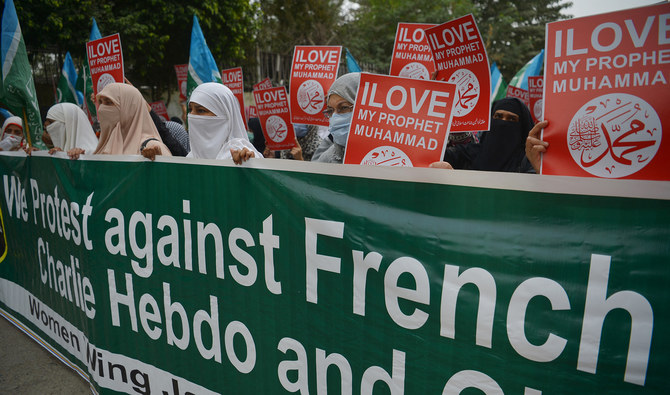
ISLAMABAD: Pakistan's government on Thursday reached yet another agreement with a hardline religious party that launched a major protest movement last year demanding an end to diplomatic relations with France due to the publishing of caricatures of the Prophet Muhammad (pbuh).
The Tehreek-e-Labbaik Pakistan (TLP) party, which has often paralyzed the country's federal capital with its demonstrations, said last November the government had promised to take a decision regarding the expulsion of the French ambassador in Islamabad after consulting the national parliament within three months.
The TLP-led protesters arrived on the outskirts of Islamabad in November, calling for the government to end diplomatic ties with France against the printing of blasphemous images. The protests turned violent, and the government had to step in and negotiate with the demonstrators.
Muslims around the world have protested against France and President Emmanuel Macron, who has vowed to stand firm against what he has described as attacks on French values and freedom of expression by radicals.
Prime Minister Imran Khan said on Thursday his team had been negotiating with TLP leadership and the two sides had made a deal extending the religious party's earlier February deadline to April 20.
"After that, we will take their demands to parliament," the PM announced.
Earlier in the day, the TLP circulated a document carrying the signatures of Religious Affairs Minister Pir Noorul Haq Qadri and Interior Minister Shaikh Rashid Ahmed.
The document said the government had entered into an agreement with the religious party on November 16, 2020 but had not implemented it yet.
In this context, it added that the two sides resumed their negotiations and agreed to present TLP's demands before parliament by April 20, 2021.
Among other things, TLP has asked the government to remove the names of its workers from the fourth schedule, a list which mentions individuals and organizations suspected of being involved in militant activities.
The document also said the prime minister would announce the temporary agreement after which it would become applicable.
The TLP, founded in August 2015 by the late cleric Khadim Hussain Rizvi, has turned blasphemy into a major political issue.
While the party initially focused on domestic events, its protests last year had implications for the country's foreign policy since it demanded a complete ban on French products and an end to diplomatic ties with the country.


![]()

Religious party’s demand to break France ties to be put before parliament — PM
Short Url
https://arab.news/c63z7
Religious party’s demand to break France ties to be put before parliament — PM
- Tehreek-e-Labbaik Pakistan held protests in the capital last year after a French magazine republished caricatures of Prophet Muhammad (PBUH)
- The government entered into an agreement with the religious party on November 16, 2020 but it has not been implemented as yet
Latest updates


© 2026 SAUDI RESEARCH & PUBLISHING COMPANY, All Rights Reserved And subject to Terms of Use Agreement.