

Pakistan will take two steps towards peace if India takes one — national security advisor

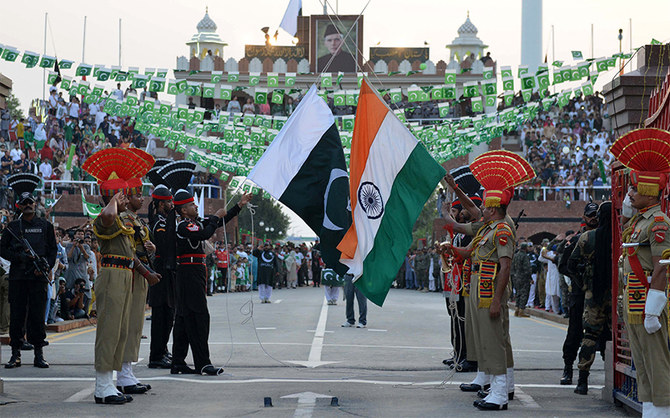
Pakistani Rangers (black uniforms) and Indian Border Security Force personnel (brown uniforms) perform during the daily beating of the retreat ceremony at the India-Pakistan Wagah Border Post, on October 30, 2017. (AFP/File)
Short Url
Updated 12 February 2021
Follow

Pakistan will take two steps towards peace if India takes one — national security advisor

  • Dr Moeed Yusuf says Pakistani PM's “number one goal in the region is peace with everybody”
  • Says Indian government needs to do the right thing to resolve the Kashmir issue

ISLAMABAD: Pakistani national security advisor Dr. Moeed Yusuf said in an interview published on Thursday that the idea of peace with India “remains,” adding that Pakistan would take two steps towards peace if India took one.

Yusuf was speaking to a Turkish news agency. 

“The idea of peace [with India] remains,” he said. “I tell you today on record for the world to know that the Pakistani prime minister's number-one goal in the region is peace with everybody.”

"Pakistan will take two steps if India takes one... we are ready even today," the national security chief added.

He said he had been a proponent of India-Pakistan peace throughout his career as a researcher but now the world was dealing with an India that behaved like a “rogue state.”

“Not just Pakistan, there's been a conflict with China,” Yusuf said. “Nepal has gotten up and passed parliamentary resolutions with a new map and taken on India. Bangladesh has raised its voice. Its relations are not good with Sri Lanka.”

Pakistan and India have long fought over the Himalayan region of Kashmir, which is claimed by both in its entirety but ruled in part. India accuses Pakistan of arming and training Kashmiri insurgents in India’s portion of the Himalayan region. Pakistan says it only provides moral and diplomatic support and denies it supports militants.

Relations have been particularly tense since August 2019 when India stripped the region of its special autonomy and moved to bring it under direct rule, imposing curfews and sending in troops. A communications shutdown was also imposed on August 5, 2019. Access to slow, 2G Internet for mobile and fixed-line subscribers was restored in March 2020, but high-speed 4G access remained blocked until this year. 

“Kashmir is under occupation, an open jail. Humans are not being treated like humans; that reality has to change for things to move forward,” Yusuf said.

“Our prime minister said when he came into office, if India takes one step, we will take two towards peace. The problem is India has taken one thousand steps in the opposite direction," the national security chief said. "So, we're hoping for that enabling environment to be created by our neighbor. The Indian government needs to do the right thing to resolve the Kashmir issue and find a way forward to connect the region.”


Pakistan eyes collaboration with Saudi Arabia, Indonesia, China for local vaccine production

Updated 5 sec ago
Follow

Pakistan eyes collaboration with Saudi Arabia, Indonesia, China for local vaccine production

  • Pakistan last week held talks with a visiting Saudi delegation on partnering to manufacture vaccines locally
  • Government working on “war footing” to ensure local production of vaccines by 2030, says health minister

ISLAMABAD: Pakistan is eyeing collaboration with Saudi Arabia, Indonesia and China to produce vaccines locally, Health Minister Syed Mustafa Kamal said on Thursday, adding that Islamabad was exploring both government-to-government and business-to-business opportunities in this regard. 

Kamal told Arab News last week that Islamabad was “very close” to an agreement with Saudi Arabia that would enable Pakistan to manufacture vaccines locally. The development took place as a Saudi delegation, led by the Kingdom’s senior adviser to the minister of industry Nizar Al-Hariri, arrived in Pakistan last week and held talks with health officials on a partnership with Pakistan which would enable it to manufacture vaccines locally. 

The efforts take place amid Pakistan’s push to strengthen its health security and industrial capacity. The country of more than 240 million currently imports all vaccines used in its national immunization campaigns, relying heavily on international partners to help cover the costs.

“Mustafa Kamal said Pakistan is exploring collaboration with Saudi Arabia, Indonesia and China for local production of these vaccines,” state broadcaster Radio Pakistan reported. 

Kamal said the government is working on a “war footing” to ensure the local production of vaccines before 2030. 

The health minister reiterated that Pakistan has the potential to locally produce raw materials of the 13 vaccines that it provides free of cost. He added that the government will also export vaccines once it starts producing them at home. 

“Mustafa Kamal said the government is exploring both government-to-government and business-to-business collaboration to achieve our objectives in vaccine production,” Radio Pakistan said. 

Pakistan’s health ministry has said it imports all 13 vaccines that it provides masses for free at an annual cost of about $400 million.

International partners currently cover 49 percent of these costs, with the remainder borne by the Pakistani government. This external support, Kamal has warned, is expected to end after 2030.