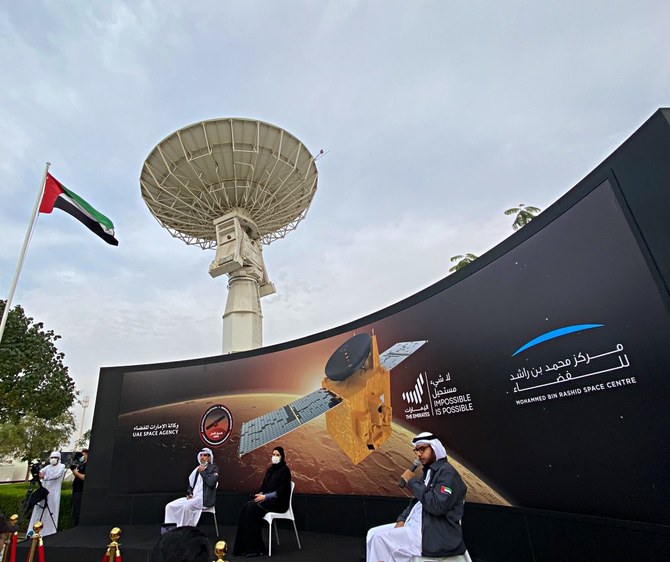

DUBAI: The United Arab Emirates’ robotic probe, named Hope entered Martian orbit, making it the fifth agency to successfully reach the red planet’s gravitational zone, joining NASA, the former Soviet Union, the European Space Agency and India.
In recent days, a number of prominent buildings and monuments across the Arab world, including Dubai’s Burj Khalifa, the tallest tower on Earth, were lit up at night in red in honor of Mars, the red planet.
“We officially transitioned today from the Mars orbit insertion phase and into Mars’ orbit. For the next two months, we will be preparing the spacecraft and the scientific instruments for going into the ‘Science Orbit,” Omran Sharaf, project manager at the Mohammed Bin Rashid Space Center (MBRSC), said in a press conference held Wednesday in MBRSC attended by Arab News.
Formally called Mars Orbit Insertion, the milestone was a critical step that required Hope to burn about half of its 800kg of fuel for 27 minutes to slow down enough for the spacecraft to be captured by Mars’ gravity and go into orbit. The probe rotated and fired all six of its powerful Delta V thrusters and slowed down from its average cruising speed of 121,000 kph to about 18,000 kph with no support from the mission’s engineers on the ground.
“In this process, we will have to calibrate the scientific instruments to make sure that the data is accurate so that by the time we start our science mission we are able to provide accurate data to the scientific community. We hope to get the first image one week from now, but that is independent from the preparations that we are doing for the science mission,” Sharaf added.
If attained, the Hope Probe will be the first probe to provide a complete picture of the Martian atmosphere and its layers.
Entry to orbit on the first attempt marked the end of a seven-month journey of nearly 500 million kilometers, the Arab world’s first interplanetary mission, the beginning of a breakthrough in scientific research and placed the Hope spacecraft on the bright side of grim Mars mission statistics: About than half of all the spacecraft that have been sent to Mars have failed.
Sharaf elaborated that the reason behind the UAE’s ability to overcome this complex maneuver, given the difficulty of the journey and the challenges that other countries have faced was because they “did not start from zero, but rather started where others ended.”
Hope’s engineers have practiced the maneuver repeatedly on data from other missions and hypothetical data through conducting over 100,000 tests in different scenarios within the span of two years to ensure that the probe successfully arrives to Mars, according to Sharaf.
Reaffirming his country’s commitment to the Artemis Accords, an international agreement aimed at ensuring peaceful collaboration among spacefaring nations, Sharaf said that “since day one of this project, the direction that we’ve received from the government has been to learn from others. Countries tend to perceive space exploration as a competition or as a race, but the UAE perceives it as an international cooperative space mission. Instead of starting everything from scratch and innovating alone, we built our project with and upon the research accumulated. For this reason, we had 450 people from different continents working on this project, of which 200 were Emiratis. So, the team collaborated as one under a single identity, which was the Mars Mission,” Sharaf said.
The Emirates Mars Mission is part of a larger investigation that planetary scientists have been pursuing for decades, hoping to discover what transformed Mars from a potentially habitable planet to the barren one seen today.
Hope will orbit Mars at a higher altitude than any previous Mars mission as it will orbit nearly parallel to the equator, allowing scientists to see half of the planet regardless of where the orbiter. Whereas most other Mars orbiters move around the poles, which limits the observation of global weather patterns. Its elliptical orbit will also help scientists learn more about how the nature of dust storms and other weather conditions near the surface can affect the speed at which Martian air leaks into outer space.
“The aim is to investigate the Martian atmosphere and to understand what happened on the red planet. As humans, we have a have a dead planet in front of us and something had happened to this planet within its atmospheric history that made it this way. We want to discover what happened there and what lead to the planet’s transformation to understand our solar system and the changes that happen within it as well as the changes that happen around our planet,” Sharaf said.
Despite the fact that Hope is a science mission, the data that it will gather is considered secondary to the primary goal of inspiring young people to practice science in order to accelerate the country’s transition towards becoming a knowledge-based economy.
Sarah Al-Amiri, the UAE’s minister of state for advanced sciences and chair of the UAE Space Agency, said that the mission “has raised the ceilings of the young generation in terms of what they are capable of dreaming and becoming. After yesterday, I don’t think that there is an Emirati household that will perceive space exploration in the same manner. If one of their children aspire to become planetary scientists or delve into space exploration, no one can tell them that it is impossible.”
“The most significant objective of the Emirates Mars Mission is to spur a young generation of scientists and engineers to get into space systems development in order to assist the UAE in entering the space economy.”
“There is no activity that matches the unique challenges of space exploration. The outcome of a project like the Emirates Mars Mission will not only be visible today or in the development of sectors in the upcoming years, but it will be ingrained in the minds of schoolchildren, change their mindsets and introduce them to a world of new opportunities.”
“This mission gives strong reason for confidence that the investments made in space exploration will have positive impacts for future generations of the UAE.”