

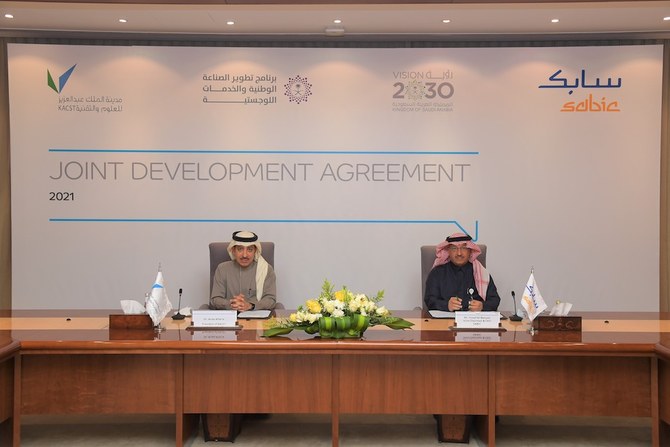
SABIC, KACST sign agreement to develop high performance, lightweight materials

The agreement was signed on Wednesday in Jeddah by SABIC Vice Chairman and CEO Yousef Al-Benyan and KACST President Dr. Anas Al-Faris. (Supplied)
Short Url
Updated 10 February 2021
Follow

SABIC, KACST sign agreement to develop high performance, lightweight materials

  • SABIC CEO Yousef Al-Benyan: These high-performance materials will be developed entirely in Saudi Arabia to serve the Kingdom’s downstream needs
  • Yousef Al-Benyan: The technology will help achieve sustainability targets by reducing greenhouse gas emissions in transportation markets

DUBAI: Saudi Basic Industries Corporation (SABIC) has signed an agreement with King Abdulaziz City for Science and Technology (KACST) to develop high performance and lightweight materials, as part of the Kingdom’s goal to develop more local industries.

The agreement was signed on Wednesday in Jeddah by SABIC Vice Chairman and CEO Yousef Al-Benyan and KACST President Dr. Anas Al-Faris.

“This joint development effort fits strategically with the objectives of Saudi Vision 2030 to promote local industries through collaboration and innovation. These high-performance materials will be developed entirely in Saudi Arabia to serve the Kingdom’s downstream needs,” Al-Benyan said in a press statement.

“The technology will help achieve sustainability targets by reducing greenhouse gas emissions in transportation markets, because of weight reductions with the use of lightweight materials,” he said.

“This agreement will allow us to serve the growing market for advanced materials uses in the Kingdom and create enormous opportunities for new and downstream industries,” Dr. Al-Faris said.

“We aim to contribute to enriching the local content, thus supporting the Kingdom’s economy and enhancing its competitive position in these industries,” he said.

Last year, Riyadh-headquartered SABIC said that it was aiming to become the largest petrochemical company in the world by 2030. It is currently ranked third globally.

Founded in 1976, SABIC has more than 33,000 employees worldwide and operates in about 50 countries. It currently has 12,540 global patent filings, and has significant research resources in the US, Europe, the Middle East, South Asia and North Asia.


Saudi minister at Davos urges collaboration on minerals

Global collaboration on minerals essential to ease geopolitical tensions and secure supply, WEF hears. (Supplied)
Updated 20 January 2026
Follow

Saudi minister at Davos urges collaboration on minerals

  • The reason of the tension of geopolitics is actually the criticality of the minerals

LONDON: Countries need to collaborate on mining and resources to help avoid geopolitical tensions, Saudi Arabia’s minister of industry and mineral resources told the World Economic Forum on Tuesday.

“The reason of the tension of geopolitics is actually the criticality of the minerals, the concentration in different areas of the world,” Bandar Alkhorayef told a panel discussion on the geopolitics of materials.

“The rational thing to do is to collaborate, and that’s what we are doing,” he added. “We are creating a platform of collaboration in Saudi Arabia.”

Bandar Alkhorayef, Saudi Minister of Industry and Mineral Resources 

The Kingdom last week hosted the Future Minerals Forum in Riyadh. Alkhorayef said the platform was launched by the government in 2022 as a contribution to the global community. “It’s very important to have a global movement, and that’s why we launched the Future Minerals Forum,” he said. “It is the most important platform of global mining leaders.”

The Kingdom has made mining one of the key pillars of its economy, rapidly expanding the sector under the Vision 2030 reform program with an eye on diversification. Saudi Arabia has an estimated $2.5 trillion in mineral wealth and the ramping up of extraction comes at a time of intense global competition for resources to drive technological development in areas like AI and renewables.

“We realized that unlocking the value that we have in our natural resources, of the different minerals that we have, will definitely help our economy to grow to diversify,” Alkhorayef said. The Kingdom has worked to reduce the timelines required to set up mines while also protecting local communities, he added. Obtaining mining permits in Saudi Arabia has been reduced to just 30 to 90 days compared to the many years required in other countries, Alkhorayef said.

“We learned very, very early that permitting is a bottleneck in the system,” he added. “We all know, and we have to be very, very frank about this, that mining doesn’t have a good reputation globally.

“We are trying to change this and cutting down the licensing process doesn’t only solve it. You need also to show the communities the impact of the mining on their lives.”

Saudi Arabia’s new mining investment laws have placed great emphasis on the development of society and local communities, along with protecting the environment and incorporating new technologies, Alkhorayef said. “We want to build the future mines; we don’t want to build old mines.”