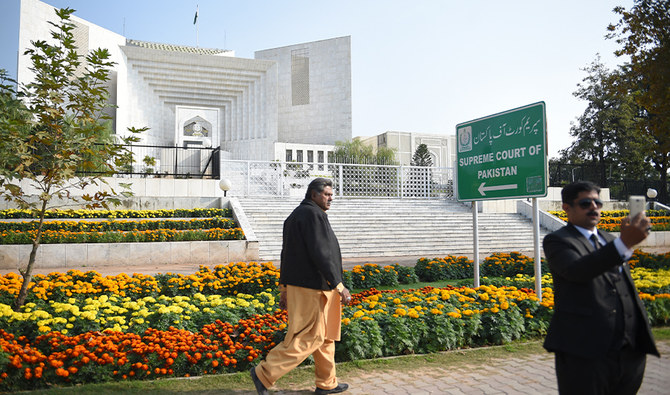
ISLAMABAD: Pakistan’s top court on Wednesday commuted the death sentences of two mentally ill prisoners, Kanizan Bibi and Imdad Ali, to life in prison in what a major prisoner rights group has called a ‘landmark judgment.’
A Supreme Court five-member bench headed by Justice Manzoor Ahmad Malik announced the verdict on Wednesday, also directing prison officials to move Ghulam Abbas, another mentally ill death row prisoner, to the Punjab Institute of Mental Health in Lahore for treatment and rehabilitation. It also said a mercy petition be prepared for Abbas, saying there was nothing on the record to show whether mental illness was taken into consideration while dismissing an earlier mercy plea.
If a prisoner on death row was unable to comprehend the rationale behind his or her punishment due to a mental illness, then carrying out the death sentence did not “meet the ends of justice,” the court ruled.
“The federal government (for Islamabad Capital Territory) and each provincial government, shall immediately constitute and notify a medical board comprising of three qualified and experienced psychiatrists and two psychologists from public sector hospitals for examination and evaluation of the condemned prisoners who are on death row and are suffering from mental illness to ensure that such mentally ill condemned prisoners ... are not executed,” the judgment read.
However, the court said every mentally ill prisoner on death row would not automatically qualify for an exemption from the death sentence.
“This exemption will be applicable only in that case where a medical board, consisting of mental health professionals, certifies after a thorough examination and evaluation that the condemned prisoner no longer has higher mental functions to appreciate the rationale behind the sentence of death awarded to them,” the judgment read.
The Justice Project Pakistan (JPP), which lobbies for the rights of prisoners, said Bibi, Ali and Abbas were all suffering from schizophrenia, a severe mental disorder that causes symptoms such as delusions, hallucinations and paranoia.
JPP head Sarah Belal called the court’s verdict a “landmark judgment,” saying it brought Pakistan in line with its international obligations and treaties the country had signed, including the International Covenant on Civil and Political Rights, the Convention against Torture, and the Convention on the Rights of Persons with Disabilities.
“They [Supreme Court] have also clarified that at the stage of trial, trial courts have an obligation to investigate and hold inquiry in an objective manner to determine if a prisoner is capable or competent to stand trial,” Belal told Arab News.
The bench had reserved its judgment in the case earlier this year after holding daily hearings in the first week of January. Hearings in the case were resumed in September 2020 after a gap of nearly two years.
Bibi, a middle-aged woman diagnosed with paranoid schizophrenia, was sentenced to death in 1991. Ali, who has paranoid schizophrenia, was sentenced to death in 2002. Abbas has been on death row for 14 years.
In Wednesday’s judgment, Justice Malik said the mental health of a person was as important and significant as his physical health.
“Unfortunately, it is often not given the importance and seriousness it deserves,” the verdict said. “Because of certain misconceptions, the implications of mental illness are overlooked and the vulnerability or disability that it causes is not given due attention.”
The court also directed the federal government and all provincial governments to immediately launch training programs and short certificate courses on forensic mental health assessment for psychiatrists, clinical psychologists, social workers, police and prison personnel.


![]()

In 'landmark judgment,' Pakistan court commutes death sentence of mentally ill prisoners
Short Url
https://arab.news/rnfqk
In 'landmark judgment,' Pakistan court commutes death sentence of mentally ill prisoners
- Says death sentence does not meet “ends of justice” if convicts cannot understand rationale behind punishment due to a mental illness
- Orders federal and provincial governments to set up medical board to evaluate mentally ill death row prisoners and ensure they were not executed
Latest updates


© 2026 SAUDI RESEARCH & PUBLISHING COMPANY, All Rights Reserved And subject to Terms of Use Agreement.