Egyptian exports to GCC increase 25.7%

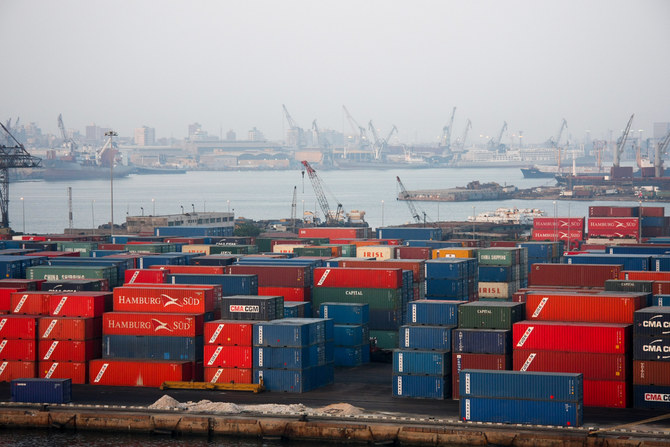
According to data, the UAE was the top market for Egyptian exports over the time period. Pictured, the port of Alexandria. (Shutterstock/File Photo)
Short Url
Updated 09 February 2021
Follow

Egyptian exports to GCC increase 25.7%

  • The UAE was the biggest investor with $1.6 billion
  • Saudi Arabia was the biggest GCC exporter to Egypt

CAIRO: Egyptian exports to the six Gulf Cooperation Council (GCC) countries during the first 10 months of 2020 rose 25.7 percent year-on-year to $4.4 billion.

According to data from Egypt’s Central Agency for Public Mobilization and Statistics (CAPMAS), the UAE was the top market for Egyptian exports over the time period, reaching $2.6 billion, followed by Saudi Arabia ($1.4 billion), Kuwait ($194.6 million), Oman ($137.6 million), Bahrain ($85.5 million), and Qatar ($655,000).

However, Egyptian imports from the GCC decreased 21.25 percent year-on-year to $6.3 billion over the period.

Saudi Arabia was the biggest GCC exporter to Egypt, with $3 billion, followed by Kuwait ($1.6 billion), the UAE ($1.1 billion), Oman ($310.9 million), Bahrain ($204.9 million), and Qatar ($19.5 million).

CAPMAS figures also revealed the total value of GCC investments in Egypt to be $3.4 billion during the fiscal year 2019/2020 compared to $2.8 billion in 2018/2019, an increase of 21.4 percent.

The UAE was the biggest investor with $1.6 billion, followed by Qatar ($679.4 million), Saudi Arabia ($448.6 million), Kuwait ($347.5 million), Bahrain ($324 million), and Oman ($10.7 million).


Saudi environmental compliance sector unveils opportunities worth over $8bn

Updated 25 February 2026
Follow

Saudi environmental compliance sector unveils opportunities worth over $8bn

RIYADH: The Invest Saudi platform offers specialized opportunities with expected revenues exceeding SR30 billion ($8 billion), according to the National Center for Environmental Compliance.

In a statement, the center invited local and international investors to seize the listed opportunities and benefit from various incentives, ranging from administrative support to direct financing.

Saad Al-Zubaidi, executive director of business development, explained that this market size reflects the specialized nature of the environmental compliance sector as a supporting sector for all economic activities. 

Sectors such as industry, energy, mining, construction, services, and infrastructure rely on it to comply with environmental regulations and enhance operational efficiency.

Incentive and financing packages

The center, in integration with various government entities, is working on developing comprehensive incentive packages for investors in the field.

These packages include direct financing tools, soft loans, and guarantee programs, in addition to regulatory and procedural enablers aimed at accelerating the investment cycle and reducing operational risks.

The payback period for investments starts from 4 years and does not exceed 7 years at most, according to the center.

The current market size stands at SR14 billion, according to Al-Zubaidi, who expects it to double within 5 years.

The market diversifies across fields including the manufacturing of pollution control systems, the manufacturing of air and water quality monitoring devices, soil and groundwater rehabilitation, and building specialized technical capacities in the environmental field.

Trend toward localizing environmental technologies

Al-Zubaidi confirmed that the announced opportunities have had their preliminary studies completed and are available for investors to review their details and to complete technical and financial feasibility studies according to various business models.

The focus is not limited to maximizing economic return but extends to localizing environmental technologies, transferring knowledge, and building local value chains capable of meeting the growing demand across various sectors.