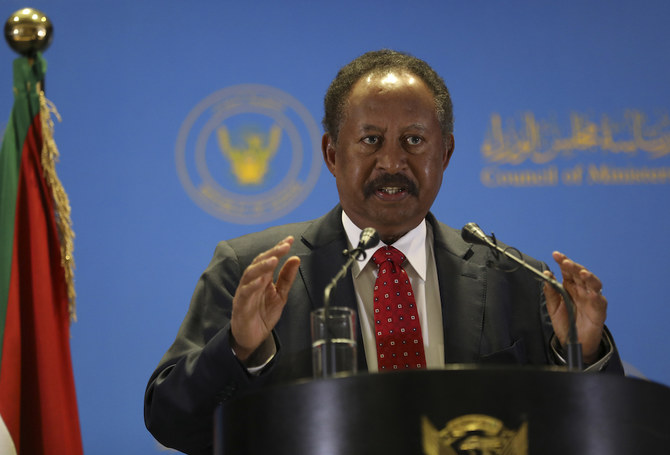
KHARTOUM: Sudan’s Prime Minister Abdalla Hamdok announced Monday a new cabinet bringing in seven ex-rebel chiefs as ministers, following a peace deal in October aimed to end decades of war.
Veteran rebel leader and economist Gibril Ibrahim, of the Justice and Equality Movement (JEM) — which played a major role in the Darfur conflict — was appointed as Sudan’s new finance minister.
“We have reached consensus on over 25 ministries,” Hamdok said, during a press conference in Khartoum.
“This lineup aims to preserve this country from collapse... we know there will be challenges but we are certain that we will move forward.”
Hamdok dissolved the previous cabinet on Sunday to make way for a more inclusive lineup in government.
Two ministers were selected from the military, with the remaining coming from the Forces for Freedom and Change group, which plays a key role in Sudanese politics.
The group was the driving force behind the anti-government protests that led to the April 2019 ouster of strongman Omar Al-Bashir.
Hamdok named as foreign minister Mariam Al-Sadiq Al-Mahdi, daughter of Sudan’s last democratically elected prime minister, Sadiq Al-Mahdi, who died aged 84 in November from a coronavirus infection.
He was toppled by Bashir in a 1989 Islamist-backed military coup.
Last week, Sudan appointed three ex-rebels to the ruling sovereign council, the civilian-majority ruling body led by General Abdel Fattah Al-Burhan, which was installed months after Bashir’s ouster.
It follows the peace deal last year between the transitional government and the Sudan Revolutionary Front (SRF), a coalition of five rebel groups and four political movements, including the troubled western region of Darfur.
Hamdok said he is still pushing for talks with two remaining holdout groups who did not sign the deal.
Fighting in Darfur since 2003 left at least 300,000 people dead and 2.5 million displaced, according to the UN.
Hamdok said his government will continue with completing other pillars of the peace agreement, including establishing a transitional parliament by February 25.
Despite the October peace deal, violence continues in Darfur, a vast and impoverished region awash with weapons where bitter rivalries over land and water remain.
Hamdok said the new government will focus on fixing the ailing economy.
Sudan’s economy was decimated under Bashir by decades of US sanctions, mismanagement and civil war, as well as the independence of oil-rich South Sudan in 2011.
Galloping inflation, chronic hard currency shortages, and a flourishing black market remain pressing challenges, with protests in recent weeks at the worsening economy.
Ibrahim, the new finance minister, taught as an economist at universities in Khartoum and Saudi Arabia, before he took over leadership of the JEM rebels when his brother Khalil was killed in an 2011 airstrike.
The government will also have to tackle stormy relations with neighboring Addis Ababa, amid both border tensions and long-running negotiations — along with Egypt — over the controversial Grand Ethiopian Renaissance Dam on the Blue Nile.


![]()

Sudan’s PM Hamdok announces new cabinet
Short Url
https://arab.news/j5u39
Sudan’s PM Hamdok announces new cabinet
- Gibril Ibrahim, of the Justice and Equality Movement, was appointed as Sudan’s new finance minister
- Hamdok named as foreign minister Mariam Al-Sadiq Al-Mahdi


Latest updates



© 2026 SAUDI RESEARCH & PUBLISHING COMPANY, All Rights Reserved And subject to Terms of Use Agreement.