

Seven years on, Yazidi survivor buries father slain by Daesh

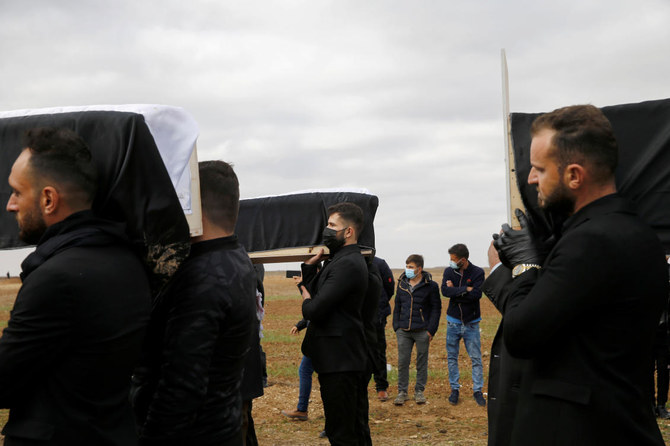
Thikran Kamiran Yousif, 22, carries a coffin with the remains of his father from the minority Yazidi sect, who was killed by Daesh militants, after they were exhumed from a mass grave, to bury them in Kojo, Iraq. (Reuters)
Short Url
Updated 08 February 2021
Follow

Seven years on, Yazidi survivor buries father slain by Daesh

  • Thikran Kamiran Yousif was 15 when Daesh fighters slaughtered members of his village in northern Iraq
  • He joined mourners for the reburial of his father and 103 other Yazidis

KOJO, Iraq: Thikran Kamiran Yousif was 15 when Daesh fighters surrounded his village in northern Iraq, rounded up residents and slaughtered several hundred of them, including his father, brother, grandfather and aunt.
Nearly seven years later, Yousif has returned to the village of Kojo in Sinjar district for the reburial of his father and 103 other Yazidis whose bodies had been dumped by Daesh in mass graves and have now been identified by DNA samples.
Yousif, now 22 and living in Germany, is still haunted by the massacre of August 2014.

“The most painful moment was when they separated me from my father. That was the last time I saw him,” Yousif told Reuters.
“To be able, after seven years, to bury (these people) where they were killed... means so much to us,” said Yousif, whose other slain relatives have not yet been identified.
The Yazidis are an ancient religious minority who combine Zoroastrian, Christian, Manichean, Jewish and Muslim beliefs.
Daesh, which views the Yazidis as devil worshippers, killed more than 3,000, enslaved 7,000 Yazidi women and girls and displaced most of the 550,000-strong community from its ancestral home in northern Iraq.
UNITAD, the UN team investigating Daesh crimes in Iraq, has discovered more than 80 mass graves in Sinjar and has exhumed 19 of them since March 2019. It has so far identified 104 bodies by DNA samples.
“You can almost see the territory controlled by Daesh by the number of mass graves in the area,” said Karim Khan, head of the United Nations team investigating Daesh crimes in Iraq (UNITAD). Daesh is another name for Daesh.
During the year-and-a-half he spent in the hands of Daesh, Yousif was moved around several times, used as a human shield in Mosul and forced to attend an Daesh-run school, where he was indoctrinated with the group’s teachings on violent jihad.
“They taught us that killing Yazidis is allowed,” he said. “They worked on our minds.”
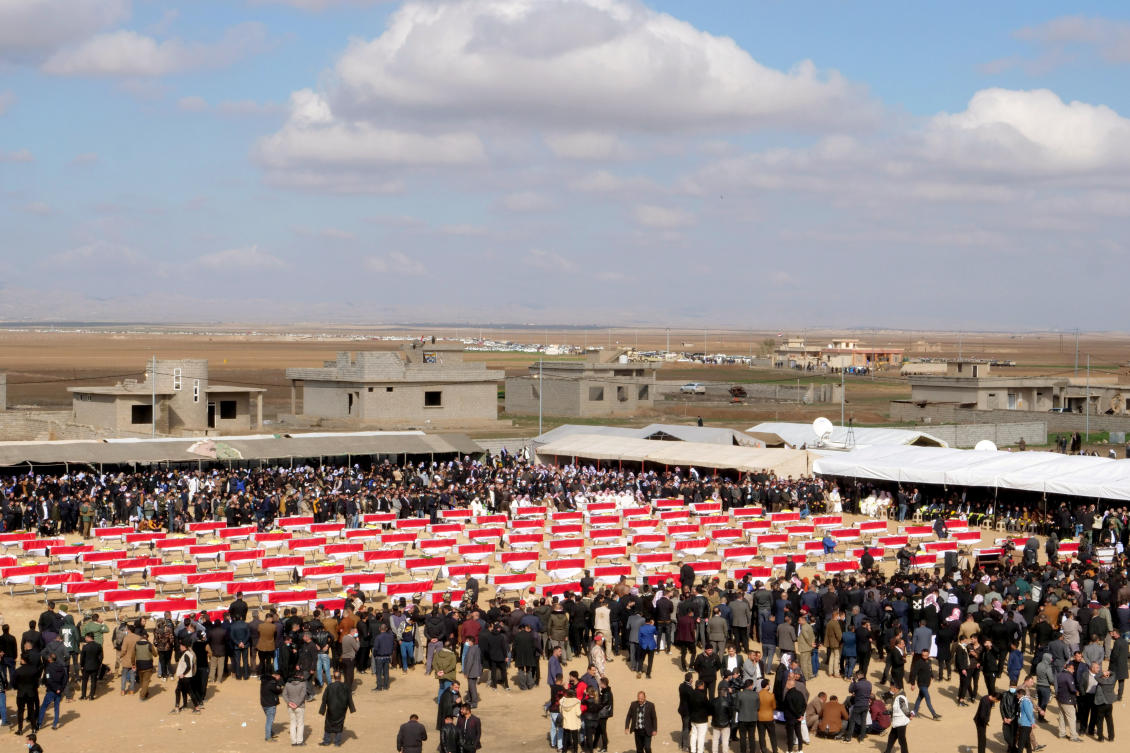


The funeral for 104 members of Iraq's Yazidi minoirty, who were killed by Daesh, took place on Saturday. (Reuters)


As bombings by the US-led coalition intensified over Daesh-held territory in northern Iraq, Yousif feared he would be killed or forced to fight for Daesh. In early 2016, he fled to Iraqi Kurdistan with his mother and sister.
“In the beginning it was very hard, psychologically. I was confused. I was telling myself that I should not forget what Daesh taught me,” Yousif said.
A year ago, Yousif, his mother and sister found refuge in Germany with the help of Air Bridge Iraq, a non-profit organization that advocates for the treatment and rehabilitation of Yazidi survivors of Daesh captivity outside of Iraq.
Iraqi President Barham Saleh and Prime Minister Mustafa Al-Kadhimi attended an official funeral ceremony for the 104 identified Yazidi victims on Feb. 4 in Baghdad, ahead of the burials in Kojo, which remains in ruins and uninhabited.
A reparation law for female survivors of Daesh captivity is awaiting ratification by the Iraqi parliament, but it excludes men and boys like Yousif who were also held captive.
And the Yazidis are demanding much more, including the legal recognition of their suffering as genocide.
“There is no legal architecture in place in Iraq to allow judges to conclude that the conduct of Daesh constituted an act of genocide, of crimes against humanity or war crimes,” Khan said, adding that UNITAD’s mandate was to provide evidence to bring the culprits to trial eventually.
About 30% of Sinjar district’s population has returned since the departure of Daesh, but the region is still racked by political instability and lacks basic services.
At his father’s graveside in Kojo, surrounded by other grieving Yazidis, mostly widows, Yousif said his community simply wanted justice.
“We want the world to see that there is a minority in Iraq that suffers,” he said. “We want the world to see us as human beings who have rights just like everyone else.”


Israel confirms ban on 37 NGOs in Gaza

A Palestinian woman carries wood for fire in the Nuseirat refugee camp in the central Gaza Strip on December 31, 2025. (AFP)
Updated 3 sec ago
Follow

Israel confirms ban on 37 NGOs in Gaza

JERUSALEM: Israel on Thursday said 37 humanitarian agencies supplying aid in Gaza had not met a deadline to meet “security and transparency standards,” and would be banned from the territory, despite an international outcry.
The international NGOs, which had been ordered to disclose detailed information on their Palestinian staff, will now be required to cease operations by March 1.
The United Nations has warned that this will exacerbate the humanitarian crisis in the war-ravaged Palestinian territory.
“Organizations that have failed to meet required security and transparency standards will have their licenses suspended,” Israel’s Ministry of Diaspora Affairs and Combating Antisemitism said in a statement.
Several NGOS have said the requirements contravene international humanitarian law or endanger their independence.
Israel says the new regulation aims to prevent bodies it accuses of supporting terrorism from operating in the Palestinian territories.
Prominent humanitarian organizations hit by the ban include Doctors Without Borders (MSF), the Norwegian Refugee Council (NRC), World Vision International and Oxfam, according to a ministry list.
In MSF’s case, Israel accused it of having two employees who were members of Palestinian militant groups Islamic Jihad and Hamas.
MSF said this week the request to share a list of its staff “may be in violation of Israel’s obligations under international humanitarian law” and said it “would never knowingly employ people engaging in military activity.”
‘Critical requirement’ 
NRC spokesperson Shaina Low told AFP its local staff are “exhausted” and international staff “bring them an extra layer of help and security. Their presence is a protection.”
Submitting the names of local staff is “not negotiable,” she said. “We offered alternatives, they refused,” hse said, of the Israeli regulators.
The ministry said Thursday: “The primary failure identified was the refusal to provide complete and verifiable information regarding their employees, a critical requirement designed to prevent the infiltration of terrorist operatives into humanitarian structures.”
In March, Israel gave NGOs 10 months to comply with the new rules, which demand the “full disclosure of personnel, funding sources, and operational structures.”
The deadline expired on Wednesday.
The 37 NGOs “were formally notified that their licenses would be revoked as of January 1, 2026, and that they must complete the cessation of their activities by March 1, 2026,” the ministry said Thursday.
A ministry spokesperson told AFP that following the revocation of their licenses, aid groups could no longer bring assistance into Gaza from Thursday.
However, they could have their licenses reinstated if they submitted the required documents before March 1.
Minister of Diaspora Affairs and Combating Antisemitism Amichai Chikli said “the message is clear: humanitarian assistance is welcome — the exploitation of humanitarian frameworks for terrorism is not.”
‘Weaponization of bureaucracy’
On Thursday, 18 Israel-based left-wing NGOs denounced the decision to ban their international peers, saying “the new registration framework violates core humanitarian principles of independence and neutrality.”
“This weaponization of bureaucracy institutionalizes barriers to aid and forces vital organizations to suspend operations,” they said.
UN Palestinian refugee agency chief Philippe Lazzarini had said the move sets a “dangerous precedent.”
“Failing to push back against attempts to control the work of aid organizations will further undermine the basic humanitarian principles of neutrality, independence, impartiality and humanity underpinning aid work across the world,” he said on X.
On Tuesday, the foreign ministers of 10 countries, including France and Britain, urged Israel to “guarantee access” to aid in the Gaza Strip, where they said the humanitarian situation remains “catastrophic.”
A fragile ceasefire has been in place since October, following a deadly war waged by Israel in response to Hamas’s unprecedented October 7, 2023 attack on Israel.
Nearly 80 percent of buildings in Gaza have been destroyed or damaged by the war, according to UN data.
About 1.5 million of Gaza’s more than two million residents have lost their homes, said Amjad Al-Shawa, director of the Palestinian NGO Network in Gaza.