



ISLAMABAD: Two Pakistani army helicopters resumed Monday the search for three mountaineers who went missing while attempting to scale K2, the world’s second-highest mountain, as their family and friends became increasingly concerned for their fate.
The three — Pakistani climber Ali Sadpara, John Snorri of Iceland and Juan Pablo Mohr of Chile — lost contact with base camp late on Friday and were reported missing on Saturday, after their support team stopped receiving communications from them during their ascent of the 8,611-meter (28,250-foot) high K2 — sometimes referred to as “killer mountain.”
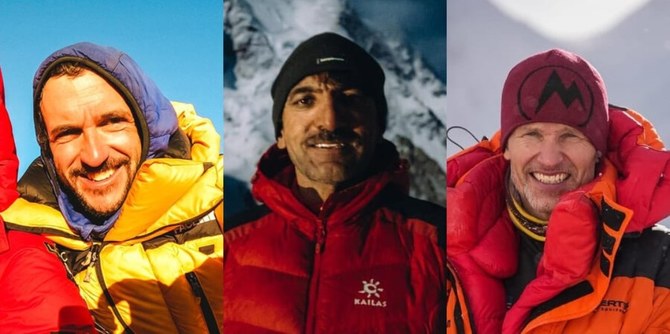
A collage of Pakistani mountaineer Ali Sadpara (C) and his two companions, John Snorri of Iceland (R) and Juan Pablo Mohr of Chile (L), who went missing while attempting to scale K2, the world’s second-highest mountain.
Located in the Karakorum mountain range, K2 is one of the most dangerous climbs. Last month, a team of 10 Nepalese climbers made history by scaling the K2 for the first time in winter.
The helicopters carrying rescuers took off early in the morning on Monday and were on the way to K2 to resume the search for the third consecutive day, said Waqas Johar, a district government administrator.
Sadpara’s son said in a video statement released to media the chances of the mountaineers’ survival in the harsh winter conditions were extremely low. Sadpara, an experienced climber, had earlier scaled the world’s eight highest mountains, including the highest, Mount Everest in the Himalayas, and was attempting to climb K2 in winter.
During the search missions on Saturday and Sunday, helicopters had found no sign of the climbers, said Karar Haideri, secretary at the Pakistan alpine Club. He said a statement from the authorities was expected later Monday.
“Miracles do happen and the hope for a miracle is still there,” he said.
Sadpara’s son Sajid Ali Sadpara, himself a mountaineer who was part of the expedition at the start but later returned to base camp after his oxygen regulator malfunctioned, said their chances after “spending two to three days in the winter at 8,000 (meters’ altitude) are next to none.”
The younger Sadpara’s oxygen regulator had malfunctioned when he reached K2’s most dangerous point, known as Bottle Neck, earlier last week. There, he waited for his father and two other climbers for more than 20 hours but with no sign of them, he descended.
Since the climbers went missing, Iceland’s foreign minister, Gudlaugur Thór Thórdarson, has spoken to his Pakistani counterpart, Shah Mahmood Qureshi, by telephone. According to Pakistan’s foreign ministry, Qureshi assured him that Pakistan would spare no effort in the search for the missing mountaineers.
Although Mount Everest is 237 meters (777 feet) taller than K2, the K2 mountain is much farther north, on the border with China, and subject to worse weather conditions, according to mountaineering experts. A winter climb is particularly dangerous because of the unpredictable and rapid change in the weather.
Winter winds on K2 can blow at more than 200 kph (125 mph) and temperatures can drop to minus 60 degrees Celsius (minus 76 Fahrenheit). In one of the deadliest mountaineering accidents ever, 11 climbers died in a single day trying to scale K2 in 2008.


