

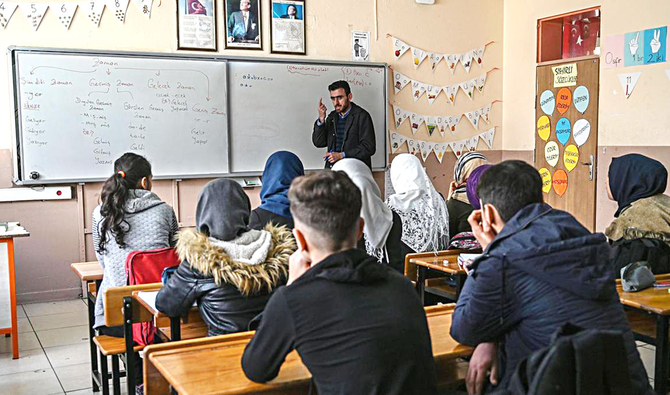

ISTANBUL: Ankara has announced that it will open a health care vocational school and a medical faculty in the Cobanbey (Al-Ra’i) town of Syria near the Turkish border.
The surprise decision was published in Turkey’s Official Gazette on Friday night.
Cobanbey, in northern Syria in Aleppo, is a predominantly Turkmen town under Syrian opposition control. The medical school will be established under the auspices of Turkey’s Health Sciences University.
While some experts consider such moves a boost to the region’s damaged social infrastructure, others say Ankara may face accusations from Syria of foreign meddling violating its territorial sovereignty.
Since 2018, Turkey has been building hospital university faculties in Syria, including in Afrin, Al-Bab and Idlib, to encourage the return of Syrian refugees. The Turkish lira is also being used in Cobanbey district and Al-Bab.
A university campus was established in Al-Bab by Turkey’s Harran University to provide trilingual education in Turkish, Arabic and English.
Turkey’s Diyanet Foundation opened a primary school for 1,100 students in Syria’s northwestern province of Idlib in November 2020.
The Turkish Health Ministry has completed three hospitals in Al-Bab, Marea and Cobanbey with a total bed capacity of 475.
With such “footprints” in Syrian territories, Ankara hopes to persuade millions of refugees in Turkey to return, but has had no big success so far.
According to Oxford University Middle East analyst, Samuel Ramani, Turkey’s infrastructure and humanitarian aid projects should win support from Syrians in rebel-held areas because humanitarian aid through international organizations such as the UN is biased in favor of the Assad regime and Russia.
“But, the Syrian government will resist Turkey’s humanitarian intervention and claim it’s a violation of sovereignty, and Turkey will face frictions from Russia and Iran on this issue,” he told Arab News.
Ramani thinks that even if Turkey is undermining the sovereignty of a UN-recognized government in Syria, there is little that the international community or legal institutions can do.
“Moreover, Turkey could perhaps invoke a variant of Responsibility to Protect to justify its actions, as it is protecting the human security and health of Syrian civilians at a time when the Syrian government of Assad is not living up to its sovereign responsibilities to protect civilians,” he said.
However, the Syrian official news agency SANA reported on Sunday that “Syria categorically rejects the Turkish regime’s decision to open a faculty and institute as this is considered a dangerous act and a flagrant violation of the international law and the UN Charter.”
“This null decision constitutes a continuation of the Turkish regime’s practices in igniting and prolonging the crisis in Syria,” the SANA report said, based on an official source from the Foreign and Expatriates Ministry.
“Syria affirms that these attacks by the Turkish regime on its sovereignty, including the building of the so-called (separation wall) and adopting the policy of Turkification at the schools, in addition to dealing in the Turkish lira and opening an authority for the Turkish Post, have been pretexts behind which this regime hides to justify its terrorist practices,” the source said.
Jomana Qaddour, nonresident senior fellow at Atlantic Council, said that the Turkish government had been connecting north Syria to the Turkish state via electricity and water provision, security, and the provision of humanitarian aid more generally.
“While there is a dire need for accredited education projects in Syria, given the fact that so many students have been deprived of education programs for years, it is important that any education initiative incorporates local educators and the needs of the local population. Local ownership and input will be necessary for this to be a welcome endeavour by Syrians,” she told Arab News.


